
Livraison le jour même ou le lendemain

Qualité garantie

Débloquez vos offres de bienvenue: Livraison GRATUITE | Jusqu'à -80 % | 30 jours d'essai gratuits à JoyPlus
Téléchargez l'application
Feeling the urge to paint, but faced with a jungle of supplies, you don't know where to start? Acrylics, oils, brushes, canvases… the basic equipment can quickly seem intimidating. Don't worry, we're here to help you see things more clearly. As a product expert at Joybuy, my mission is to find practical solutions for you to start creating without getting bogged down in technical details.
Let's review the essential criteria for choosing the right beginner's paint kit and discover our selection of sets designed to get you started hassle-free.
Before taking the plunge, a few key points can guide your decision. Here are the three criteria to consider to find the supplies to start painting that are truly right for you.
This is the very first question to ask. Each medium has its own set of rules.
A good complete paint kit should contain everything you need to start painting right out of the box. Make sure it includes at a minimum:
The advantage of an all-in-one paint set? It saves you the chore of buying each item separately. A real time and money saver.
For a first purchase, there's no need to invest in dozens of tubes. A kit of 5 to 12 colours is an excellent starting point.
Also, consider the tube capacity (in ml). 20 ml tubes are perfect for experimenting, while 75 ml or larger formats will give you enough material to create several paintings.
To guide you, here are three options perfectly suited for budding artists.
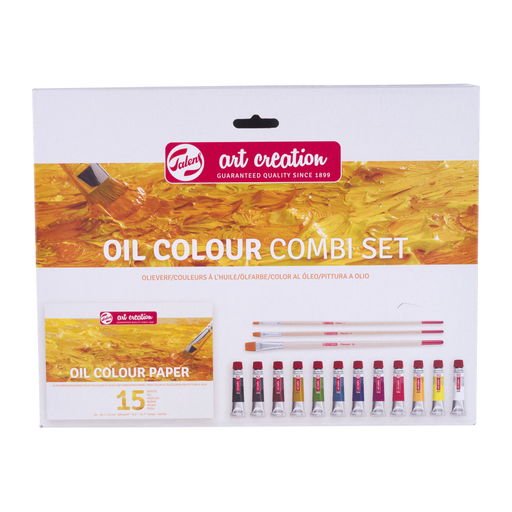
What sets it apart This set is THE all-in-one solution for getting started with oil painting. It stands out by including not only paints and brushes but also a suitable surface: 15 sheets of A4 paper specially prepared for oil. The added bonus? A QR code that leads to video tutorials for step-by-step learning.
Highlights
Who is it for? This kit is perfect for beginners curious about oil painting who are looking for a guided experience and a 100% ready-to-use set.
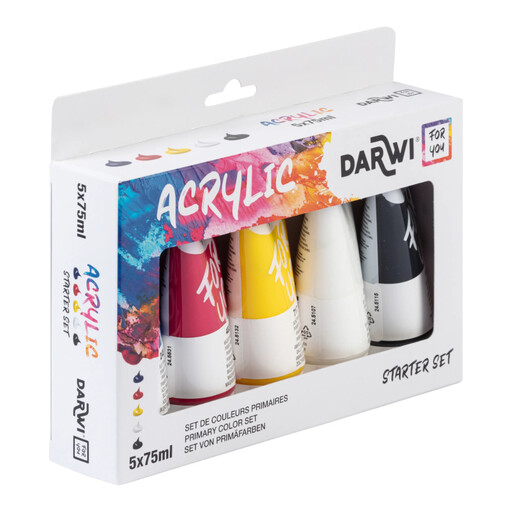
What sets it apart This acrylic paint set gets straight to the point: colour. It offers five fundamental shades in generous 75 ml tubes. A pragmatic approach, ideal for those who want to practice colour mixing intensively without running out of paint.
Highlights
Who is it for? This set is for beginners who want to focus on the art of mixing and prefer to choose their brushes and surfaces separately.
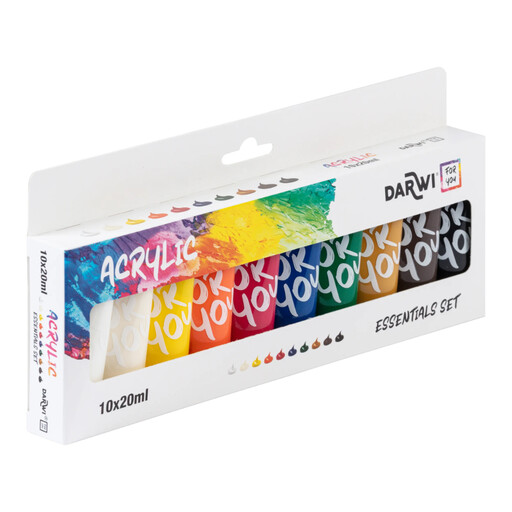
What sets it apart This alternative to the previous set focuses on variety, with 10 ready-to-use colours in a more compact format. This allows you to explore a wider palette from the start, without having to do all the mixing yourself.
Highlights
Who is it for? Ideal for beginners who want a varied range of colours on hand, or for those with limited workspace or storage.
Starting to paint is a personal journey. If our selection hasn't completely won you over, or if you're simply curious to discover other types of supplies, feel free to browse our complete category of blank art materials to explore a much wider range of paints, canvases, brushes, and accessories.
Acrylic paint is often recommended for its simplicity: it dries quickly, cleans up with water, and has almost no odour. However, oil paint shouldn't be dismissed: its slow drying time gives you plenty of time to rework your canvas. Ultimately, the choice will depend on your patience and your project.
Both are great for starting out. Thick paper treated for paint (acrylic or oil) is a budget-friendly solution, perfect for practice and experiments. A stretched canvas offers a more traditional feel and a durable support, ready to be displayed. Some beginner kits include one or the other.
A paint set of 5 to 12 colours is more than enough to get started. A set with the three primary colours (red, yellow, blue), plus black and white, is sufficient to create an infinite number of shades through mixing. Larger sets simply offer more convenience with ready-to-use colours.