
Livraison le jour même ou le lendemain

Qualité garantie

Débloquez vos offres de bienvenue: Livraison GRATUITE | Jusqu'à -80 % | 30 jours d'essai gratuits à JoyPlus
Téléchargez l'application
A dead battery: every driver's nightmare. Whether it's on a freezing winter morning or in a remote corner of a car park after a long holiday, the dreaded click of the ignition is always a sure sign of stress and hassle. Fortunately, a simple and incredibly effective solution exists: the battery jump starter. This compact device, sometimes called a portable car starter, brings your engine back to life in minutes, without needing another vehicle.
But with an overwhelming number of options on the market, how do you find the right one? This guide is here to break down the key features and present our selection of the best models to help you make the right choice in 2026.
Before you buy, a few technical details are essential to find the perfect booster for your needs.
Expressed in amps (A), power is the number one criterion. Be careful not to confuse the two key values:
The choice depends directly on your vehicle's engine. A more demanding diesel engine requires a lot more "juice" than a petrol engine of the same size, especially when the temperature drops.
Modern jump starters are true Swiss Army knives. A model with a built-in compressor is a game-changer: no more searching for a service station to inflate a tyre. Most also double as a power bank for your car, capable of recharging smartphones, tablets, and even laptops via their USB ports. Some take it a step further with a fast charging function, both for your devices and for the booster itself.
A good battery jump starter must include a full suite of protections: short-circuit, reverse polarity, overheating, overcharging... This is fundamental. Check that the model is equipped with "smart" clamps that alert you in case of an incorrect connection. The battery technology (lithium-ion, or sodium-ion for the newest models) is also crucial for the device's lifespan, resistance to extreme temperatures, and overall reliability.
We have selected three models that stand out for their performance and versatility, each catering to a specific user profile.
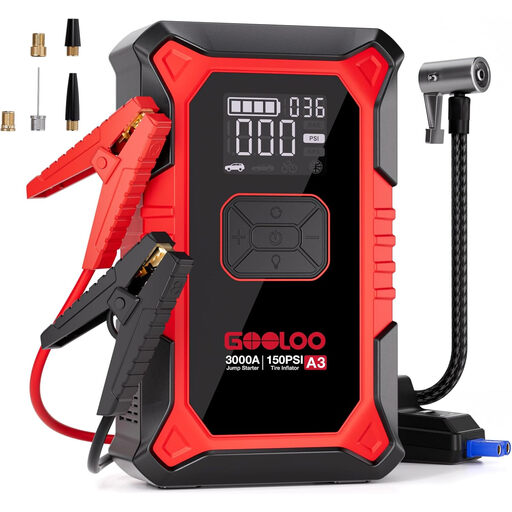
Why It Stands Out: The GOOLOO A3 is the ultimate Swiss Army knife. It combines ample starting power with a digital air compressor, making it the ultimate emergency tool to keep in your boot.
Key Features:
Who Is It For? For everyday drivers and families who want a single device to handle any roadside emergency, from a dead battery to a flat tyre.
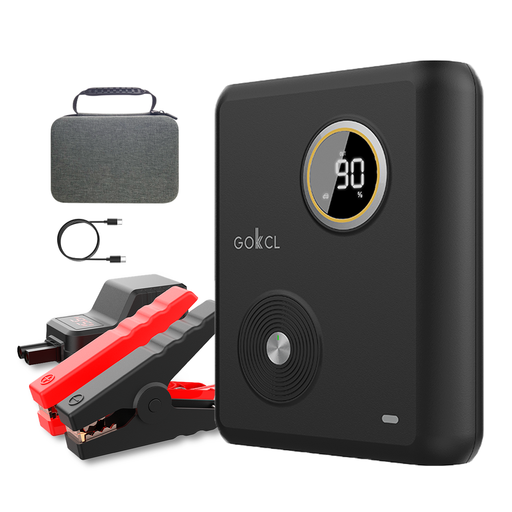
Why It Stands Out: The GOKKCL GK03 is all about innovation with its sodium-ion battery. According to the manufacturer, this technology promises far superior durability and safety compared to traditional lithium batteries.
Key Features:
Who Is It For? For those looking for a long-term investment, prioritising reliability and safety above all. Ideal for residents of regions with extreme climates.
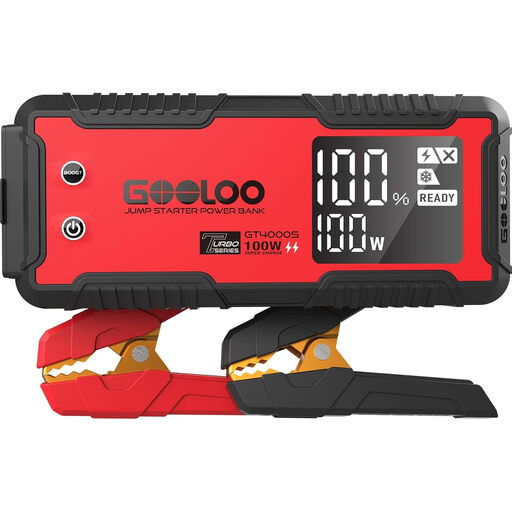
Why It Stands Out: The GT4000S is raw power dedicated to performance. With its 4000 peak amps and 100W two-way charging, it's aimed at those who refuse to compromise on power and speed.
Key Features:
Who Is It For? For owners of large vehicles (4x4s, SUVs, trucks, campervans, boats) and professionals who demand flawless starting power and lightning-fast charging.
Our selection covers the most common uses, but your vehicle (heavy-duty truck, agricultural machinery, etc.) may have specific needs. For even more powerful or specialised models, feel free to explore our full catalogue.
? Discover our full range of jump starters for diesel vehicles
1. What power level should I choose for my battery jump starter? It all depends on your engine. For a small petrol city car, 1500 peak amps are sufficient. For a diesel SUV, aim for at least 2000 A. For very large engines (over 6.0L), a 3000 A or 4000 A model like the GOOLOO GT4000S is essential to ensure a flawless start, especially in the middle of winter.
2. Can you leave a battery jump starter in your car permanently? Yes, but not just any model. It depends on its technology. Sodium-ion models like the GOKKCL GK03 are designed for this, withstanding temperatures from -40°C to 80°C (-40°F to 176°F). So you can leave it in the glove box without any issues. For more traditional lithium-ion models, it is crucial to check the manufacturer's recommended storage temperature range to avoid damaging it.
3. Can a jump starter replace a battery charger? Absolutely not; they are two tools with opposite roles. The jump starter is a sprinter: it delivers an intense, brief electrical shock to start an engine. The battery charger, on the other hand, is a marathon runner: it provides a low, steady current to gently recharge a battery and maintain its charge over the long term. The jump starter is the emergency solution; the charger is the maintenance solution.