
Livraison le jour même ou le lendemain

Qualité garantie

Débloquez vos offres de bienvenue: Livraison GRATUITE | Jusqu'à -80 % | 30 jours d'essai gratuits à JoyPlus
Téléchargez l'application
Your baby's well-being is your top priority. This extends to choosing the simplest everyday products, like wipes. Faced with a multitude of options, ingredients, and marketing promises, picking the right pack can quickly become a headache. How can you navigate this to care for your little one's fragile skin?
This guide is here to help. We've broken down the essential criteria for you to select the safest and most suitable baby wipes for your needs, with a focus on composition, tolerance, and ecological impact.
Before diving into our selection, let's review the key criteria for making an informed choice.
A baby's skin, much thinner and more permeable than an adult's, absorbs everything. It is therefore crucial to examine the ingredient list (the famous INCI list) with a magnifying glass.
While all baby skin is delicate by nature, some is even more reactive. If your child has atopic skin, prone to eczema or redness, choosing wipes for sensitive skin is fundamental. Look for products with "dermatologically tested" or "hypoallergenic" labels. These certifications guarantee that the formula has been designed to minimise allergy risks.
The daily use of wipes generates a considerable amount of waste. Fortunately, for parents concerned about their ecological footprint, more virtuous alternatives exist.
To help you make your choice, we have scrutinised several flagship products on the market, based on the criteria we have just detailed.
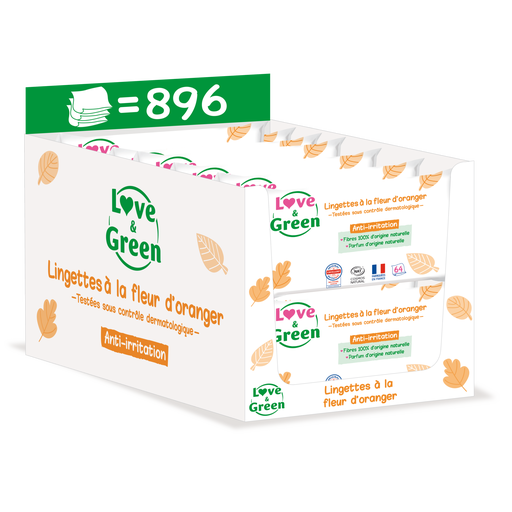
Highlights: These wipes succeed in combining ecological standards with a high-tolerance formula. Made in France, they are designed with 100% natural origin fibres and are COSMOS NATURAL certified by ECOCERT, a guarantee of quality and respect for the skin.
Advantages:
Who is it for? For parents seeking a product that is both ecological and sensory, offering a light, natural scent without compromising on a clean formula for nappy changes, face, and hands.
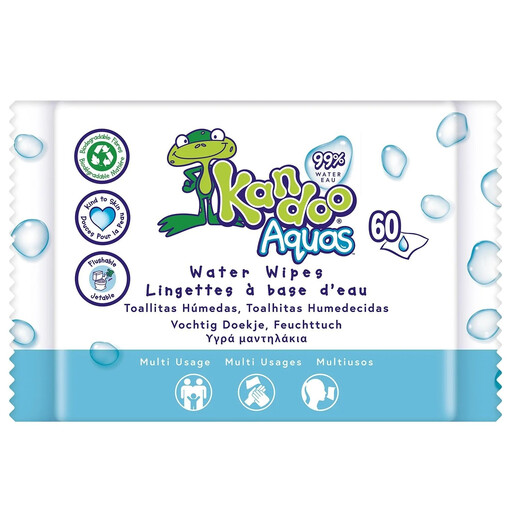
Highlights: Simplicity is the key principle of KANDOO Aqua. With a 99% water formula, free from fragrance and dyes, these wipes get straight to the point: cleaning effectively and gently. The fact that they are biodegradable and flushable (in moderation) is a real daily plus.
Advantages:
Who is it for? Ideal for families looking for a versatile, effective, and streamlined solution. Their water-based formula is suitable for frequent use, and the ability to flush them is a significant asset for potty training.
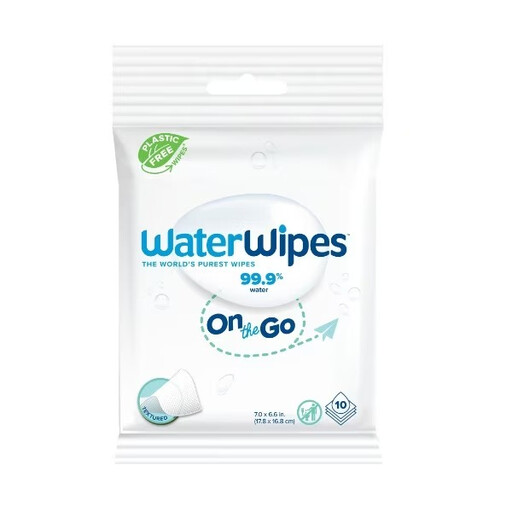
Highlights: WaterWipes has established itself as THE benchmark for the most fragile skin. Its formula is of unparalleled purity: 99.9% purified water and a single drop of grapefruit seed extract. Plastic-free and plant-based, they are even validated by organisations like Allergy UK.
Advantages:
Who is it for? The top choice for parents of newborns, premature babies, or children with very sensitive skin or allergies. The on-the-go format is a decisive asset for all outings.
Once the nappy change is done and baby is all clean, it's time for play! Your child's development also happens through these moments of connection and discovery.
Discover our selection of Baby Entertainment Toys to stimulate their senses and share unforgettable moments.
The perfect composition is short, simple, and transparent. The main ingredient should be water (Aqua). Avoid synthetic fragrances, alcohol, dyes, phenoxyethanol, and parabens. A touch of natural moisturising agents like glycerin or aloe vera is a plus, as long as the ingredient list remains minimalist.
Yes, but only if the product is specifically formulated for this use. Most quality wipes, especially those that are water-based or for sensitive skin, are gentle enough to clean the face and hands. However, it is recommended to avoid the immediate eye area. When in doubt, always refer to the manufacturer's instructions on the packaging.
Not necessarily. The term "eco-friendly" can refer to the composition (organic ingredients), the packaging (recyclable), or the wipe itself. To be sure a wipe is biodegradable, the claim must be explicitly stated on the pack. Those made from 100% plant-based fibres (cellulose, viscose, cotton) generally are, but this does not mean they can be thrown into nature. The rule is simple: follow the disposal instructions; most should be thrown in the general waste bin.