
Livraison le jour même ou le lendemain

Qualité garantie

Débloquez vos offres de bienvenue: Livraison GRATUITE | Jusqu'à -80 % | 30 jours d'essai gratuits à JoyPlus
Téléchargez l'application
Indoor air quality has become a major concern for our comfort and health. From outdoor pollution and pollen to pet dander and smoke, our homes are veritable hotbeds for fine particles and allergens. An air purifier is the solution to restoring a healthy environment, but how do you navigate the jungle of available models?
Our editorial team has scrutinised the best devices on the market to help you make the right choice. This guide covers the essential criteria and our selection of the most relevant models, tailored to every need and home.
Before you dive in, it's crucial to understand a few technical concepts that make all the difference. Here are the three points you absolutely shouldn't overlook.
The CADR (Clean Air Delivery Rate) is THE key performance indicator. Expressed in cubic metres per hour (m?/h), it measures the volume of air a device can effectively process. For optimal purification, choose a purifier with a CADR that matches your room's size. As a general rule, aim for a device capable of circulating the entire volume of air in the room at least two to three times per hour. For example, for a 20 m? room with a 2.5 m ceiling (totalling 50?m?), a CADR of 150?m?/h is an excellent starting point.
The filtration system is the core of the machine. The most effective models combine several levels of filtration:
An air purifier is often designed to run continuously, including at night. Its noise level is therefore a critical comfort factor. For a bedroom, a quiet model is non-negotiable. Look for a night mode with a noise level below the 30-decibel (dB) mark. Finally, certain extra features can make a real difference in daily use, such as a timer, an air quality sensor, or Wi-Fi connectivity for remote control.
We have selected three models that stand out for their performance and suitability, each catering to a specific use case.
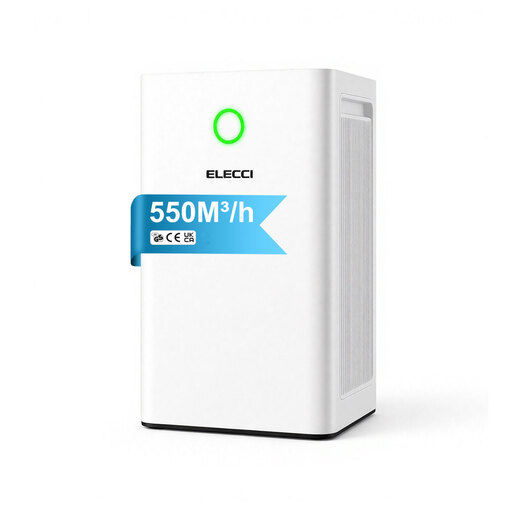
Why we chose it This model plays in the big leagues with its heavy-hitting power. With a CADR of 550 m?/h, it is built to sanitise very large volumes, up to 120 m?. It's the ideal candidate for large living rooms, open-plan spaces, or offices.
Key features
Who is it for? Ideal for people living in large flats or houses with spacious living areas, as well as for shared offices where fast, powerful purification is required.
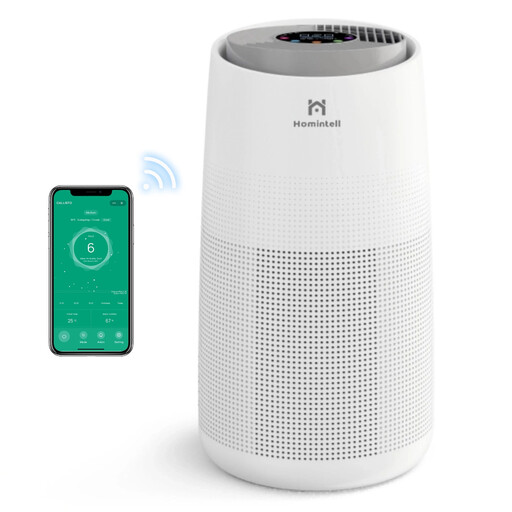
Why we chose it The Homintell's key advantage is its connectivity and intelligence. Control via Wi-Fi, a real-time air quality sensor, and bonus features like UV sterilisation make it a decidedly modern and versatile device.
Key features
Who is it for? Perfect for tech enthusiasts who want total control and precise data about their environment. Its CADR of 300 m?/h makes it suitable for medium-sized rooms up to 36 m?.
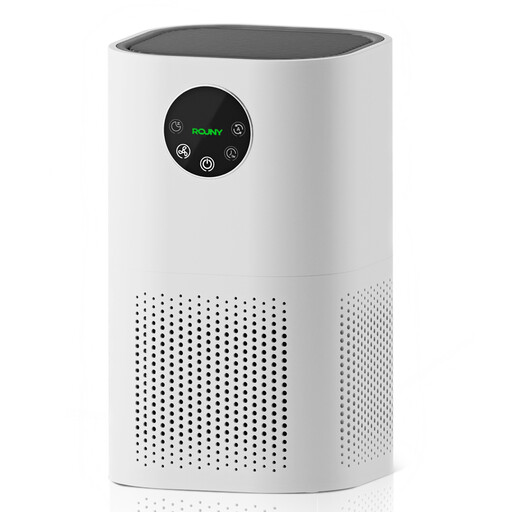
Why we chose it The ROUNY is the champion of discretion, a perfectly balanced solution for a bedroom or office. Its key asset: near-silent operation in night mode, measured at ≤25 dB.
Key features
Who is it for? Recommended for anyone looking for a bedroom air purifier that is both effective and perfectly quiet. Its CADR of 150 m?/h is ideal for rooms from 20 to 50 m?, which covers most bedrooms and offices.
This selection is just a glimpse of the excellent models available. If you haven't found what you're looking for here or wish to compare other features, feel free to explore our full catalogue.
Discover our complete selection of HEPA purifiers to find the model that's right for you.
Simply put: a standard filter captures "large particles" (dust, hair). The HEPA filter, on the other hand, is an ultra-fine mesh net certified to trap at least 99.97% of particles as small as 0.3 microns. This includes allergens invisible to the naked eye, such as pollen, mould spores, dust mites, and pet dander, which pass right through standard filters.
Yes, and it's one of its main benefits. By capturing airborne pollen particles, a purifier equipped with a HEPA filter drastically reduces the concentration of allergens in your home, thereby relieving allergy symptoms for sensitive individuals.
Ideally, it should be left running continuously, either in automatic mode or at a low speed, to maintain constant air quality. If you prefer to use it intermittently, a quick, high-power session for one to two hours when you get home will purify the air rapidly.