
Livraison le jour même ou le lendemain

Qualité garantie

Débloquez vos offres de bienvenue: Livraison GRATUITE | Jusqu'à -80 % | 30 jours d'essai gratuits à JoyPlus
Téléchargez l'application
Getting started with acrylic painting is a fantastic creative adventure. But when faced with a jungle of options, choosing your first acrylic paint set can quickly become overwhelming. Between the number of colours, the size of the tubes, and the included accessories, it's easy to feel lost.
This guide is here to give you clear, concrete advice. As the Head of Product Recommendations at Joybuy, my mission is to help you navigate this world and find the supplies that truly match your creative ambitions, without any unnecessary marketing jargon. Let's review the essential criteria for making the right choice before diving into our product selection.
Before we get to our selection, let's go over a few key points to guide your choice. The ideal set ultimately depends on your projects and your skill level.
This is often the first dilemma: should you opt for a set with a multitude of small colours, or one with fewer shades but in larger quantities?
Acrylic is renowned for its great versatility. Most student-grade paints, like those in the Talens Art Creation range, adhere to a multitude of surfaces. Make sure the set you're considering is compatible with your projects, whether it's acrylic paint on canvas, paper, cardboard, wood, or even stone. The paint's consistency (pasty, thick) and its final finish (satin, glossy) are also criteria to consider depending on the effect you're looking for.
For absolute beginners, an acrylic paint box set that includes not only paints but also brushes and paper is the simplest solution. No need to run around different shops to buy your art supplies separately: everything is there and perfectly compatible. It's the ideal starting point to get going without delay.
Keeping these criteria in mind, here is a selection of three sets from the Talens acrylic paint brand, each meeting specific needs.
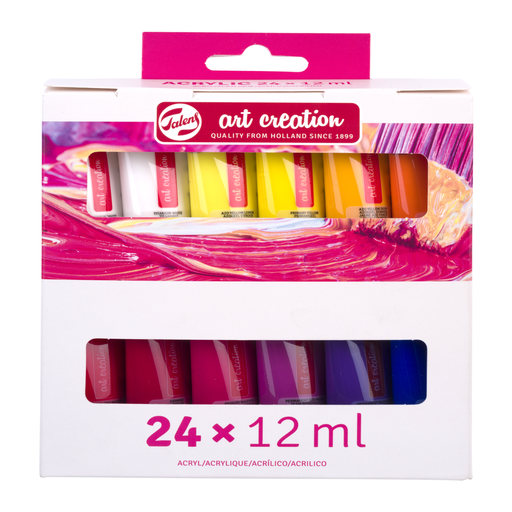
Why it stands out: This set is all about diversity. With its 24 carefully selected colours, it offers a very rich chromatic palette right from the start, ideal for exploring without limits.
Advantages:
Who is it for? This set is particularly suited for beginner or amateur artists who want a wide range of ready-to-use colours to embark on varied and detailed projects.
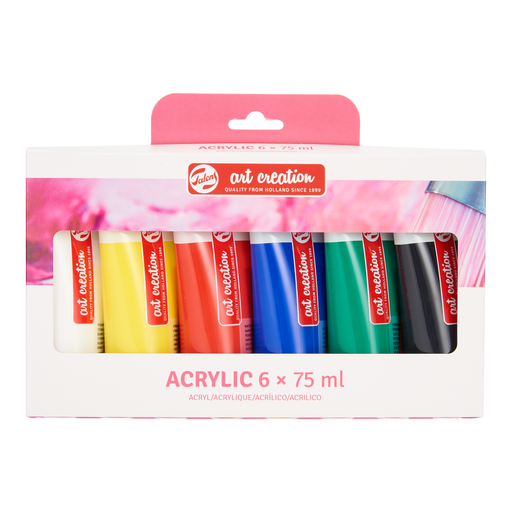
Why it stands out: Here, the focus is on quantity and learning. With its generous 75 ml tubes, this set is designed for those who want to practice the art of mixing.
Advantages:
Who is it for? Ideal for art students and motivated beginners who want to master colour theory, as well as for artists looking to restock their basic colours.
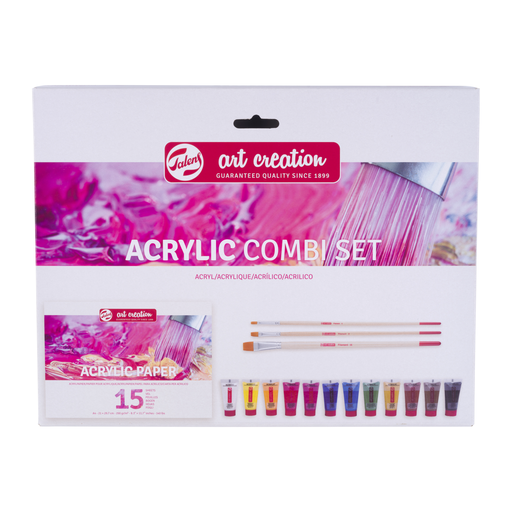
Why it stands out: This is the ultimate all-in-one solution. This box set contains everything you need to start painting right away.
Advantages:
Who is it for? This beginner's acrylic paint kit is the ideal recommendation for those new to painting, as a gift, or for anyone looking for a practical, turnkey solution.
Our selection highlights popular and versatile choices, but every artist is unique. If these products don't quite match what you're looking for, or if you simply want to explore other avenues, feel free to browse our complete collection.
? Explore our entire range of acrylic paint sets
The main difference lies in the pigment concentration. "Artist-grade" paint contains significantly more pigment, resulting in more intense colours and better lightfastness. "Student-grade" paint, like that from the Art Creation range, offers excellent value for money: its pigmentation is already very good, making it perfect for beginners, students, and hobbyists.
Acrylic is incredibly versatile. It adheres perfectly to most porous, non-greasy surfaces like canvas, thick paper, cardboard, wood, plaster, or stone. For very smooth or non-porous surfaces (plastic, metal, glass), it is advisable to apply a primer, or gesso, to ensure optimal adhesion.
This is one of the great advantages of acrylic: its fast drying time! A thin layer can be dry to the touch in just a few minutes, while a thicker layer may take up to an hour. Once dry, it becomes permanent and waterproof, allowing you to layer colours without the risk of reactivating the layers underneath.