Which households is this for?

Households waiting for a full load

You build up laundry from several uses before starting a wash and want to avoid half-loads without choosing an unnecessarily large drum. ADEME indicates that a 7 kg capacity is usually enough to avoid running multiple cycles with underfilled drums.

People living in a compact home

You have limited width or prefer loading laundry while standing up: a top-loader may fit better, provided you accept its generally more limited capacity and compare the energy label for each individual model.

Buyers focused on service life

You want to reduce the risk of replacing your appliance prematurely or are considering a refurbished machine: check the professional seller, exact model, warranty terms and any available information about durability or repairability.

Buying priorities

Front-loading washing machine

Choose this if: you regularly combine loads and have around 60 cm of available width.

Watch out for: a larger capacity does not replace matching the load to the laundry you have actually accumulated.

Top-loading washing machine

Choose this if: available width is the priority or you prefer loading laundry without bending down.

Watch out for: compare the individual model’s label, as its format alone says nothing about energy use or spin performance.

Refurbished washing machine

Choose this if: the professional seller provides the appliance’s condition, exact model and warranty terms.

Watch out for: the machine’s history, installation requirements and model specifications should be checked before purchase.

Priority What to check Your needs
Suitable capacity Compare the capacity in kg with the laundry accumulated between washes. ADEME uses 7 kg as a sufficient benchmark in most cases; adjust this according to bulky fabrics and how often you wash. I want to combine laundry without running a significantly underfilled drum or buying a capacity I will not use.
Water, energy and spin performance Compare kWh/100 cycles, litres/cycle, spin-drying efficiency class, Eco 40-60 duration and spin noise across comparable models. I want to assess measurable data rather than assume that a top-loader or front-loader will automatically be more economical.
Dimensions Measure width, depth, height, door or lid clearance, connections and handling space. Also check the loading type. My appliance must fit the available space while remaining suitable for my usual loads.
Durability and refurbished appliances For a new washing machine covered by the scheme in France, check the durability index. For a refurbished appliance, verify the seller’s status, condition, model and warranty terms. I want to reduce the risk of early replacement and compare a new appliance with a refurbished offer more accurately.

Mistakes to avoid before buying

  • Choosing a large capacity solely to avoid every half-load

    A capacity far beyond the amount of laundry you actually accumulate does not guarantee better use. The aim is still to reduce cycles with an underfilled drum while taking account of the fabrics and programmes you use.

    Use 7 kg as a general benchmark, then adjust it according to your regular household-laundry loads, bulky fabrics and washing frequency.

  • Assuming that a top-loader or front-loader is always more economical

    Energy use, noise and spin efficiency vary from one model to another. The format alone is not enough to draw conclusions about these criteria.

    Place the labels of your shortlisted models side by side and check that the units and reference cycle are comparable.

  • Overlooking the space needed around a compact appliance

    A top-loader mainly reduces the width required; depth, height, lid access, connections and handling space still need to be considered.

    Measure the installation space and necessary clearances before ordering; do not compare width alone.

  • Treating a refurbished machine like a new one without checking its history

    When buying from a professional seller, the legal guarantee of conformity may apply to used and refurbished goods. However, it does not by itself provide information about wear, maintenance or the model’s actual specifications.

    Choose a listing that states the exact model, condition, warranty terms and available data on energy use or repairability.

Relevant brand benchmarks

Bosch

A useful benchmark for households looking for an 8 kg front-loading washing machine in a standard width. The WGE03207FR appears in a selection of washing machines recently tested by Que Choisir.

  • For the WGE03207FR, Bosch states a capacity of 8 kg, 1,200 rpm and dimensions of 848 × 598 × 588 mm.
  • These figures apply to this specific model and cannot be used to generalise about energy use, noise or durability across the entire brand.

AEG

A useful benchmark where a reduced width is essential. The LTR8C7331A is a 7 kg top-loader listed among the appliances recently tested by Que Choisir.

  • For the LTR8C7331A, AEG states a width of 397 mm, a capacity of 7 kg, energy class A, 45 kWh/100 cycles and 44 L/cycle.
  • Its reduced width does not remove the need to compare capacity, noise and other criteria with the models you are considering.

Miele

A useful benchmark when comparing an 8 kg front-loader where spin performance and longevity information are important to the decision.

  • The WCA132WCS product sheet specifies front loading, an 8 kg capacity and speeds of up to 1,400 rpm.
  • Compare the energy label, noise level and durability information on the French product sheet for the model being sold.

Washing machines available on Joybuy

Joybuy options for households that want to combine their domestic laundry loads, including front-loading models and one top-loader to compare according to capacity, dimensions and energy label.

Bosch WGE02407FR 7 kg front-loading washing machine

Bosch WGE02407FR, 7 kg front-loader, 1,400 rpm

An option for combining household laundry loads when 7 kg matches your usual volume.

Class A; 40 kWh/100 cycles; 44 L/cycle; spin-drying class B; 72 dB. Stated dimensions: 59.8 × 84.8 × 59 cm; also check the door clearance.

Joybuy

Hisense WF5I8043BWF 8 kg front-loading washing machine

Hisense WF5I8043BWF, 8 kg front-loader, 1,400 rpm

Worth considering if your regular loads exceed 7 kg but you need a reduced depth.

Class A; 33 kWh/100 cycles; 38 L/cycle; spin-drying class B. Stated depth: 47 cm; check the clearances for the door, connections and handling.

Joybuy

Haier THASN276TM6-S 7 kg top-loading washing machine

Haier THASN276TM6-S, 7 kg top-loader, 1,200 rpm

A top-loader option for a compact home when a 7 kg capacity is enough for your usual loads.

Class A; 40 kWh/100 cycles; 42 L/cycle; spin-drying class B. Stated width: 40.5 cm; depth 60 cm, height 86 cm and lid-opening space to be checked. Stated spin noise: 77 dB, class C.

Joybuy
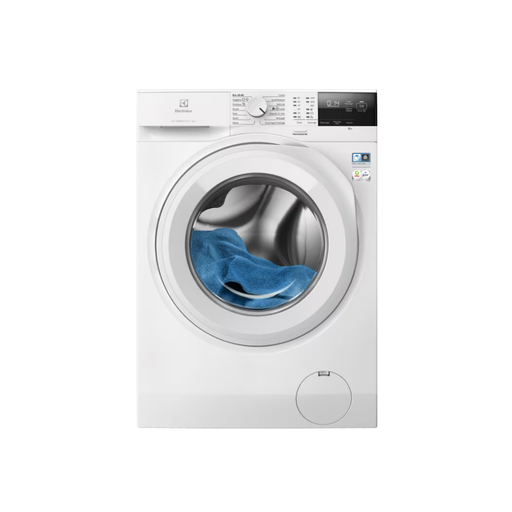
Electrolux EW6FI4805AW 8 kg front-loading washing machine

Electrolux EW6FI4805AW, 8 kg front-loader, 1,400 rpm

Worth comparing for larger household loads, with an 8 kg capacity.

Class A; 47 kWh/100 cycles; 43 L/cycle; spin-drying class B. Stated dimensions: 596 × 847 × 576 mm; the 14-minute quick programme is intended for small loads.

Joybuy
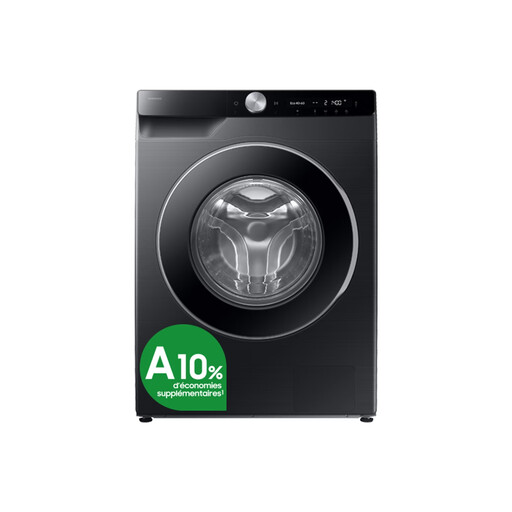
Samsung WW90DG6U85LBU3 9 kg front-loading washing machine

Samsung WW90DG6U85LBU3, 9 kg front-loader, 1,400 rpm

This capacity is particularly suitable for households that regularly accumulate large volumes of laundry.

Class A; 44 kWh/100 cycles; 50 L/cycle; spin-drying class B; 72 dB. Stated dimensions: 60 × 85 × 55 cm; allow for 63 cm with the door and check the necessary clearances.

Joybuy

Frequently asked questions

Is a 7 kg capacity enough to limit partial loads?

ADEME indicates that a 7 kg washing machine is usually sufficient to avoid running multiple cycles with underfilled drums. This is not a mandatory threshold: if you regularly accumulate bulky laundry or larger loads, consider a higher capacity without overloading the drum.

How should you compare two washing machines with different capacities or formats?

Compare the energy label for the specific model: capacity in kg, energy in kWh/100 cycles, water in litres/cycle, Eco 40-60 duration, spin-drying efficiency class and noise level. Do not infer these figures simply from whether the machine is a top-loader or front-loader.

Does a top-loading washing machine necessarily use less energy than a front-loader?

No. For example, the 7 kg AEG LTR8C7331A top-loader is rated at 45 kWh/100 cycles and 44 L/cycle according to the model data; these figures cannot establish a general rule for all top-loaders. Compare them with the label for the front-loader you are considering.

Is the durability index compulsory for new washing machines in France?

For applicable new washing machines, the durability index has replaced the repairability index since 8 April 2025, according to the French ministry responsible for Ecology. This score out of 10 complements the energy label: consider it alongside capacity, energy use and repair information.

What should you check before buying a refurbished washing machine?

Ask for the exact model, capacity, actual condition, available consumption figures, delivery and installation arrangements, and the seller’s identity. When buying from a professional seller, the legal guarantee of conformity applies to new, used and refurbished goods; check the specific terms of the offer before payment.