
Livraison le jour même ou le lendemain

Qualité garantie

Débloquez vos offres de bienvenue: Livraison GRATUITE | Jusqu'à -80 % | 30 jours d'essai gratuits à JoyPlus
Téléchargez l'application
Stringing, surface bubbles, and poor layer adhesion... These 3D printing defects are a nightmare for many enthusiasts and professionals. The culprit is almost always the same: moisture absorbed by your filament spools. Materials like PETG, TPU, or Nylon are particularly prone to absorbing moisture, which can quickly ruin the quality of your creations. This is where a 3D filament dryer comes in: an essential accessory for restoring your materials to their pristine condition.
This guide will help you understand the key criteria for choosing the right filament dry box and presents our top picks to finally achieve reliable prints.
Before you make a purchase, let's review the key technical points that will make all the difference in the effectiveness and convenience of your future filament dehydrator.
First and foremost: how often do you print? Are you printing with a single machine or several in parallel?
Each filament has an ideal drying temperature. A quality 3D filament oven must therefore offer precise temperature control.
The ability to set a timer (from a few hours to over a day) is another major advantage, allowing you to start a cycle and forget about it.
A good dryer doesn't just heat; it must also vent the moist air. The best-performing models feature a fan and 360° heating to ensure fast, uniform dehydration. Some devices also double as a 3D filament storage box once the cycle is complete, keeping your spools safe from moisture and dust.
Our editorial team has vetted the market's options to bring you solutions that meet real-world needs, whether you're a casual user or a seasoned maker.
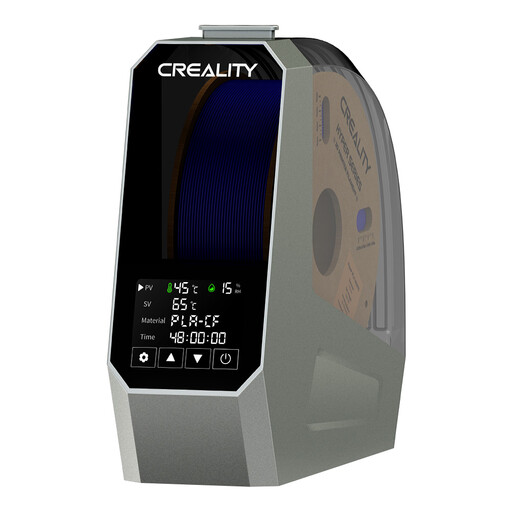
Why It Stands Out The Creality Space Pi focuses on the essentials: fast and effective drying. It features a 110?W PTC heating technology that ensures a rapid and stable temperature rise. Its real strength? A 360° hot air circulation system that guarantees perfectly uniform treatment of the entire spool, leaving no cold spots.
Pros
Who Is It For? This device is the smart choice for makers looking for a reliable and high-performance solution to treat one spool at a time. It's ideal for preparing a filament just before a critical print or for reviving a spool that has become too damp.
Once your filament is perfectly dry, it's time to let your creativity shine. And to truly see the difference, there's nothing like a quality filament.
CAILAB Filament PLA Rainbow Gradient - Silk Rainbow #11

"Silk" filaments are known for their ultra-glossy finish, but they are also particularly sensitive to moisture, which can quickly dull their shine. Using a filament like the CAILAB Rainbow fresh out of the dryer ensures you'll get vibrant colour gradients and a perfectly smooth surface, free from any moisture-related defects.
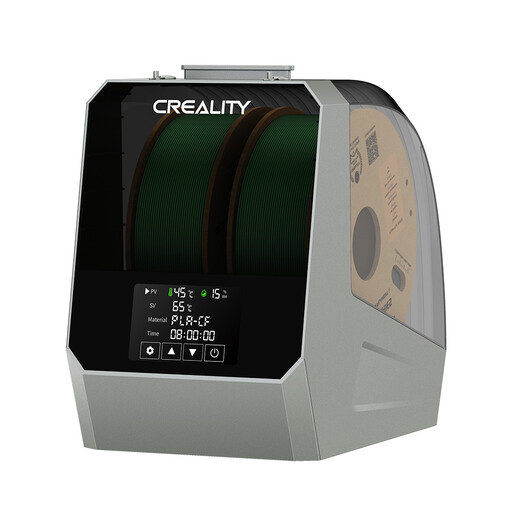
Why It Stands Out The "Plus" model takes the winning formula of its smaller sibling and offers a beefed-up version for more intensive use. Its standout feature: it can hold two 1?kg spools at the same time. It also comes with an LCD touchscreen to easily navigate between 12 filament presets or manually adjust the temperature (from 45 to 70?°C) and duration (up to 48 hours).
Pros
Who Is It For? This model is clearly aimed at power users, small workshops, or those who constantly juggle highly hygroscopic materials. Its dual capacity and advanced settings make it a 3D printer accessory designed to optimise workflow.
Our selection highlights proven solutions, but the world of 3D printer accessories is vast. Want to explore other dryer models, airtight storage boxes, or other tools to perfect your prints? Feel free to browse our complete catalog.
? To learn more, discover our full collection of 3D printing accessories.
There are several tell-tale signs. During printing, if you hear small crackling or hissing sounds from the nozzle, it's a sign that water in the filament is evaporating. Visually, the results are unmistakable: a grainy surface, excess stringing, poor layer adhesion, or an unusually brittle part. The filament itself can also become as brittle as glass.
This is a classic bad idea. While technically possible, we strongly advise against this method. Kitchen ovens lack precision, and their temperature fluctuations can easily exceed the glass transition point of PLA (around 60?°C). The risk? You could end up with a melted spool of filament, rendering it useless. Not to mention the risk of contaminating surfaces intended for food use. A dedicated 3D filament dryer offers infinitely more precise and safer temperature control.