
Livraison le jour même ou le lendemain

Qualité garantie

Débloquez vos offres de bienvenue: Livraison GRATUITE | Jusqu'à -80 % | 30 jours d'essai gratuits à JoyPlus
Téléchargez l'application
Finding the ideal 28?cm frying pan can quickly become overwhelming. Between the different materials, coating promises, and stovetop compatibility, it's easy to get lost in the options. Yet, a good pan is a key investment for everyday cooking, whether you're preparing meals for one or for the whole family.
As the Head of Product Recommendations at Joybuy, my mission is to provide you with clear, objective information. This guide is designed to help you sort through the choices by breaking down the essential criteria and showcasing a selection of models with distinctly different philosophies.
Before diving into our top picks, let's review the key criteria to consider to make the right choice—one that truly fits your kitchen and your cooking style.
The material of your pan determines its heat distribution, responsiveness, and, of course, its durability.
Always check the pan's compatibility with your stovetop. Most modern pans are compatible with "all hobs," including induction. Also, consider another major advantage: oven safety. This feature vastly expands your cooking possibilities, allowing you to start a dish on the stovetop and finish it in the oven, for a gratin-style meal, for example.
Food safety is non-negotiable. Choosing a pan guaranteed to be PFOA-free is a reassuring benchmark. Finally, don't overlook the handle: a stay-cool handle prevents burns and ensures a safe, comfortable grip.
Here are three models that stand out for their materials and design philosophies, each catering to very different needs.
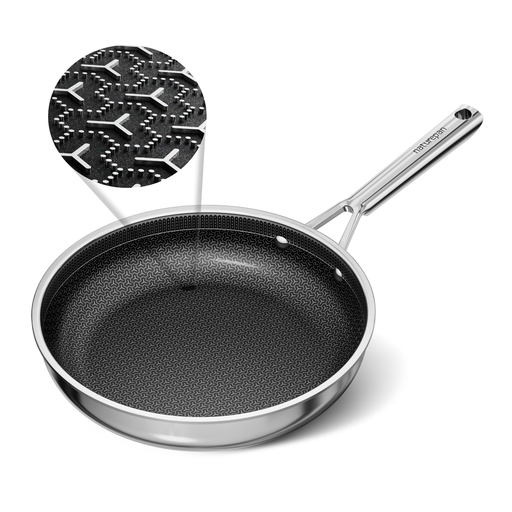
Why it stands out: This model successfully combines the best of both worlds. Its unique laser-etched hexagonal pattern features raised stainless steel for a perfect sear, while the valleys have a ceramic non-stick coating to ensure nothing sticks.
Key features:
Who is it for? For those who want the searing performance of stainless steel without giving up the everyday convenience of a non-stick pan.
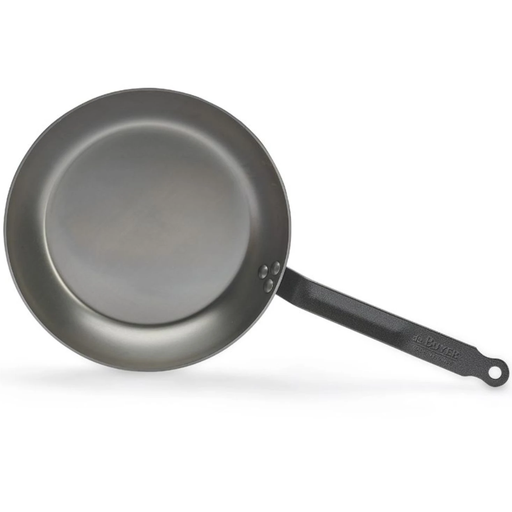
Why it stands out: Made in France, this carbon steel pan is a traditional piece of cookware built to last a lifetime. Its 3?mm thick steel body provides exceptional thermal inertia, which is ideal for achieving a perfect caramelisation (the Maillard effect).
Key features:
Who is it for? For cooking enthusiasts who appreciate beautiful, authentic tools and are willing to dedicate a little time to maintenance for unparalleled cooking results, especially with red meat.
Discover the de Buyer Carbon Steel Pan
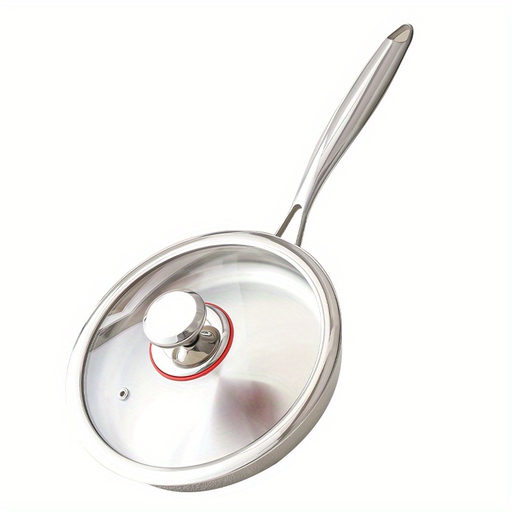
Why it stands out: This stainless steel pan focuses on durability and thermal performance. Its triple-ply construction (stainless steel-aluminium-stainless steel) ensures fast, even heat distribution across the entire surface, preventing hot spots for perfectly controlled cooking.
Key features:
Who is it for? For those looking for a healthy, virtually indestructible workhorse pan. A true cornerstone for your cookware collection, built to last for years.
Explore the PURE COOK Stainless Steel Pan
Our selection highlights three distinct philosophies. If you'd like to explore other sizes, materials, or designs, feel free to browse our complete collection.
Discover our collection of frying pans
1. What's the difference between a stainless steel pan and a carbon steel pan? The stainless steel pan is versatile, corrosion-resistant, and requires no special maintenance, but it is not naturally non-stick. The carbon steel pan excels at high-heat searing and becomes non-stick over time through seasoning, but it requires rigorous care to prevent rust.
2. Is a PFOA-free non-stick pan really safer? Yes. PFOA (perfluorooctanoic acid) is a chemical compound that was long used in the manufacturing of non-stick coatings, but its use is now highly regulated in Europe due to proven health risks. Choosing a pan labelled as PFOA-free guarantees that the manufacturer complies with current standards and uses more modern, safer processes.
3. How do I care for my pan to make it last longer? The golden rule for all pans is to avoid thermal shock (never run a hot pan under cold water). For non-stick coatings, use wooden or silicone utensils. For stainless steel, proper heat management and a little oil are your best friends. Finally, for carbon steel, seasoning is key: after each use, clean it with hot water without detergent, dry it immediately, and apply a thin layer of oil to protect it.