
Livraison le jour même ou le lendemain

Qualité garantie

Débloquez vos offres de bienvenue: Livraison GRATUITE | Jusqu'à -80 % | 30 jours d'essai gratuits à JoyPlus
Téléchargez l'application
Choosing a 1.75mm PLA filament can quickly become overwhelming with the sheer number of options available. Finishes, performance, colours... it's easy to get lost. Whether you're a seasoned maker churning out functional prototypes or an artist bringing decorative objects to life, filament quality is the cornerstone of your 3D prints.
This article is here to guide you. As the Head of Product Selections at Joybuy, my mission is simple?: to give you the keys to choosing the perfect filament for your projects, without the marketing jargon or empty promises.
Before diving into our top picks, let's review the essential criteria that will guide your choice.
The final look of your object depends entirely on the filament's finish.
With the rise of ultra-fast 3D printers, not all filaments are created equal. A high-speed PLA filament is formulated to melt and extrude with perfect stability at high flow rates. This minimises the risk of under-extrusion or nozzle clogging. If your printer exceeds 150?mm/s, choosing an optimised filament isn't a luxury?: it's a necessity to ensure the quality and strength of your prints. Always remember to check the manufacturer's recommended speed range.
The 1?kg PLA spool is the standard size and often the most cost-effective. It provides plenty of material for most projects, saving you from frequent spool changes. When it comes to colours, the choice is nearly infinite. Beyond solid shades, options like dual-colour or tri-colour 3D filament allow you to create objects with shifting hues depending on the viewing angle, adding a unique artistic dimension to your creations.
Here is our selection of PLA filaments that stand out from the crowd, each tailored to specific needs.
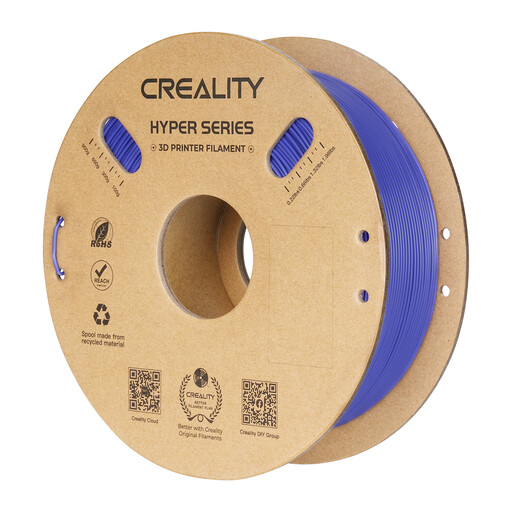
Why It Stands Out This filament was specifically developed to keep pace with the fastest 3D printers. Its formula is optimised for perfectly smooth extrusion, even at very high speeds, allowing for prints up to 600?mm/s according to the manufacturer. Its dimensional accuracy of +/- 0.02?mm ensures exceptional consistency, a non-negotiable criterion for technical parts.
Advantages
Who Is It For?? For owners of high-speed 3D printers who are prototyping or printing functional parts, and for whom every minute and every micron counts.
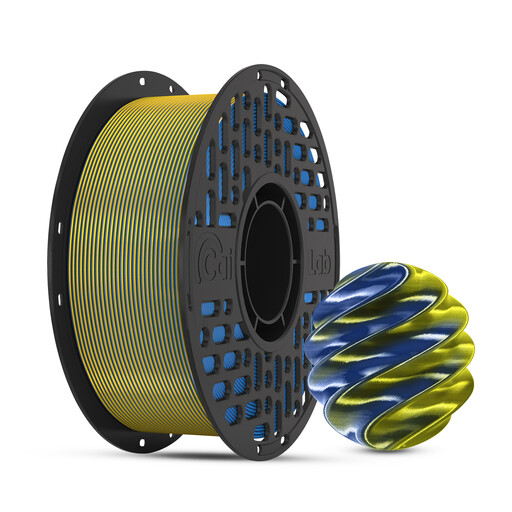
Why It Stands Out The key feature of this silk PLA filament is its incredible dual-colour effect. By fusing two colours (in this case, blue and gold) into a single strand, it brings objects to life with a hue that shifts depending on the viewing angle. The silky finish enhances this effect by dynamically catching the light.
Advantages
Who Is It For?? For creators, artists, and makers who want to produce decorative objects, jewellery, or figurines where aesthetics are the top priority.

Why It Stands Out This matte PLA filament is distinguished by its textured, reflection-free finish, which has the major advantage of masking the appearance of layer lines. The result?: an object with a more uniform and professional look. Its formula ensures excellent bed adhesion and a consistent flow, thereby reducing the risk of print failures.
Advantages
Who Is It For?? The ideal choice for architects, designers, and modellers printing mock-ups, appearance prototypes, or art objects that demand a clean, flawless finish.
Blue is a very versatile colour, but every project has its own colour scheme. If the shades featured here don't perfectly match your project, or if you want to explore other finishes in the same palette, we've got you covered.
? Discover our full range of blue PLA 3D printer filament on Joybuy
High-speed PLA filament has better melt fluidity and cools faster. This specific formulation allows it to be extruded without issue at very high flow rates, without sacrificing part strength. Under the same conditions, a standard PLA would risk causing under-extrusion and creating weak layers.
PLA (Polylactic Acid) is a bioplastic derived from renewable resources like corn starch. It is indeed considered a biodegradable PLA, but be aware?: this only applies under industrial composting conditions (high temperature, controlled humidity, etc.). It will degrade very slowly in a home compost bin and even less so in nature. Nevertheless, it remains a much more eco-friendly alternative to petroleum-based plastics.