Buying criteria
Start by comparing the type of drinks you expect to make, then consider the available space, maintenance tasks and total cost based on your actual preparation routine.
| Priority |
What to check |
Your needs |
| Long-term cost |
Compare the appliance, coffee, any filters, descaler and the number of cups you expect to make. UFC-Que Choisir states that the advertised cost per cup with a grinder is two to three times lower than with a pod espresso machine, under the conditions set out in its guide. |
I want to compare my actual spending, not just the machine’s starting price. |
| Maintenance |
Check access to the coffee grounds container, drip tray and brew group, as well as descaling alerts. For milk-based drinks, check the cleaning steps for the steam wand or milk system. |
I prefer a routine that fits the time I can devote to rinsing and cleaning. |
| Space and noise |
Measure the width, depth, height and access to the tanks before buying. UFC-Que Choisir says that an automatic grinder takes up more space and makes more noise than a capsule machine or filter coffee maker. |
My worktop and schedule require a machine suited to limited space or discreet use. |
| Drinks and coffee |
Decide whether you want single espressos, automatic milk recipes, a manual steam wand or larger quantities of filter coffee. Also check which coffee the machine accepts: beans, ground coffee or compatible capsules. |
I want to choose the format that matches what my household actually drinks, rather than paying for features we rarely use. |
Machines available on Joybuy
These Joybuy options are automatic bean-to-cup machines designed for making regular espressos at home, with different approaches to milk-based drinks and manual settings.
 Image unavailable
Philips EP2230/10 Series 2200 LatteGo
For a household that makes espressos and cappuccinos with a LatteGo system.
Grinder adjustable across 12 settings, 1.8 L tank, 275 g bean container and removable brew group. The AquaClean filter is listed as compatible; check whether it is included and the replacement requirements.
Joybuy
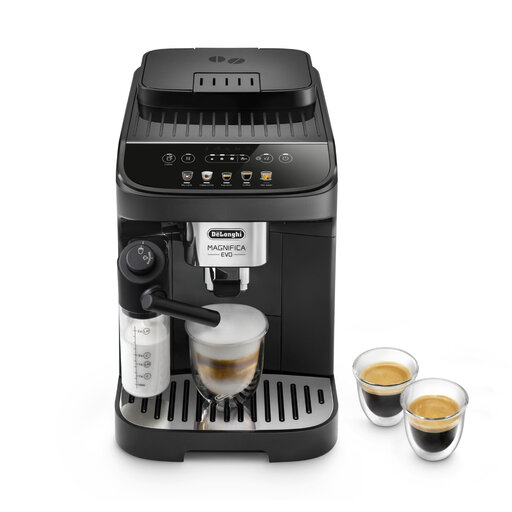 Image unavailable
De’Longhi Magnifica Evo ECAM290.61.B
For households wanting espressos and cappuccinos with the LatteCrema Hot system.
13-level grinder, 1.8 L tank and 250 g bean container. The milk carafe requires cleaning after milk-based drinks; check the exact recipes offered by this variant.
Joybuy
 Image unavailable
De’Longhi Magnifica Start ECAM220.21.WW
For a household that mainly makes espresso, coffee and Doppio+, and prefers to froth milk manually.
Conical grinder with 13 settings, 1.8 L tank, 250 g bean container and two-cup preparation. The steam wand requires manual use and cleaning.
Joybuy
 Image unavailable
HiBREW H16 automatic espresso machine
For a household wanting to vary its drinks using a touchscreen.
15-level stainless-steel conical grinder, 1.5 L tank, 4.3-inch screen and six advertised drinks. Consult the manual for the recipes available and the cleaning procedures specific to this variant.
Joybuy
 Image unavailable
De’Longhi Magnifica S ECAM22.140.B
For regular espressos using beans or ground coffee, with milk froth prepared by hand.
Integrated grinder, 15-bar pump, 1.8 L tank, two-cup function, steam wand and descaling programme with alert. Check the dimensions, noise level and water-filter requirements before buying.
Joybuy
Frequently asked questions
Is a grinder machine necessarily cheaper to run than a capsule machine?
No, not automatically for every household. UFC-Que Choisir says that a bean-to-cup espresso machine requires a higher investment, but that its advertised cost per cup is two to three times lower than that of a pod espresso. Compare the appliance, coffee, expected number of cups, any filters and descaling products against your own habits.
What maintenance is required for a bean-to-cup espresso machine?
Plan to rinse the coffee grounds container and drip tray regularly, and, depending on the model, the brew group or brewing chamber. Descale the machine when prompted; for milk-based drinks, follow the cleaning instructions for the steam wand or milk system after use.
Can coffee capsules be recycled in France?
ADEME states that aluminium or plastic capsules should go in the sorting bin, bag or container for paper and packaging. Always check the Info-tri label on the product and your local authority’s guidance.
Which legal guarantee applies to a coffee machine bought from a professional seller in France?
The statutory guarantee of conformity is compulsory for new, second-hand or refurbished goods sold by a professional to a private individual, according to the French Ministry for the Economy. The seller must provide goods that conform to the contract; keep the receipt, offer description and correspondence with the seller.


