Which option is right for you?
Your choice largely depends on the kind of coffee you make and how much you want to do each day.
Espresso lovers who want to choose their beans
If you often make coffee at home and want to switch between beans without being tied to a particular pod format, an automatic grinder could suit you. You’ll still need to find a spot for it and keep up with regular maintenance.
Busy households or those short on space
Pods make preparation simpler when saving space and minimising steps matter more than choosing your beans. Check which formats are compatible with the machine you’re considering. UFC-Que Choisir notes that a bean-to-cup espresso machine takes up more space and makes more noise than a pod system.
Espresso lovers who enjoy the hands-on approach
A portafilter lets you use ground coffee without pods or an automatic grinder. You’ll need to prepare and empty the portafilter every time you make a coffee, as UFC-Que Choisir points out.
How do the machines compare?
Start with the drinks you want to make, then consider how each option fits your available space and the maintenance you’re willing to do.
Bean-to-cup espresso machine
Worth considering if: you regularly make espresso and want to choose your beans using an integrated grinder.
Bear in mind: it takes up more space, makes more noise and needs maintenance, according to UFC-Que Choisir.
Portafilter
Worth considering if: you want to make espresso with ground coffee and be involved in every extraction.
Bear in mind: you’ll need to prepare and empty the portafilter for every coffee, as UFC-Que Choisir points out.
Capsules or pods
Worth considering if: you want a simple way to make coffee and have limited space.
Bear in mind: each drink uses a pre-packaged portion. Check which formats are compatible before choosing a machine.
Filter coffee machine
Worth considering if: you mainly make filter coffee, especially several cups at a time.
Bear in mind: it won’t make espresso or grind beans fresh on demand without a separate piece of equipment.
| Criteria | What to check | What I need |
|---|
| Choice of coffee |
Types of coffee it accepts; grind settings on a bean-to-cup model; compatible pod formats. |
I want to switch between beans without being tied to a particular pod format. If I also want to use ground coffee, I’ll check that the machine I choose accepts it. |
| Maintenance |
Access to the used coffee grounds container, drip tray and brew unit; descaling process; cleaning the milk system, if there is one. |
An automatic machine suits me, as long as the rinsing, emptying and cleaning described in the manual fit into my routine. |
| Space and noise |
Height, depth and width; clearance to fill the tanks and remove parts; whether it has a grinder. |
The machine needs to fit in its usual spot, including beneath wall units if necessary. I’ll also consider the noise from grinding when making coffee in the morning. |
| Drinks and preparation |
Espresso or filter coffee; the drinks actually available; manual steps for preparing the coffee and, where relevant, the milk. |
If I mainly drink filter coffee, I’ll have different needs from someone who mainly drinks espresso. For espresso, I may prefer to use a portafilter myself or let the machine measure and grind the coffee. |
| Packaging |
Whether each drink uses an individually packaged portion; how much coffee suits the household’s consumption; local recycling guidance. |
I want to cut down on individual packaging without buying more beans than I can use. If I keep using pods, I’ll follow the relevant recycling guidance. |
A look at some ranges
These range examples show why it’s important to check the exact model, particularly when it comes to milk-based drinks and access to parts that need cleaning.
De’Longhi
The Magnifica range includes bean-to-cup espresso machines, with recipes and milk systems that vary by model.
- De’Longhi’s product information for the Magnifica S ECAM22.140.B lists a 1.8 l water tank and an adjustable water hardness setting.
- For this model, De’Longhi says that descaling takes around 45 minutes. Bear this in mind when planning your maintenance routine.
Philips
Some Philips automatic machines combine coffee preparation with a LatteGo system for milk-based drinks.
- For its Series 2200 EP2235/47, Philips says the LatteGo carafe can be cleaned in 15 seconds. This time applies to that carafe and model only.
- Cleaning the milk system doesn’t replace cleaning the other parts. Check the full cleaning process for the specific machine you’re considering.
Siemens
The EQ500 range includes bean-to-cup machines whose preparation and maintenance features should be checked model by model.
- For the EQ500, Siemens describes front access to the drip tray, bean container and brewing unit for cleaning.
- Siemens notes that water hardness affects how often descaling is needed. Check the setting and process for the model you choose.
Bean-to-cup machines on Joybuy
These five models are bean-to-cup espresso machines that make coffee from beans. They’re worth considering if you’d like to move away from pods. To choose between them, focus on the recipes, the space available and the maintenance required for each model.
 Image unavailable
Philips Series 2200 EP2230/10 LatteGo
This bean-to-cup espresso machine is aimed at households that want to use beans and are also considering milk-based drinks with the LatteGo system. Check which recipes are available on the EP2230/10 and read the full maintenance instructions before choosing.
View on Joybuy
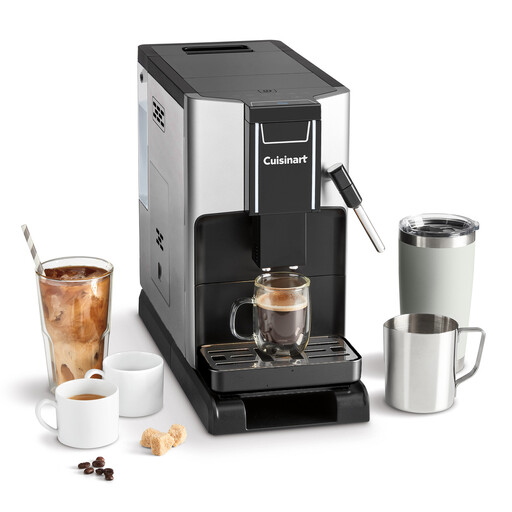 Image unavailable
Cuisinart EM550E
The Cuisinart EM550E product information lists four ways to prepare coffee from beans: Espresso, Double Espresso, Americano and Cold Brew. It specifies a 1.5 l water tank and a 150 g bean container. Check that you have enough room to fill and clean the machine where you plan to keep it.
View on Joybuy
 Image unavailable
De’Longhi Magnifica S ECAM22.140.B, black
This model combines a grinder with automatic espresso preparation. For the ECAM22.140.B, De’Longhi lists a 1.8 l water tank and dimensions of 236 × 429 × 348 mm, in height, depth and width order. The brand also says that descaling takes around 45 minutes. Check that the maintenance and access requirements work for your kitchen.
View on Joybuy
 Image unavailable
De’Longhi Magnifica Start ECAM220.21.WW, white
This automatic bean-to-cup machine is another option for making espresso without pods. To compare it with the Magnifica S, check the ECAM220.21.WW product information for the recipes you want, its dimensions and the parts you’ll need to access for maintenance.
View on Joybuy
 Image unavailable
HiBREW H16 with milk system
The H16 combines a grinder and milk system with a touchscreen, and its product description lists six coffee varieties. If you plan to use the milk functions regularly, check the manual for this model to find out which parts need cleaning and what to do after making a drink.
View on Joybuy
Frequently asked questions
What maintenance does a bean-to-cup espresso machine need?
Be prepared to empty and clean the containers, maintain the brew unit as directed for your machine and descale it when prompted. If you make milk-based drinks, follow the instructions for cleaning the steam wand or milk system after use. The manual for your chosen model explains what to do and how often.
Why adjust the water hardness setting on a bean-to-cup machine?
This setting helps tailor descaling alerts to the water you use. Siemens says that harder water needs more frequent descaling. Check your model’s manual for instructions on setting up the machine and following the recommended process.
Where should you dispose of aluminium or plastic pods in France?
ADEME advises putting aluminium or plastic pods in the recycling bin, bag or container for paper and packaging. Check your local authority’s guidance too, so you can sort your waste correctly at home.
Does an easy-to-clean milk system mean you don’t need to maintain the machine?
No. Cleaning the milk system doesn’t replace cleaning the containers, the brew unit if it’s accessible on your model, or descaling. Philips says the LatteGo carafe on its Series 2200 EP2235/47 can be cleaned quickly, but this doesn’t cover maintenance for the whole machine or for other models.


