What factors affect your choice?
To decide whether to move on from capsules, start with the drinks you actually make. Then check how much space you have and what maintenance you’re prepared to do.
Bean-to-cup machine
Consider it: if you regularly make espresso from beans using an automatic machine.
Bear in mind: UFC-Que Choisir notes that these machines take up more space and make more noise than capsule machines or filter coffee makers, and need regular maintenance.
Capsule machine
Consider it: if quick preparation and a compact design matter more to you than choosing your own coffee beans.
Bear in mind: UFC-Que Choisir says that many machines use just one capsule format.
Portafilter espresso machine
Consider it: if you’d like more control over the steps involved in making espresso.
Bear in mind: the process involves more hands-on preparation than using an automatic bean-to-cup machine.
Filter coffee maker
Consider it: if filter coffee is your usual drink rather than espresso.
Bear in mind: it won’t directly replace a machine you use to make espresso.
| Factor |
What to check before you buy |
Who is it for? |
| Coffee choice |
Compare the beans you’d like to use with the capsule format accepted by your current machine. |
I make espresso regularly and want to choose my own beans without being tied to a capsule format; around 33% of consumers would make this freedom their priority. |
| Convenience and space |
Measure the space you have and allow room to access the water tank and trays; also consider the grinder’s noise. |
Space is limited in my kitchen, so I’d rather keep coffee-making quick and simple. Convenience would come before other factors for around 25% of consumers. |
| Maintenance and support |
Check the model’s instructions for cleaning, descaling and repair options. |
I want to know what I’ll need to do before switching to a bean-to-cup machine; around 25% of consumers would put maintenance and appliance support first. |
| Drinks and settings |
Think about the drinks you make each week and check the settings, along with any cleaning steps for a milk system. |
We all like our espresso differently at home, and we’d make good use of the available settings. This flexibility would be the priority for around 17% of consumers. |
Machines to suit the way you make coffee
The first four models are bean-to-cup machines. The last is a portafilter machine for those who prefer a more hands-on approach.
 Image unavailable
Philips Series 2200 EP2230/10 LatteGo, black
Worth considering if you’re switching to beans but still want to make milk-based drinks. This model is described as an espresso machine with a grinder and LatteGo system; check the manual for cleaning instructions.
View on Joybuy
 Image unavailable
DE'LONGHI Magnifica Start ECAM220.21.WW, white
An automatic bean-to-cup espresso machine to consider for regular use at home. If you’d also like to make milk-based drinks, check the manual for instructions on using and cleaning the steam wand.
View on Joybuy
 Image unavailable
DE'LONGHI Magnifica S ECAM22.140.B, black
Worth a look if you’re after an automatic espresso machine with a grinder. Before setting aside space for it, check its dimensions and allow room for maintenance. The steam wand also needs cleaning after making milk-based drinks.
View on Joybuy
 Image unavailable
HiBREW H16, automatic espresso machine with grinder
Worth considering if you’d genuinely make several different drinks: the product name mentions six types of coffee, a milk system and a touchscreen. Check the manual for the cleaning required for these features.
View on Joybuy
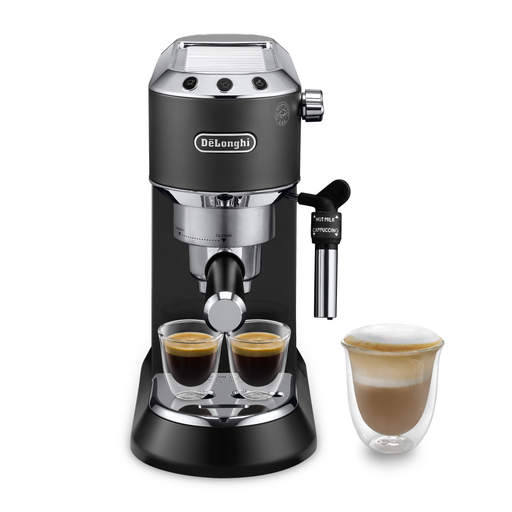 Image unavailable
DE'LONGHI Dedica Style EC685.BK, black
Worth considering if you’d rather make espresso with a portafilter than switch to an automatic bean-to-cup machine. The product name states a rated pressure of 15 bar; check the water tank capacity for the model on offer before you choose.
View on Joybuy
Frequently asked questions
How often should you descale a bean-to-cup machine?
There’s no one-size-fits-all schedule: De’Longhi France says that water hardness affects how often you need to descale. Set the water hardness if your model allows it, and follow the machine’s alerts and instructions.
What maintenance does a bean-to-cup machine need?
Rinse the trays regularly and follow the cleaning and descaling instructions for your model. If you make milk-based drinks, also check what to do with the steam wand or milk system after use.
Who is responsible if a machine bought in France is faulty?
For a machine sold by a business to a consumer in France, the seller is responsible for the statutory guarantee of conformity, according to the Ministry of the Economy. This applies to new, second-hand and refurbished goods; a manufacturer’s commercial warranty can be added, but does not replace it.
How can you check what support is available before choosing a model?
Look up the manual and repair options for the exact model. Philips France lets you search for support by model number, while JURA France lets you identify parts by product number or EAN code. Then check the terms that apply to the machine you’re considering.


