
Livraison le jour même ou le lendemain

Qualité garantie

Débloquez vos offres de bienvenue: Livraison GRATUITE | Jusqu'à -80 % | 30 jours d'essai gratuits à JoyPlus
Téléchargez l'application
The aroma of freshly ground coffee, the sound of the machine starting up… For any true coffee lover, nothing beats the experience of a bean-to-cup coffee machine. If you're tired of the cost and waste of capsules, or if filter coffee no longer satisfies your palate, you've come to the right place.
Choosing an automatic coffee machine can feel like a daunting task given the overwhelming number of options. Our guide is here to cut through the noise, decipher the technical specs, and help you make the right choice—without the unnecessary marketing jargon.
Before you settle on a model, let's review the technical points that will make all the difference in your daily cup.
The quality of your espresso depends first and foremost on the grind. A good bean-to-cup espresso machine must offer several fineness levels. A fine grind is ideal for an intense espresso, while a coarser grind is better for a lungo. Conical grinders made of steel or ceramic are often preferred: they have the advantage of heating the beans less during grinding, thus preserving their full aroma.
Pressure, expressed in bars, is an often-highlighted marketing point. While a 20-bar coffee machine might seem more powerful on paper, be aware that an effective 9 bars at the brew group is more than enough for a perfect espresso. Even more important is the heating system. Machines equipped with a dual system (dual boiler or dual thermoblock) allow you to brew coffee and froth milk simultaneously. This is a major advantage for fans of cappuccino coffee machines and lattes, who will no longer have to wait between the coffee and the milk foam.
An automatic coffee machine should make your life easier. An intuitive touchscreen, clear programs, and the ability to customise and save your preferences (length, intensity, milk quantity) are key advantages. Don't overlook ease of maintenance either: automatic cleaning and descaling programs, as well as removable components (brew group, grounds container, water tank), are the guarantee of a healthy and long-lasting machine.
We have selected three models that stand out for their technical specifications and design, catering to different needs and budgets.
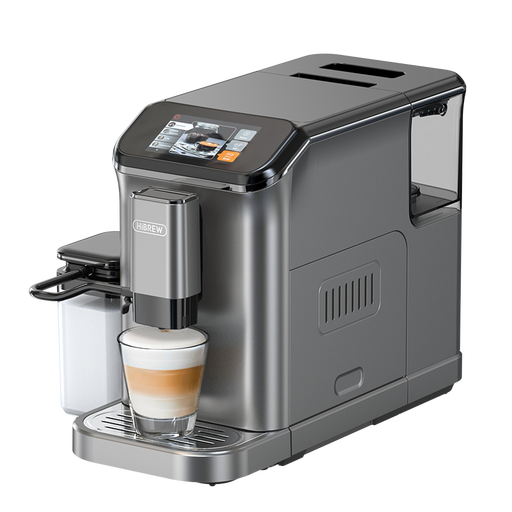
Why it stands out The HiBREW H16 stands out with its large 4.3-inch colour touchscreen, which makes customising drinks incredibly simple. Its dual boiler system is a real bonus in this price range, allowing you to prepare milk-based drinks without any delay.
Key Features
Who is it for? For families or anyone looking for an ultra-comprehensive and intuitive machine thanks to its large screen, and who loves to vary their coffee creations without any hassle.
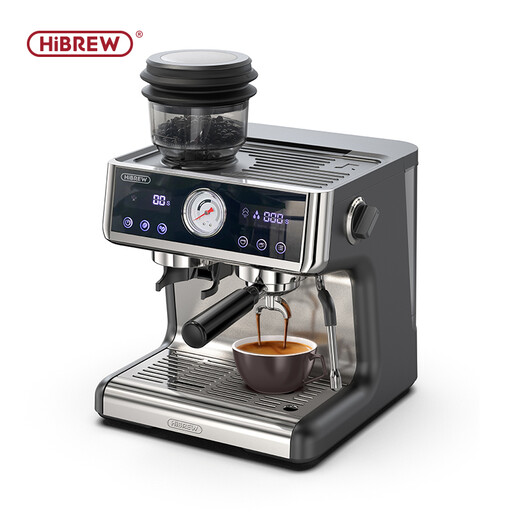
Why it stands out With its brushed stainless steel body and high-end components, the HiBREW H7A targets purists who want to recreate the barista experience at home. Its dual boiler and dual pump system, along with 30 grind levels, offer advanced control over every step.
Key Features
Who is it for? For coffee enthusiasts who love having control over every parameter, as well as for small offices looking for a reliable and high-performance machine.
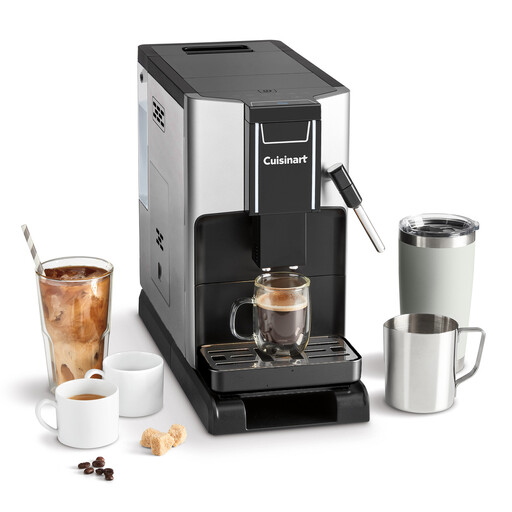
Why it stands out The Cuisinart EM550E is proof that you can combine performance and a compact design. Perfect for kitchens where every square inch counts, it gets straight to the point, while still including a coffee machine with a steam wand for latte lovers and a rather unexpected "Cold Brew" function.
Key Features
Who is it for? For those living in apartments or with small kitchens who want the quality of bean-to-cup coffee without the bulk or complexity of larger models.
Is the modern look of these automatic machines not to your taste? If you're more drawn to retro charm, other options are available. For a style that blends nostalgia with performance, take a look at our selection of vintage coffee makers.
1. What is the difference between a bean-to-cup coffee machine and a classic espresso machine? A bean-to-cup coffee machine, or bean-to-cup espresso machine, is an all-in-one solution. It grinds the beans on demand, doses and tamps the grounds, and starts the espresso extraction, all completely automatically. In contrast, a manual espresso machine (with a portafilter) requires an external grinder and a lot more elbow grease to prepare each coffee.
2. How do you maintain an automatic coffee machine with a grinder? Regular maintenance is the secret to its longevity. This involves:
3. Is 20 bars of pressure really necessary? Technically, a pressure of 9 bars applied to the coffee puck is the standard for optimal espresso extraction. Manufacturers communicate the maximum pump pressure (15, 19, or 20 bars) as a marketing point. A powerful pump ensures a rapid and stable pressure build-up, which is a good thing. However, a pressure higher than 9 bars at the moment of extraction will not improve the taste of your coffee in any way; that's a common misconception.