
Livraison le jour même ou le lendemain

Qualité garantie

Débloquez vos offres de bienvenue: Livraison GRATUITE | Jusqu'à -80 % | 30 jours d'essai gratuits à JoyPlus
Téléchargez l'application
The aroma of freshly ground beans filling your kitchen as you wake up... it's a promise few coffee lovers can resist. A bean-to-cup coffee machine transforms this daily ritual into a true tasting experience. But with a plethora of options and sometimes misleading marketing claims, making the right choice can be a daunting task.
The marketing promise of a barista-quality coffee at the touch of a button is tempting, but the reality is often less idyllic. Before you pull out your credit card, it's best to know the common pitfalls to avoid buyer's remorse.
Buying an automatic coffee machine is a significant investment. To avoid disappointment, here are the key things to watch out for.
Many machines highlight an automatic cleaning function. While this feature is certainly convenient for rinsing the internal circuits, it rarely eliminates the need for manual intervention. The grounds container must be emptied, the brew group rinsed (if it's removable), and most importantly, the milk system and its steam wand require meticulous cleaning after each use for obvious hygiene reasons. A machine that is poorly designed in these areas quickly becomes a chore.
A colour touchscreen, 17 recipes, Bluetooth connectivity... these options look appealing on paper, but will you really use them every day? Most users stick to two or three drinks: espresso, long coffee, and for the more indulgent, a cappuccino. Paying a hefty premium for features you'll never use is rarely a wise investment.
The true value of a bean-to-cup coffee maker lies in its integrated grinder. It, and it alone, guarantees the incomparable freshness of the grind. But be warned, not all grinders are created equal. A model with no fineness adjustment or with low-quality burrs will produce an inconsistent grind, ruining the promise of a great coffee. The quality of the grinder is therefore a non-negotiable criterion.
To get a clearer picture, let's focus on the features that directly impact the quality in your cup.
The core component of any bean-to-cup espresso machine is its mill. There are two main types of burrs:
More important than the material is the ability to adjust the grind fineness. A precise adjustment (with multiple levels) is essential to adapt the extraction to the type of bean and to control the strength of your coffee, from a bold ristretto to a milder lungo.
Pressure, expressed in bars, is an often-touted marketing point. A pressure of 15 bars at the pump is a standard that ensures proper extraction and a rich crema on your espresso.
The heating system is the other key element. The Thermoblock system is the most common: it heats water on demand, making it fast and energy-efficient. It's ideal for making one espresso after another. Higher-end machines, equipped with a dual heating system (or double boiler), allow you to prepare coffee and froth milk simultaneously. A real bonus for milk-based drink lovers in a hurry.
Beyond the promises of automation, look closely at the details that will genuinely make your life easier:
With these criteria in mind, here are a few models that stand out from the crowd, catering to different user profiles.
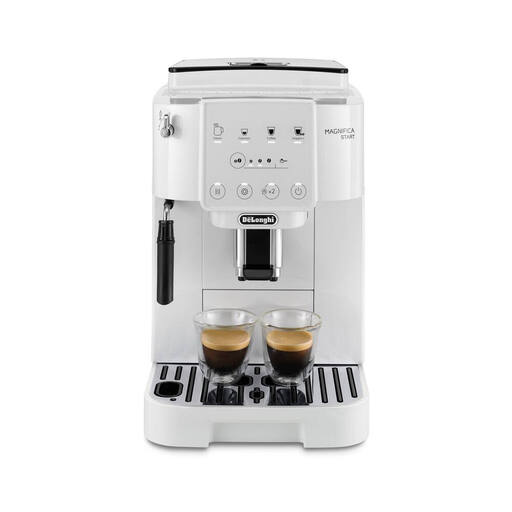
Why we love it: Ideal for those who want excellent coffee without getting lost in settings. It gets straight to the point with one-touch buttons for core drinks (Espresso, Coffee, Doppio+), making it incredibly simple for daily use.
This model skips superfluous features. It packs in the essential De'Longhi expertise (adjustable grinder, 15-bar pump) without unnecessary complexity, which is reflected in its very competitive price.
13-setting conical burr grinder. Manual steam wand for cappuccinos. Guided cleaning and descaling programs.
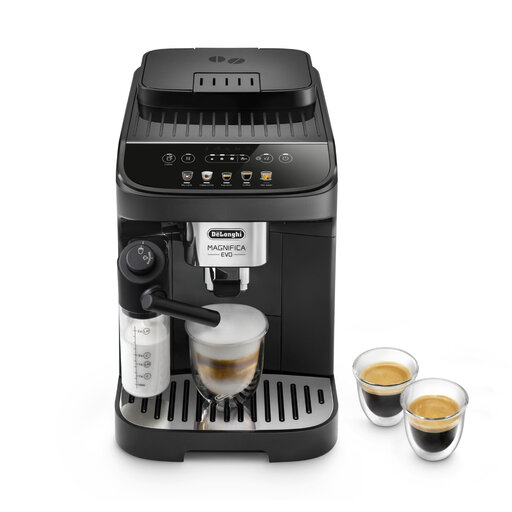
Why we love it: For those for whom a cappuccino or latte macchiato is a sacred ritual. Its LatteCrema system automatically prepares a dense, creamy milk foam directly into the cup with impressive consistency.
It tackles the headache of milk system maintenance head-on. The carafe has an automatic cleaning function (just turn a dial) and is dishwasher-safe. Maintenance becomes child's play.
LatteCrema system for perfect, automatic milk foam. Touch control panel with colour icons for 5 one-touch drinks. MyLatte function to customise your beverages.
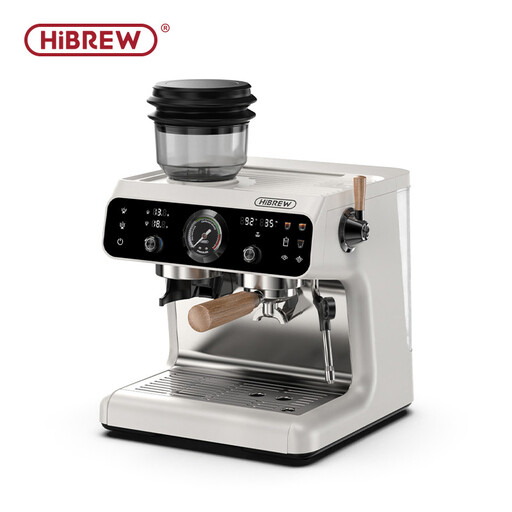
Why we love it: For the expert who wants total control. This semi-pro (or *prosumer*) machine lets you fine-tune every detail: 30 grind levels, adjustable extraction temperature (PID), and a dual boiler system to pull shots and steam milk simultaneously without any waiting time.
It solves the problem of often-disappointing integrated grinders. With its 48mm steel conical burrs and 30 adjustment settings, it offers precision worthy of a standalone grinder, ensuring a perfect grind for every bean.
Dual boiler system. PID temperature control. 30-level adjustable grinder. Professional 58mm portafilter.
For heavy-duty use in an office or restaurant setting, the demands for performance and durability are even higher. Discover our dedicated selection.
The lifespan of a coffee machine with a grinder depends on its build quality, but more importantly, on how rigorously it is maintained. A well-maintained machine (regular descaling, cleaning the brew group) can easily last for 7 to 10 years. The availability of spare parts, a point that brands like De'Longhi are transparent about, is also an excellent indicator of durability.
The debate rages on! Ceramic burrs are known for being quieter and heating the beans less. Steel burrs are praised for their unbeatable durability (handy if a small stone slips in with the beans). Ultimately, the choice is personal. The most important factor remains the number of fineness settings, which will have a much more direct impact on the result in the cup.
The cost is very reasonable. You should budget for filter cartridges (to be replaced every 2-3 months, around €10-15 each) and descaling solution (a €10-20 bottle is good for several cycles). For typical home use, the annual budget is therefore between €50 and €80. A modest investment to ensure the longevity and performance of your machine.