Who are these formats for?

Households that make espresso every day

If you regularly make several coffees, consider whether the grinder, its maintenance and the initial outlay are right for your actual consumption. Que Choisir Ensemble highlights the importance of choosing a machine to suit the drinks you want to make.

Fans of a range of drinks

If you switch between espressos, longer coffees and milk-based drinks, check the recipes available on the exact model you’re considering. Make sure you know whether it has a steam wand for manual use or an automatic milk preparation system.

Households focused on an easy daily routine

If cleaning time, available space or the choice of consumables matters to you, compare capsule or pod machines, portafilter machines and filter coffee machines too.

What to compare

Automatic espresso machine with grinder

Choose this if: you regularly make espressos from beans and are happy to follow the cleaning routine set out in the instructions.

Bear in mind: the initial outlay, space and maintenance involved; a steam wand may mean preparing milk by hand.

Capsule or pod machine

Choose this if: you prefer making one drink at a time and want a compact machine.

Bear in mind: which format the machine accepts and the cost of the consumables you’ll buy.

Portafilter espresso machine

Choose this if: you want to make each espresso by hand using ground coffee, or ESE pods if the model accepts them.

Bear in mind: preparation and cleaning are manual; if you want to use whole beans, you’ll also need a suitable way to grind them.

Filter coffee machine

Choose this if: you mainly make filter coffee, especially several cups at a time in a carafe.

Bear in mind: this format isn’t a substitute for an espresso machine; check the capacity and filter type.

Criteria What to check Who it matters to
Volume and running costs Keep track of your cups and doses, then compare the machine, coffee and necessary consumables over the same period. If I make several coffees every day, I want to compare costs against the doses I use and the products I actually buy. Around 36% of consumers surveyed prioritise the volume prepared and the running costs.
Drinks and preparation Check the recipes available on the exact model, the settings on offer and the type of milk frother. If your household switches between espressos, longer coffees and milk-based drinks, you need to know which preparations are automatic and which require hands-on steps. Around 29% of consumers surveyed prioritise the variety of drinks.
Maintenance and parts Check the instructions for the required tasks, how often they need doing, access to the parts that need cleaning and the parts listed for the model. If I want a routine I can stick to over time, I check what needs cleaning and whether repairs are possible. Around 21% of consumers surveyed put maintenance and parts support first.
Space and format Measure the machine and the clearance it needs; also check the capacity and compatibility of capsules, pods or filters. If worktop space is limited or you need to serve several cups, the machine’s format should suit your space and household routine. Around 14% of consumers surveyed prioritise the machine’s footprint and preparation format.

Mistakes to avoid

  • Assuming you’ll definitely save money based on the cost per cup

    The dose you use, the coffee you choose and the consumables you buy all affect the calculation, depending on the household and machine.

    Keep track of your consumption and compare known costs over the same period for each format you’re considering.

  • Assuming an automatic rinse takes care of all the cleaning

    The coffee grounds and drip trays need regular cleaning; other tasks depend on the features of the model.

    Check the instructions for the exact model and make sure its cleaning routine suits you before buying.

  • Confusing capsules, soft pods and ESE pods

    These formats aren’t interchangeable: a portafilter’s ESE compatibility doesn’t mean it accepts every type of pod or capsule.

    Check which system and consumables the exact model accepts before deciding what to buy.

  • Confusing a limit in the commercial warranty with your legal guarantee

    Que Choisir Ensemble has reported commercial warranty conditions based on the number of coffees made for some machines. These conditions alone don’t set out consumers’ legal rights in France.

    Check the commercial warranty conditions and the legal rights that apply to your purchase separately, and identify the professional seller involved.

Brands to consider when comparing formats

De’Longhi

The Magnifica S ECAM22.140.B and Dedica Style EC685.BK EX:4 models offer examples of an automatic grinder and a manual portafilter machine respectively.

  • According to De’Longhi, the Magnifica S ECAM22.140.B grinds beans and has a traditional steam wand; the Dedica Style EC685.BK EX:4 accepts ESE pods and is 15 cm wide.
  • A manual steam wand doesn’t mean milk preparation is automatic, and width alone doesn’t tell you how much clearance you’ll need to install the machine.

Philips

The Series 2200 EP2220/10 is an example of a grinder machine with a classic milk frother; SENSEO uses soft pods.

  • Philips says the EP2220/10 has a removable brew group and adjustable grind settings.
  • SENSEO soft pods aren’t rigid capsules; check which system is compatible with the machine you choose.

Melitta

The Solo and EasyTop Timer let you compare a single-serve espresso grinder machine with a filter coffee machine that makes a carafe.

  • Melitta lists a maximum capacity of 10 cups and a 1x4® filter for the EasyTop Timer.
  • The doses listed for the Solo apply to that specific model and don’t reflect actual consumption on another machine.

Nespresso

The Essenza Mini is a compact example of the Original capsule system.

  • Nespresso France lists two standard sizes, espresso and lungo, and a 0,6 L water tank for the Essenza Mini.
  • Check the capsule format and cost for your needs; repairs depend on parts being available.

Bean-to-cup coffee machines on Joybuy

These Joybuy models are automatic espresso machines with grinders, designed to make coffee from beans.
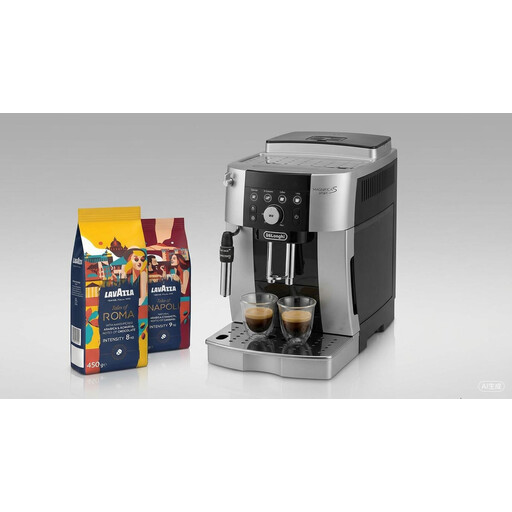
DeLonghi ECAM250.23.SB Magnifica with Lavazza coffee

DeLonghi ECAM250.23.SB Magnifica with Lavazza Tales of Napoli & Roma, 450 g, 2 packs

This model has an integrated grinder and is suited to households that want to make espressos from beans.

The bundle includes Lavazza Tales of Napoli & Roma coffee, listed as 450 g (2 packs) in the product name. The description specifies that the steam wand requires you to handle the milk and its container manually.

View on Joybuy
HiBREW H16, automatic espresso machine with grinder

HiBREW H16, automatic espresso machine with grinder

Worth considering if you’re looking for an automatic espresso machine with a grinder to make coffee from beans.

The product name lists six coffee varieties and a colour touchscreen.

View on Joybuy
HiBREW H7A, espresso machine with grinder

HiBREW H7A, grinder, dual boiler, 20-bar pump, 2,8 L tank

This model is designed for people who want an espresso machine with a grinder to make coffee from beans.

The product name lists a dual boiler, a 20-bar pump and a 2,8 L water tank.

View on Joybuy

Philips EP2230/10 Series 2200 with LatteGo

Philips EP2230/10 Series 2200 with LatteGo

This grinder machine may suit people who want to make coffee from beans and are also interested in milk-based drinks.

The model number listed is EP2230/10; the product name mentions the LatteGo system.

View on Joybuy
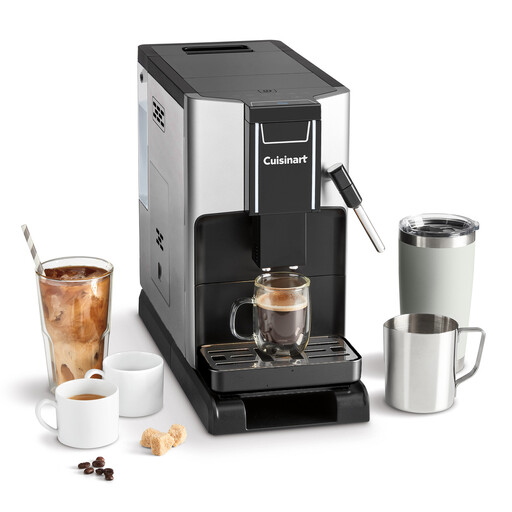
Cuisinart EM550E, automatic coffee machine with grinder

Cuisinart EM550E, automatic coffee machine

Worth considering if you’re looking for an automatic machine with a grinder to make coffee from beans.

The product name lists four coffee options. The description specifies that the steam wand is operated manually for milk-based drinks.

View on Joybuy

Frequently asked questions

How can I estimate my annual bean consumption?

Count the cups you actually make, multiply by the dose in grams for your chosen setting, then divide by 1,000 to get the weight in kilograms. For the Melitta Solo only, Melitta lists approximate doses of 7,5 g, 9,5 g or 11,5 g, depending on the strength setting; these doses can’t automatically be applied to another machine.

Does a machine that rinses itself automatically clean itself completely?

No: automatic rinsing doesn’t replace the maintenance required for the machine. Que Choisir Ensemble says the coffee grounds and drip trays need regular rinsing; other tasks depend on the instructions and the machine’s features, including its milk system.

What should I check when it comes to running costs and after-sales service?

Compare the coffee you actually use, filters and required cleaning products over the same period, then check which parts are listed for the model. In France, if the manufacturer tells the retailer how long parts will be available, the DGCCRF says the retailer must pass this information on to the consumer; this doesn’t guarantee that every part will be available for every model.

Does a commercial warranty replace my legal rights in France?

No. If you buy as an individual from a professional seller, your legal guarantee of conformity is against the seller; according to the DGCCRF, you have two years from delivery of the goods, whether new or second-hand, to bring a claim. This guarantee is separate from the commercial warranty: check its terms separately, including any limit on the number of coffees made.

Can I throw away capsules or coffee grounds without checking the sorting guidance?

No: check the guidance for each type of waste. France’s Ministry for Ecological Transition says that source separation of biowaste has been rolled out across France since 1 January 2024; for coffee grounds, use the solution provided locally. For capsules, check the guidance for their material and local collection arrangements.