People who drink espresso regularly
If you often make coffee at home and want to choose your own beans without relying on a capsule format, a grinder is worth considering. You’ll also need to be prepared to keep up with its maintenance routine.


A bean-to-cup machine is a good option if you drink coffee regularly, want to choose your own beans and are happy to empty the containers, clean the machine and descale it as instructed. To decide between one, a capsule machine, a portafilter espresso machine or a filter coffee machine, start with the drinks you actually make, then consider maintenance, available space and grinder noise. In its comparison, UFC-Que Choisir notes that the cost per cup can be lower than with capsules, but that alone isn’t enough to make it the right purchase for every household.
If you often make coffee at home and want to choose your own beans without relying on a capsule format, a grinder is worth considering. You’ll also need to be prepared to keep up with its maintenance routine.
If you often make cappuccinos or lattes, pay as much attention to cleaning the milk system as you do to the drinks menu. A milk carafe and a steam wand require different cleaning steps after use.
If you have a small kitchen or make coffee early in the morning, measure the space available and consider how noisy the grinder is. UFC-Que Choisir notes that a bean-to-cup machine takes up more room and makes more noise than a capsule machine or a filter coffee machine.
The type of coffee you make every day is the best place to start. Maintenance and installation requirements can then help you narrow down your options.
Consider it if: you drink espresso regularly and want to choose your own beans without using capsules.
Be prepared for: emptying the containers, cleaning the machine and grinder noise. UFC-Que Choisir also notes that it takes up more space than a capsule or filter coffee machine.
Consider it if: saving space and keeping preparation simple matter more to you than choosing your own beans.
Be prepared to: check which capsules are compatible and estimate your regular spending based on how much coffee you drink.
Consider it if: you want to take a more hands-on approach to making espresso.
Be prepared to: allow time for preparation and cleaning the portafilter.
Consider it if: you mainly make several cups of longer coffee rather than espresso.
Be aware that: this option won’t meet your needs if you want espresso or automatically prepared milk-based drinks.
| Criteria | What to check | How you use it |
|---|---|---|
| Long-term cost | Compare the machine, the coffee you’ll use and the consumables listed for each model. Consider the total in relation to how many cups you expect to make. | I drink coffee often enough to consider the running costs, but I won’t assume that a saving per cup will necessarily make up for the cost of the machine. |
| Maintenance | Check the instructions for the used-coffee container, drip tray and brewing unit, if it’s accessible. Look at rinsing, descaling and cleaning the milk system. | A daily routine I can keep up with matters more to me than an automatic programme with features I wouldn’t use. |
| Drinks | Check that it makes the drinks you usually have and look at the settings available on the exact model. Make sure you know whether the milk system is automatic or uses a manual steam wand. | We need to be able to make the coffees we actually drink at home, with or without milk. |
| Noise and space | Measure the available height and depth, as well as the space needed to fill the machine. For noise levels, look for a measurement that specifies the test conditions. | If I make coffee early, I need to bear in mind the grinder and rinsing noise. The machine also needs to be easy to reach on my worktop. |
| Model and parts | Make a note of the full model number. Look for filters, milk-system components and other useful parts for that exact model. | I want to identify the consumables and parts available for the specific version I’m buying, not just for its product range. |
A lower cost per cup won’t automatically offset the price of a bean-to-cup machine, especially if you don’t make much coffee.
Estimate how much you’ll drink over time and include the consumables required by the model in your comparison.
Depending on the machine and how you use it, filters, descaler and milk-system cleaning products can also add to your costs and maintenance time.
A drinks menu doesn’t tell you what’s involved in cleaning a carafe, steam wand or tube after use.
Read the instructions for the exact model and check which parts can be removed and whether you’ll need a cleaning product.
Grinding makes noise. A claim from a brand isn’t enough, on its own, to compare two machines using the same method.
If you’ll be using the machine early in the morning, look for a noise measurement with stated test conditions and check the exact model.
Two machines in the same range can have different model numbers: the De’Longhi ECAM290.61.B EX:2 and ECAM290.85.SBX EX:1 are not the same version.
Compare the full model numbers, drinks, accessories and dimensions before choosing.
These examples highlight features to check on specific models. They don’t represent every machine from each brand, or necessarily feature in the selection below.
The Series 3300 LatteGo EP3341/50 is an example of a machine offering both coffee and milk-based drinks.
The Magnifica Evo ECAM290.85.SBX EX:1 is worth considering if you want automatically prepared coffee and milk-based drinks.
Searching for parts by model number can help you assess the future maintenance needs of a bean-to-cup machine.
These four options are designed for making espresso at home from whole beans. If you’re leaning towards capsules, a portafilter machine or filter coffee, use the criteria above to compare those options. This selection isn’t a comparison of every type of coffee machine.
 Image unavailable
Worth considering if you want to make coffee from whole beans and milk-based drinks at home. If you’ll be using the EP2230/10 early in the morning, check how noisy the grinder is. Also check which consumables are needed for maintenance.
 Image unavailable
This automatic machine is listed with a grinder, a milk system and 6 drinks. If you often make milk-based drinks at home, check the milk-system cleaning instructions before choosing the H16.
 Image unavailable
An option for whole-bean coffee if you’re happy to prepare milk-based drinks manually: the steam wand needs to be used and cleaned after each use. Check the grinder noise if you’ll be using the machine at times when noise could be an issue.
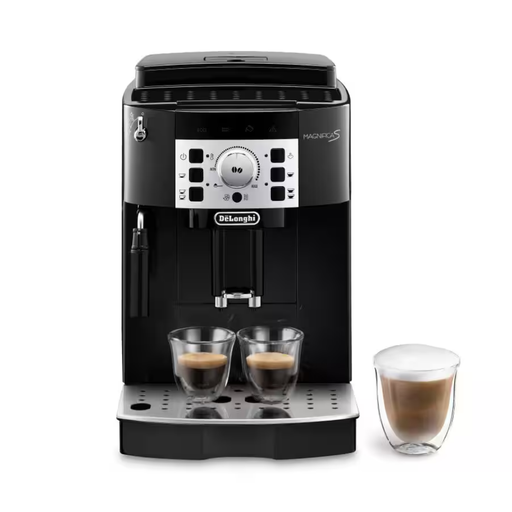 Image unavailable
This bean-to-cup machine is worth considering if you make espresso and are happy to use the steam wand manually for milk. According to the information for this model, the wand gets very hot, so let it cool before cleaning. Check the dimensions to make sure it’ll fit on your worktop.
Empty and rinse the containers regularly, then follow the model’s descaling instructions. In its tests, UFC-Que Choisir looks at points including the drip tray, reservoirs, grounds container and brewing unit. After making a milk-based drink, follow the cleaning instructions for the milk system too.
For the same period and number of cups, add together the machine, coffee or capsules, and any consumables needed for maintenance. UFC-Que Choisir’s comparison shows a lower cost per cup for whole-bean coffee, but the cost for your household will depend on how much you drink and what you actually buy.
Search for the machine’s full model number in the manufacturer’s support and parts sections. Melitta France offers original parts, and Philips support includes sections on parts for certain models. Still, check whether the specific part you may need is available.
Espresso machines aren’t included in the categories subject to this display requirement on the list published by the French Ministry of the Economy in August 2026. So the absence of an index isn’t enough on its own to judge how repairable a model is. Instead, check which parts are available and what support is offered.