
Same-day & Next-day Delivery

Quality Guaranteed

Unlock Your Welcome Offers: FREE Delivery | Up to 80% OFF | Free 30-day JoyPlus trial
Download the APP
A well-chosen log rack keeps your firewood organised, easy to reach and protected from damp. But some purchases can disappoint after just a few weeks: an unstable frame, poorly judged dimensions or inadequate protection from the weather. Before comparing a firewood rack, log holder or outdoor log store, check the features that really matter for your needs.
A generous width doesn’t necessarily make for practical storage. If a rack is too deep, logs at the back can be difficult to reach, while a model that’s too low may mean you have to keep restacking the pile. Consider the length of your logs, which is usually between 25 and 50 cm, as well as the space available around your fireplace or stove.
Firewood is heavy. A lightweight log rack or one with a base that’s too narrow could shift when you remove a log. For a tall model, check for closed sides, a stable base or a wall-fixing system. In all cases, place it on a flat, sturdy surface.
A durable metal coating doesn’t make a rack suitable for outdoor use by itself. If you’re storing firewood in the garden, choose a model with a sloping or curved roof, a raised floor and good airflow at the sides. Even with an outdoor log store, avoid direct contact with the ground and spots that are constantly exposed to run-off.
Measure the available space, leaving enough room to load and remove logs. A vertical model suits patios and smaller spaces, while a horizontal rack offers more room for a seasonal supply.
Always note the three dimensions in this order: width × depth × height. For an indoor log holder, depth and distance from the flames are particularly important. Outdoors, also check that the roof protects the pile properly without restricting ventilation.
A metal log rack may be made from galvanised steel, painted steel, powder-coated iron or stainless steel. Galvanising improves resistance to oxidation, while powder coating gives a better finish and protects against scratches. However, none of these treatments makes a product invulnerable: wipe away standing water and inspect the joints regularly.
Stainless steel is particularly well suited to exposed environments, but it generally costs more. For indoor use, iron or steel with an anti-corrosion finish can work perfectly well, as long as you keep the logs dry.
Good ventilation helps prevent moisture building up around the wood. Choose an open frame, a raised base or supports that let air circulate beneath the logs. Follow the manufacturer’s maximum load limit and distribute the logs evenly.
Tall or wide models may need anchoring. Wall fixings are particularly recommended for narrow, vertical racks. Check that screws and accessories are included before assembly: some storage systems require fixings to be bought separately.
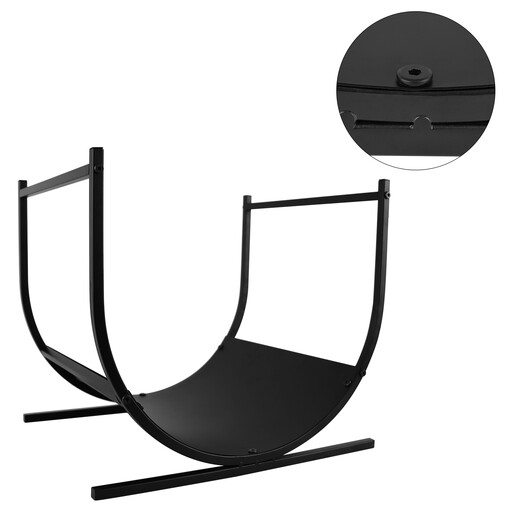
Why it suits this type of user: This compact design is ideal for a first purchase beside a fireplace or stove, or on a covered patio. Its handles make it easy to move when needed.
Its raised frame keeps logs off the ground, while its dimensions of 44.5 × 37.5 × 40 cm help you avoid any surprises when it comes to the space it takes up.
Powder-coated steel, stated capacity of up to 30 kg, integrated handles and assembly hardware included.
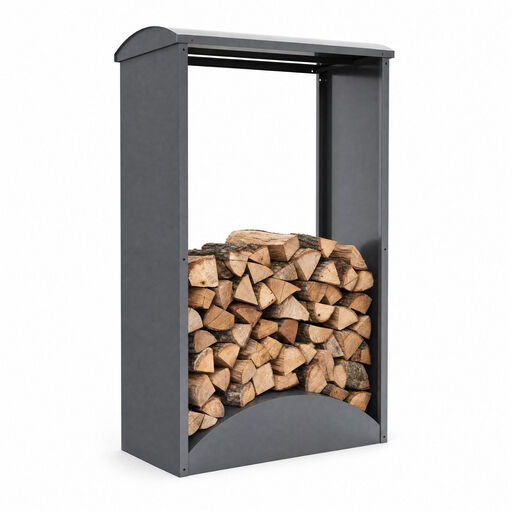
Why it suits this type of user: Its vertical design measures 98.4 × 52.4 × 160 cm, making it easy to fit on a covered patio or in a sheltered outdoor space. It also keeps your logs neatly stacked and on display.
The closed sides keep the stack in place, while the curved roof helps reduce direct exposure to rain. The open front makes loading easy.
Galvanised, powder-coated steel, stated weight of around 26 kg, curved base and roof, and practical vertical storage space.
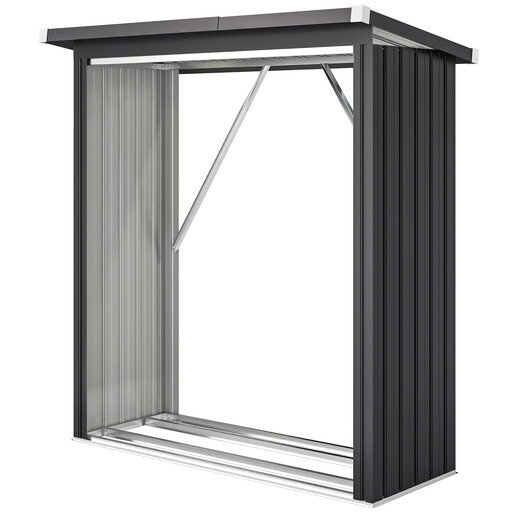
Why it suits this type of user: This large 150 × 66.5 × 150 cm log store is designed to hold a substantial supply outdoors, in the garden or near an outdoor fireplace.
The sloping roof sheds water, while the raised floor helps keep logs away from damp ground. The structure still needs to be installed on a flat, level surface.
Galvanised steel, raised floor, sloping roof and stated footprint of 0.77 m².
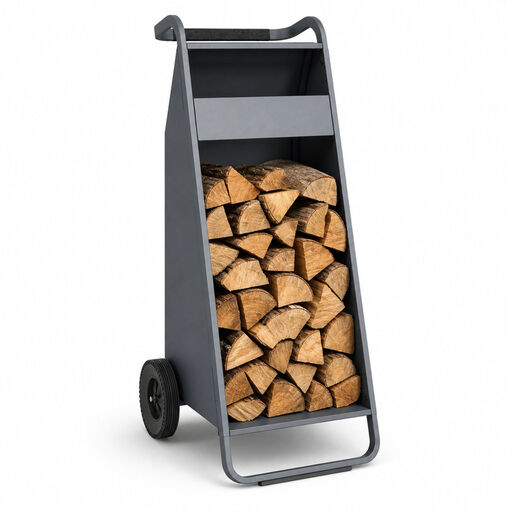
Why it suits this type of user: Its two wheels and padded handle make it easy to move logs between the storage area, fireplace and outdoor hearth.
It saves you from carrying multiple baskets and making repeated trips, while the closed sides keep logs in place as you move them.
Dimensions of 43 × 56 × 116 cm, galvanised, powder-coated steel, two wheels and a central handle.
We’ve put together a comprehensive selection, updated in real time, of products that meet these demanding criteria and European safety standards.
Place it on a flat, well-drained surface, away from areas where water tends to collect. A covered or partly sheltered spot will help protect the logs. Always keep a safe distance from flames, a hot flue or any other heat source.
Raise the logs off the ground, leave space for air to circulate between them and avoid closing off the sides completely. A cover or roof can protect them from rain, but an airtight covering may trap moisture. The logs should also be sufficiently dry before you put them away.
Its lifespan depends on the material, the quality of the joints and how exposed it is to the weather. A galvanised or powder-coated model will retain its appearance and properties for longer if it’s installed correctly and inspected regularly. Touch up scratched areas, tighten the fixings and never exceed the stated maximum load.