
Livraison le jour même ou le lendemain

Qualité garantie

Débloquez vos offres de bienvenue: Livraison GRATUITE | Jusqu'à -80 % | 30 jours d'essai gratuits à JoyPlus
Téléchargez l'application
A dead battery on a cold morning, a flat tire far from any service station... these are stressful situations every driver dreads. Instead of relying on a tow truck or the kindness of another driver, an all-in-one solution allows you to get back on the road completely independently. The battery jump starter with compressor has established itself as the essential piece of kit to keep in your trunk.
This guide is designed to shed light on the essential features of these automotive Swiss Army knives. Our goal: to give you everything you need to choose the emergency jump starter kit that truly fits your vehicle and your needs, all without unnecessary marketing jargon.
Faced with a plethora of options, a few technical criteria are all you need to make the right choice. Here are the key points to check before you buy.
A jump starter's number one mission is to restart your vehicle. This power, measured in amperes (A), is crucial. The higher the peak current, the more power the device will have to start the engine.
The second major advantage of these devices is the integrated air compressor. Its maximum pressure, expressed in PSI (Pounds per Square Inch) or bars, is a key performance indicator. Most models go up to 150 PSI, a value more than sufficient for all passenger vehicle tires.
Also, consider checking the air flow (in L/min), which directly affects the inflation speed. The automatic shut-off function at the desired pressure is a real bonus: it prevents any risk of over-inflation and gives you peace of mind.
A good 4-in-1 multifunction jump starter isn't just for starting and inflating. It's also a true portable car power station. Take a look at its internal battery capacity (in mAh) and the available ports. The presence of USB ports (with fast charging, it's even better) will be a lifesaver for recharging a smartphone or tablet. Some models even offer a 12V DC output to power small equipment like an electric cooler or a car vacuum.
We have selected three models that stand out for their performance and versatility, designed to meet the needs of different types of users.
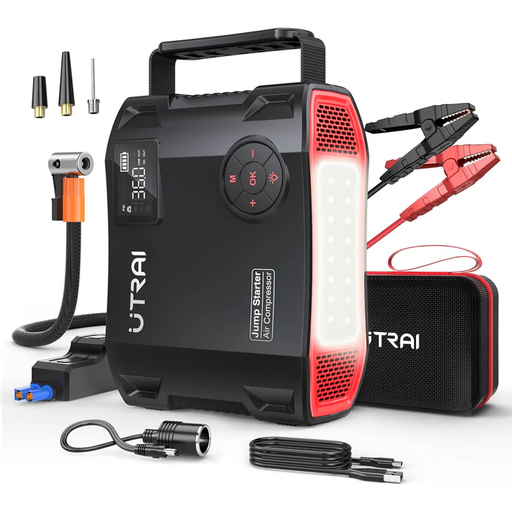
Why it stands out: With its impressive 6000A peak current, the UTRAI JS5 is built for the most extreme situations. Capable of starting any gasoline engine and large diesel engines up to 10.0L, it's the perfect companion for owners of large SUVs, RVs, or commercial vehicles.
Key features:
Who is it for? For drivers of large vehicles (4x4s, RVs, commercial vans) and professionals looking for a super-powerful starting solution and a reliable mobile power source in the field.
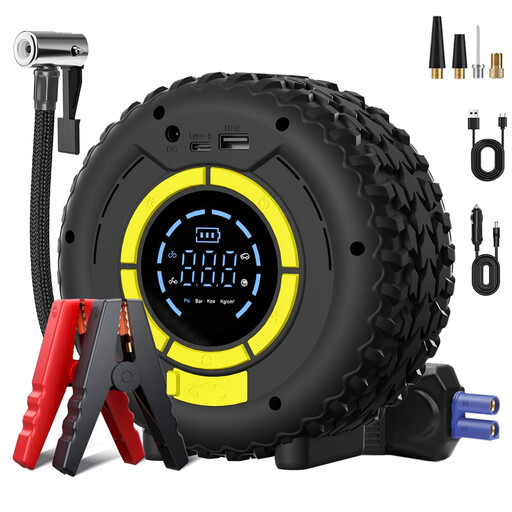
Why it stands out: The COCCKO model focuses on compactness and light weight. Tipping the scales at just 600 grams, it easily fits into a glove box or under a seat. It's the ideal solution for city cars, motorcycles, and drivers who prioritize portability above all else.
Key features:
Who is it for? Perfect for city dwellers, motorcyclists, and anyone looking for a compact and easy-to-store battery booster and tire inflator for daily commutes and minor breakdowns.
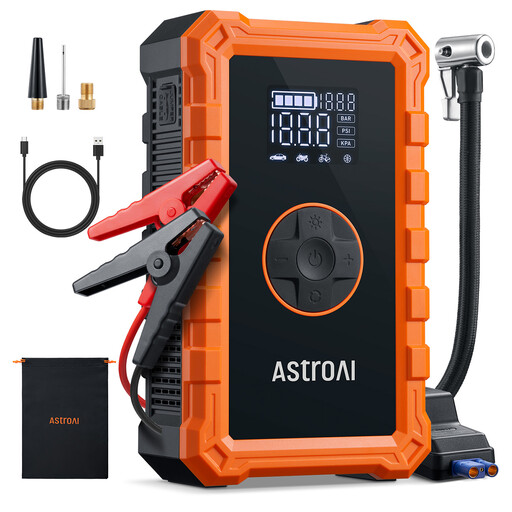
Why it stands out: The AstroAI S8 represents the perfect balance of power, features, and ergonomics. Its large 2.4-inch screen, perfectly readable even in direct sunlight, makes it very intuitive to use. It displays real-time pressure, battery level, and any error codes.
Key features:
Who is it for? The driver of a family car, sedan, or mid-size SUV. It's the sensible choice for anyone looking for a reliable, easy-to-use, and well-designed device for the whole family's safety.
If these models don't check all your boxes or if you're looking for a more specific device, like a simple portable car air compressor without a jump-starting function, we've got you covered.
Discover our complete selection to find the equipment that will accompany you on the road: Best Portable Tire Inflators and Air Compressors.
1. How often should you recharge a battery jump starter? Even without use, it's advisable to recharge it every 3 to 4 months. This helps preserve the battery's lifespan and ensures it will be fully operational when you need it. Rest assured, most models have a very low self-discharge rate, but this minimal maintenance is good practice.
2. Is a jump starter compatible with all vehicles? Yes, the vast majority of jump starters are designed for 12V systems, which are found in almost all cars, motorcycles, and recreational vehicles. The only real criterion to follow is the starting power (in A), which must be appropriate for the engine size and type (gasoline or diesel) of your vehicle, as explained above.
3. Is using a jump starter risky for my car's electronics? Absolutely not. Modern jump starters integrate multiple safety systems (usually between 8 and 10). They protect against reverse polarity, short circuits, overheating, or over-voltage. In case of incorrect handling, an audible or visual alarm will alert you immediately. Their use is therefore completely safe, for both you and your vehicle.