
Livraison le jour même ou le lendemain

Qualité garantie

Débloquez vos offres de bienvenue: Livraison GRATUITE | Jusqu'à -80 % | 30 jours d'essai gratuits à JoyPlus
Téléchargez l'application
You turn the key, hear dead silence, and then that dreaded clicking sound... The unmistakable sign of a dead battery. Gone are the days of waiting for a tow truck or a good Samaritan willing to share their battery. The battery booster, also known as a portable jump starter, has become an essential safety accessory. Compact and incredibly simple to use, it restores your independence and gets you back on the road in minutes.
With an overwhelming number of options on the market, choosing the right model can quickly become a headache. This guide is here to shed light on the criteria that matter and present our top picks to help you make the right choice.
Before you buy, let's review the three key criteria to ensure your purchase perfectly matches your needs.
The number one criterion is its ability to deliver enough peak current (in amps, A) to start your engine.
A modern emergency starter does more than just wake up your battery. Its extra features can make a real difference:
A good booster must be foolproof, even in a novice's hands. Opt for models with built-in protections, a standard feature on quality devices. Essential safety features include protection against:
Sturdy, well-insulated alligator clips and a clear screen displaying the charge level are also hallmarks of simplicity and safety.
Here are three models that caught our eye, each catering to specific needs.
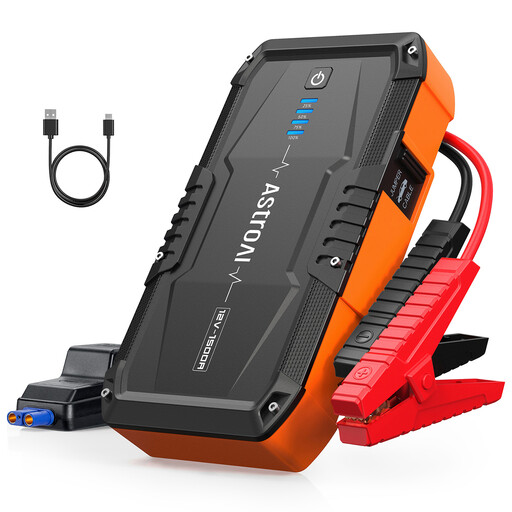
Its Standout Feature This model is a champion of performance for its size. Its secret weapon? A manual "BOOST" mode, capable of reviving even the most stubborn batteries (voltage below 9V), where conventional boosters would give up.
Key Features
Who is it for? For drivers of cars, SUVs, and motorcycles who want a reliable, compact portable starter with rock-solid safety features for desperate situations.
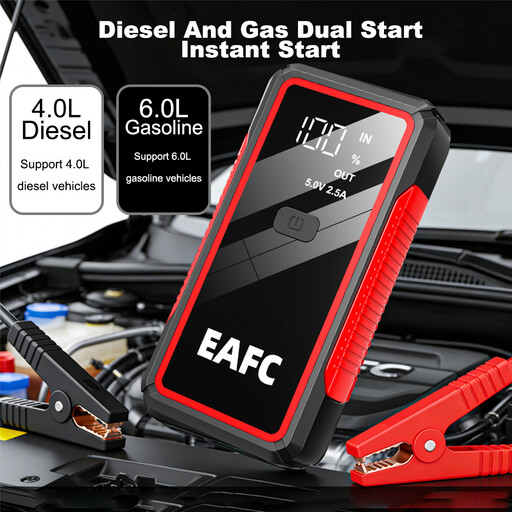
Its Standout Feature With its 2,000A peak current, this EAFC model targets owners of more power-hungry vehicles, such as large-displacement gasoline engines and sizable diesels. Its wide operating temperature range makes it a reliable ally for tackling extreme climates.
Key Features
Who is it for? Ideal for owners of SUVs, 4x4s, or utility vehicles, and for anyone living in regions with unpredictable weather.
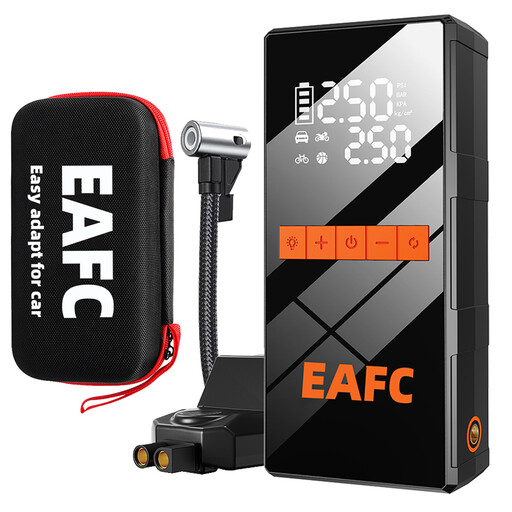
Its Standout Feature This is the driver's Swiss Army knife. In addition to its function as an emergency starter, it includes an air compressor capable of inflating a tire up to 150 PSI. The all-in-one solution for handling any roadside emergency.
Key Features
Who is it for? For prepared drivers, road trip fans, and campers who want a single device to manage both dead batteries and flat tires.
An emergency kit isn't just for jump-starting. For working on your car at night or in a poorly lit car park, good lighting is essential for your safety. Consider completing your kit with a high-performance work light.
? Discover our selection of 12V lights and other lighting accessories.
Peak Amperage (or Peak Amps) is the maximum burst of power the booster can send in a fraction of a second to jolt the starter motor. Cranking Amps is the current it can sustain for several seconds to turn the engine over. While both numbers matter, it's primarily the peak amperage that determines compatibility with your engine size.
Most modern lithium boosters have a very low self-discharge rate. They can retain over 80% of their charge for 6 to 12 months. As a precaution, we recommend checking and recharging your device every 3 to 4 months. Better safe than sorry!
Yes, but it depends on the booster. Standard models need to detect a minimum residual voltage to activate. When faced with a completely dead battery (near 0V), they are powerless. This is where models like the AstroAI S8 come in, with their manual override ("BOOST") mode that sends current "blindly." For this procedure, follow the manufacturer's instructions meticulously.