
Livraison le jour même ou le lendemain

Qualité garantie

Débloquez vos offres de bienvenue: Livraison GRATUITE | Jusqu'à -80 % | 30 jours d'essai gratuits à JoyPlus
Téléchargez l'application
A cold winter morning, and then... silence. Instead of your engine's familiar roar, you hear a single "click." A dead battery?— the scenario every driver dreads, a synonym for hassle, delays, and calls for help. Fortunately, there's a simple solution to get you back on the road: the battery jump starter.
This compact device has become an essential item in many drivers' glove compartments. Say goodbye to jumper cables and relying on a second vehicle! A portable car starter lets you restart your engine in minutes, no matter where you are.
With an overwhelming number of options on the market, it can be hard to know where to start. This guide breaks down the essential criteria to help you choose the perfect model for your needs, without any unnecessary technical jargon.
Before diving into our top picks, here are the key points to check to make the right choice.
A jump starter's number one criterion is its power, measured in amperes (A). What we're interested in is the peak current (or peak amps): this is the maximum burst of energy the device can deliver in a short instant to start the engine.
In any case, check the compatibility specified by the manufacturer (often in terms of engine displacement in litres) to ensure the jump starter is properly sized for your vehicle.
Modern jump starters are true Swiss Army knives. A good multifunction starter often includes several very practical tools for the road:
A good portable battery starter must include comprehensive protection against short circuits, overloads, reverse polarity, and overheating. So-called "smart" clamps, which signal any connection errors, are an essential guarantee of peace of mind.
The battery type also plays a role in safety and durability. While lithium-ion batteries are the most common, new technologies like sodium-ion (Na-ion) are emerging. Their advantages? Impressive stability in extreme temperatures and an extended lifespan.
We've scoured the market and selected three models that stand out from the crowd, each tailored to a specific user profile.
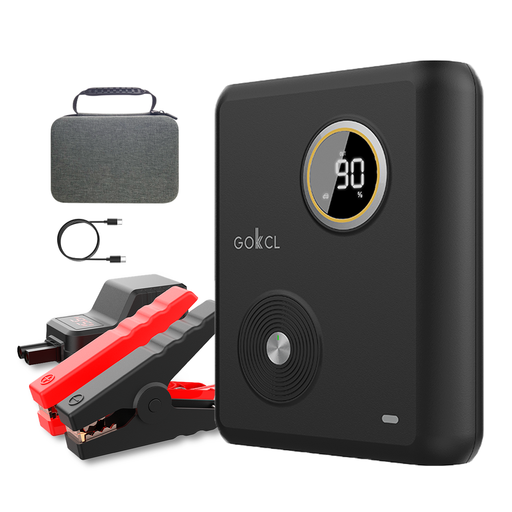
Why it stands out: The GK03 is a cut above the rest thanks to its sodium-ion battery. This technology gives it exceptional resistance to extreme temperatures (from -40°C to 80°C), where conventional lithium batteries show their limitations. Its very low self-discharge rate allows it to remain operational for years, even when forgotten in the trunk.
Advantages:
Who is it for? Ideal for those who leave their jump starter in their car permanently, especially in regions with extreme climates. It's the choice for peace of mind for anyone who prioritises safety and durability above all else.
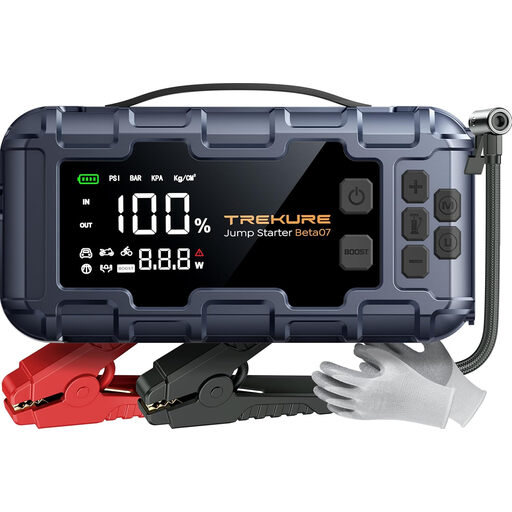
Why it stands out: The TREKURE Beta07 is the ultimate Swiss Army knife for drivers. With a massive 6000A peak current and a 160 PSI air compressor, it tackles the two most common roadside emergencies: a dead battery and a flat tyre.
Advantages:
Who is it for? The perfect ally for owners of large SUVs, RVs, or commercial vehicles. It's also the ideal road trip companion for long journeys, offering complete peace of mind thanks to its versatility.
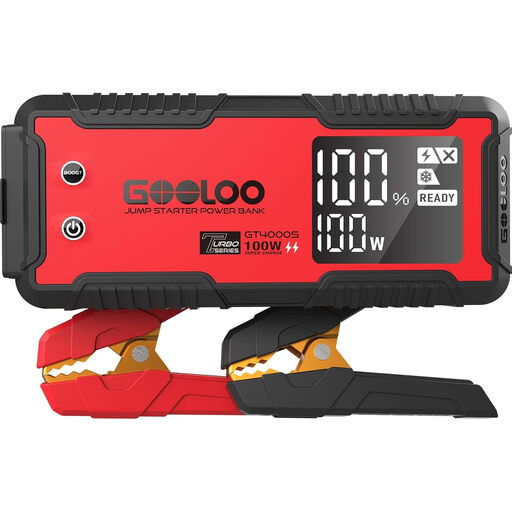
Why it stands out: The GOOLOO GT4000S's ace up its sleeve is its 100W two-way ultra-fast charging. Not only can it charge a laptop at full speed, but it can also fully recharge itself in just over an hour. Even better: just a few minutes plugged into the mains is enough to get the power you need for an emergency jump-start.
Advantages:
Who is it for? For those in a hurry and anyone looking for maximum efficiency. Its express charging and high power make it an ultra-reliable tool for heavy use or for managing multiple vehicles, including the most powerful ones.
Does your vehicle have specific needs, or do you simply want to compare other models? Take a look at our full catalogue to find the perfect fit for your requirements.
? Discover Our Full Range of Rechargeable Portable Starters
As a general rule, it all depends on your engine. For a petrol city car, 1500A is enough. For a diesel car jump starter or a large SUV, aim for at least 2500A to 4000A. When in doubt, choosing a model that's slightly more powerful than you need is a welcome precaution, especially if you live in a cold region.
It depends on its battery technology and the climate in your region. Models like the GOKKCL GK03, with their sodium-ion battery, are designed to withstand extreme temperatures (from -40°C to 80°C) and can be left in the trunk all year round without worry. For more conventional lithium jump starters, it's best to follow the manufacturer's recommendations and avoid letting them bake inside the car in the middle of summer.
Most manufacturers recommend recharging a lithium jump starter every 3 to 6 months to maintain its battery health. However, models with very low self-discharge rates, like those based on sodium-ion, can hold a charge for several years. The best practice: check the battery level before a long trip or as winter approaches.