
Livraison le jour même ou le lendemain

Qualité garantie

Débloquez vos offres de bienvenue: Livraison GRATUITE | Jusqu'à -80 % | 30 jours d'essai gratuits à JoyPlus
Téléchargez l'application
A dead battery?: one of the most dreaded roadside emergencies for any driver. Getting stranded on a freezing winter morning or on the way back from vacation… a hassle we'd all rather avoid. Fortunately, a battery jump starter is the perfect solution to get you back on the road independently, without having to call a tow truck or a friend for a jump.
The problem?: the market is flooded with marketing promises and confusing spec sheets. Between the sky-high power figures and gimmicky features, the risk of making the wrong choice is high. As a Product Expert at Joybuy, my mission is to help you cut through the noise. Let's break down the pitfalls to avoid and the essential criteria for choosing a reliable emergency jump starter that's truly right for your vehicle.
Purchasing a piece of safety equipment like a battery starter shouldn't be taken lightly. Here are the most common mistakes that lead directly to buyer's remorse.
Manufacturers love to highlight astronomical Peak Amp figures?: 3000?A, 4000?A, or even 6000?A. Be careful, as this is often a marketing trap. While this number indicates the maximum power the device can deliver for a split second, it says nothing about its actual ability to start an engine. The only metric that truly matters is the Starting Current (or Cranking Amps), which is the continuous power needed to turn the engine over. A high peak current absolutely does not guarantee sufficient starting current, especially for a jump starter intended for large-displacement petrol and diesel engines.
Most portable jump starters use lithium-ion batteries. While they are lightweight and compact, their performance is highly sensitive to extreme temperatures. Left in a car in the middle of summer or during a polar vortex, they can lose a significant portion of their effectiveness, or even refuse to work right when you need them most. Worse, prolonged exposure to high heat poses a significant safety risk.
A portable battery jump starter designed for a small petrol city car will be completely useless for starting a diesel SUV or a motorhome. The displacement (in litres) and fuel type of your vehicle are decisive factors. A diesel engine, for example, requires much more starting torque than a petrol engine of the same size. Choosing an undersized model is simply throwing your money away.
To avoid these pitfalls, focus on the technical specifications that truly matter to ensure the performance and safety of your jump starter.
Forget peak current—it's a marketing metric. Instead, look at the engine compatibility stated by the manufacturer. Here are some reliable benchmarks?:
The capacity, expressed in milliampere-hours (mAh), gives an idea of its battery life, especially for its function as a power bank. But the underlying technology is an equally crucial criterion.
A battery jump starter with a compressor is an excellent choice if you travel often. It allows you to top up your tyre pressure anywhere. Make sure the maximum pressure (in PSI or Bars) is sufficient for your vehicle. Other truly useful features include?:
To help you make a clear choice, we've selected a few models that suit different user profiles, based on our performance and safety criteria.
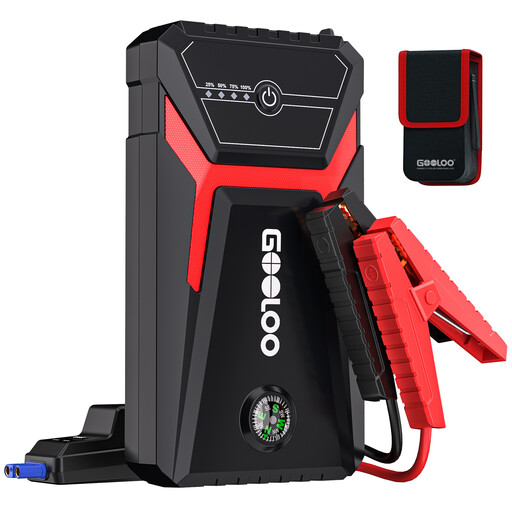
Why it's the right fit : Perfect for drivers of city cars, sedans, or small SUVs (both petrol and diesel) who want a simple, compact, and reliable emergency solution without breaking the bank. Its small footprint allows it to be easily stored in the glove box.
It clearly states its compatibility (up to 6.0 L petrol / 4.0 L diesel), which prevents the risk of choosing an undersized model for the majority of cars on the road.
It features 10 levels of protection (spark-proof, reverse polarity, etc.) and a 3-mode LED light. An excellent balance of performance and ease of use.

Why it's the right fit : Ideal for owners of large SUVs, motorhomes, or commercial vans, as well as for families who love road trips. It's the driver's Swiss Army knife, combining high starting power with a genuinely practical compressor.
Its power is built for large engines (up to 9.0 L petrol / 8.0 L diesel), saving it from the "jack-of-all-trades, master-of-none" trap. The 150 PSI compressor is a truly useful feature, not a gimmick.
Its digital compressor with auto-shutoff, 5 preset modes, and multiple nozzles make it highly versatile. The LCD screen clearly displays the remaining battery life and real-time tyre pressure.

Why it's the right fit : For those who want to be able to leave their jump starter in the car all year round with complete peace of mind. This model prioritises absolute safety, durability, and the serenity that comes with cutting-edge technology.
It directly addresses the Achilles' heel of lithium batteries : temperature. Its sodium-ion technology ensures it operates from -40 °C to 80 °C, making it perfectly safe to store in a vehicle, regardless of the season.
Its self-discharge is virtually non-existent (the manufacturer claims it's ready to use even after 5 years of storage) and its lifespan is record-breaking (up to 6000 cycles). This is a true long-term investment.
Explore our full selection of products that meet our strict criteria for performance and safety.
Don't rely solely on peak current. The most reliable method is to check the compatibility with your engine's displacement. Here are some benchmarks?:
It all depends on its battery technology. For a lithium-ion model, it is strongly advised not to leave it in the cabin during extreme heat or prolonged freezes. On the other hand, sodium-ion models are designed for this?: manufacturers claim a much wider storage temperature range (e.g., -40?°C to 80?°C), making them ideal for staying in the vehicle year-round.
Its longevity depends on the number of charge/discharge cycles and its maintenance. A good lithium-ion model can last several years if it is recharged every 3 to 6 months to preserve its battery. According to manufacturer data, sodium-ion models promise a much longer lifespan (several thousand cycles) and require almost no maintenance thanks to their very low self-discharge rate.