
Livraison le jour même ou le lendemain

Qualité garantie

Débloquez vos offres de bienvenue: Livraison GRATUITE | Jusqu'à -80 % | 30 jours d'essai gratuits à JoyPlus
Téléchargez l'application
A dead battery is every driver's nightmare. Whether it's on a frosty winter morning or after a long parking spell, that dreaded silence when you turn the ignition key is a terrible sign. A battery booster, also known as a jump starter, is the modern solution to avoid relying on a tow truck or a kind stranger with jumper cables.
The problem is, the market is flooded with models making tempting promises, and it's easy to get lost. As the Head of the Tech section, my mission is to cut through the noise for you. Here are the pitfalls to avoid and the criteria that really matter to make the right choice.
To make the right choice, focus on the features that truly make a difference in performance and safety.
Forget peak amps. The real criterion is engine compatibility. A reputable product page will always state the maximum engine displacement it can handle for both gasoline and diesel engines (e.g., "up to 8.0L gas and 6.0L diesel"). This is the most reliable indicator of whether the booster will suit your 12V vehicle. Generally, a 1500 to 2000 A model is sufficient for most passenger cars. For large SUVs, vans, or diesel RVs, aim for 3000 A or more.
Expressed in milliampere-hours (mAh), the internal battery's capacity determines the booster's autonomy. The higher it is, the more starting attempts you can make or the more you can charge your portable devices. Most models also double as a power bank thanks to their USB ports.
The most versatile ones even integrate an air compressor to top up your tires. A real bonus for long trips or outdoor adventures.
The quality of the clamps is paramount. Opt for robust, well-insulated clamps with copper cables thick enough to ensure good conductivity. The smart clamps' housing must integrate several layers of protection:
A visual (LED) or audible indicator that confirms a correct connection is a guarantee of peace of mind and ease of use.
Rather than an endless list, we've selected three models that meet specific needs, applying our strict performance and safety criteria.
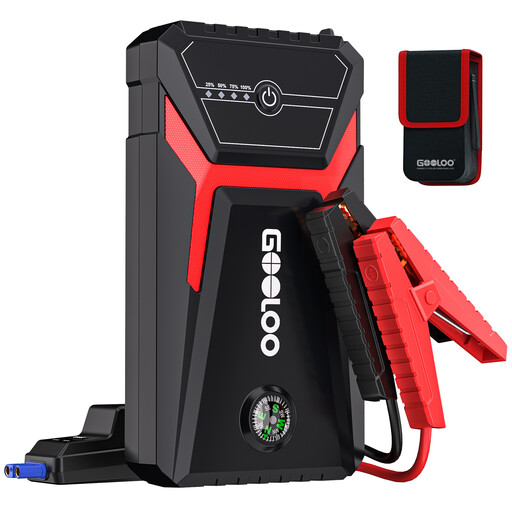
Why we chose it: This model is an excellent entry-level device. Compact and lightweight, it slips into the glove box and delivers enough power for most gasoline city cars and sedans (up to 6.0L) or small diesel engines (up to 4.0L).
It doesn't try to bluff with its power rating. Its 1500 A is paired with realistic engine sizes, avoiding the "universal" false promise pitfall.
Its excellent size-to-performance ratio makes it the perfect tool for daily commutes. It naturally includes all essential safety protections.

Why we chose it: This is the go-to model for owners of large SUVs, vans, RVs, or vehicles with powerful diesel engines (up to 10.0L). Its 4000 A power, coupled with a "BOOST" function to wake up even the most stubborn batteries, makes it a powerful ally in critical situations.
It is aimed squarely at the most power-hungry vehicles, where "universal" models would give up. Its all-metal clamps are built for durability.
Its massive power reserve and "BOOST" function provide true peace of mind, even when facing the most demanding engines in freezing weather.
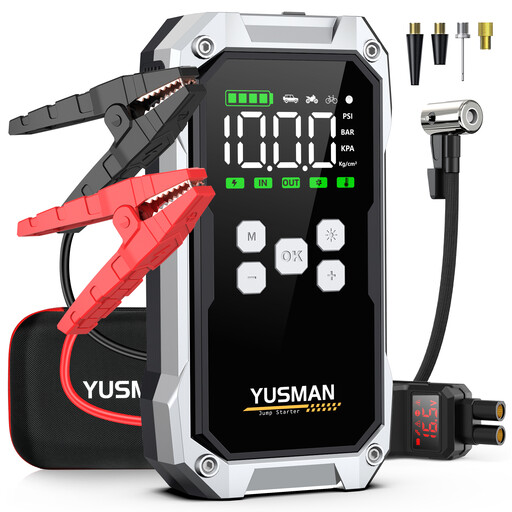
Why we chose it: Much more than a simple booster, this device includes a 150 PSI air compressor. It's the perfect tool for road trip enthusiasts, campers, or anyone looking for an all-in-one solution.
Its larger size is justified by a genuinely useful feature. No gimmicks here, just a 2-in-1 solution that combines jump-starting with tire maintenance.
The combination of a heavy-duty booster (5000 A) and an air compressor with a digital display makes it the ultimate safety and convenience tool for the road.
Our complete selection brings together the best models on the market, all tested and approved according to our performance and safety criteria.
Most modern boosters use a lithium battery with a lifespan of 3 to 5 years, depending on quality and usage. The best practice to preserve its longevity? Recharge it every 2 to 3 months, even if you don't use it. This prevents a deep discharge, which can permanently damage the battery.
Yes, but with a few precautions. They are designed to withstand wide temperature ranges (often from -20°C to +60°C / -4°F to 140°F). However, avoid leaving it in direct sunlight on the dashboard during a heatwave. In winter, the cold may slightly reduce its charge, but it will remain fully operational.
Not necessarily. An oversized booster for your car won't be any more effective, but it will be more expensive and bulkier. The key is to choose a model that is appropriate for your vehicle's engine displacement and type. Rely on the manufacturer's recommendations ("for gas engines up to X liters") to find the best performance-to-price ratio.