
Livraison le jour même ou le lendemain

Qualité garantie

Débloquez vos offres de bienvenue: Livraison GRATUITE | Jusqu'à -80 % | 30 jours d'essai gratuits à JoyPlus
Téléchargez l'application
A dead battery: every driver's nightmare. A cold winter morning, the key turns, and... nothing. It's a scenario no one wants to experience. Fortunately, a modern car battery jump starter can spare you the endless wait and the hefty bill from a tow truck. But be warned: the market is a jungle of devices with tempting promises and often opaque technical specifications. As the head of product selection at Joybuy, I'm here to help you see through the noise.
Before you jump on the first portable car starter you see, here are the 3 pitfalls to avoid to ensure you don't regret your purchase?:
To make the right choice, rely on facts, not marketing hype.
To choose a jump starter that won't let you down, three technical criteria are essential.
Don't be blinded by peak amps. The only true performance indicator is the starting amperage (or cranking amps), which measures the power the booster can deliver continuously for several seconds. This sustained power is what's needed to start an engine, especially in cold weather. A powerful jump starter must above all state a clear compatibility with your engine's displacement—a much more reliable piece of information than an out-of-context peak number.
With their higher compression ratio, diesel engines are much more power-hungry at startup than gasoline engines of equivalent displacement. A diesel-compatible jump starter must therefore be specifically sized to provide this extra power. Always check the maximum compatibility indicated by the manufacturer, expressed in litres (L) for gasoline and diesel engines (e.g., "up to 8.0L Gas / 6.0L Diesel"). Choosing an undersized model is a surefire way to fail when you need it most.
A portable car jump starter worthy of the name is always equipped with smart clamps. These integrate multiple electronic protections to prevent accidents. The most important ones are?:
These safeguards make the operation simple and safe, even for a complete novice in mechanics.
Instead of an endless list, here is our targeted selection, designed for different user profiles and based on strict performance and safety criteria.
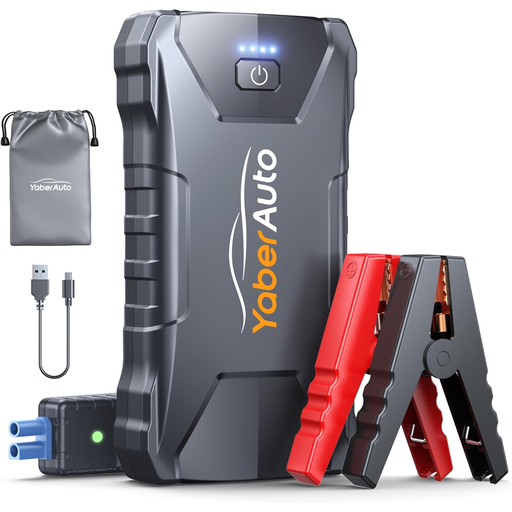
Our take: The ideal companion for drivers of city cars, sedans, or small SUVs. Compact enough to slip into the glove box, it offers sufficient power for the majority of vehicles on the road. It also doubles as a portable power bank to charge a dead smartphone.
It doesn't just rely on a peak number. It clearly specifies its compatibility (up to 7.0L Gas / 5.5L Diesel), which is practical and verifiable information for the user.
Its extreme compactness, without sacrificing essential safety features. A discreet and reliable travel companion.
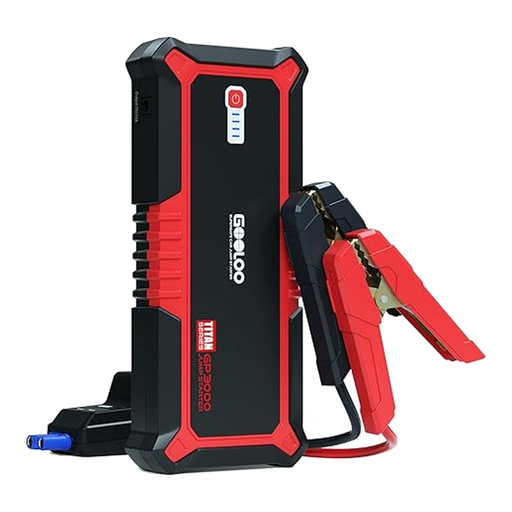
Our take: Built for large engines: SUVs, vans, or large diesel sedans. Its "BOOST" function is a real plus for forcing a start on deeply discharged batteries, where standard jump starters would give up.
It focuses on a concrete function (the 'BOOST' mode) rather than just a number. Its compatibility with large engines (9.0L Gas / 7.0L Diesel) is clearly defined.
Its large power reserve and its ability to start batteries even at very low voltage. A safe bet for the most power-hungry vehicles.
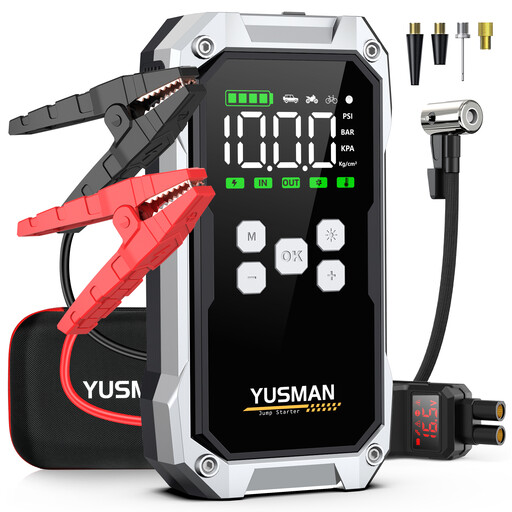
Our take: The ally of road-trippers, campers, and anyone who wants an all-in-one tool. Its integrated 150 PSI air compressor allows you to manage tyre pressure, inflate an air mattress or sports equipment, in addition to its main function as a jump starter.
It turns the "add-on feature" into a real asset. The compressor, with its digital display and automatic shut-off, is a useful and well-integrated function, not just a gimmick.
Versatility. It's the Swiss Army knife for the modern driver: jump starter, compressor, power bank, and flashlight. A single device for multiple emergencies or leisure activities.
Discover our full selection of jump starters that meet our criteria for performance and safety.
A lithium-ion battery jump starter typically has a lifespan of 3 to 5 years. This largely depends on the frequency of use, storage conditions, and maintenance. To preserve its battery, remember to recharge it every 2 to 3 months, even when not in use.
Yes, most models are designed for a wide temperature range (often from -20°C to +60°C). However, it is advisable to check the manufacturer's specifications. Be aware that prolonged exposure to extreme heat (behind a windscreen in mid-summer) or polar cold can degrade its performance and battery life.
It all depends on your engine's displacement. A 2000A jump starter is generally suitable for diesel engines up to 5.0L or 6.0L. However, this is only an estimate. The only reliable criterion remains the compatibility stated by the manufacturer (in litres of displacement). Always rely on this data to avoid making a mistake.