
Livraison le jour même ou le lendemain

Qualité garantie

Débloquez vos offres de bienvenue: Livraison GRATUITE | Jusqu'à -80 % | 30 jours d'essai gratuits à JoyPlus
Téléchargez l'application
A dead battery: every driver's nightmare. Whether it's on a freezing winter morning or because you left the headlights on, being stranded is never fun. That's where the portable battery booster (or jump starter) comes in: the life-saving solution to get you back on the road independently, without waiting for a tow truck or help from another driver.
The only problem? The market is flooded with models making often-misleading marketing claims. As the Head of Product Recommendations at Joybuy, I'm here to break down the spec sheets and help you avoid the most common traps.
To avoid getting ripped off, focus on the features that really count. This is what will determine if a battery jump starter is truly right for your vehicle and your needs.
Instead of the marketing-driven peak current figure, look for the advertised compatibility with your engine's displacement (in litres). A reputable manufacturer will always clearly state which engines (petrol/diesel and what size) their device is designed for.
A booster is also a large external battery. To compare their real capacity, rely on Watt-hours (Wh), a much more reliable unit than mAh. Wh represents the total amount of energy the device can store and deliver.
Most models also serve as a jump starter power bank thanks to their USB ports, perfect for recharging a smartphone or tablet. The most comprehensive ones even integrate a jump starter with an air compressor, an incredibly handy feature for topping up your tyre pressure anywhere, anytime.
A good car jump starter must include several protection systems to prevent a disaster. Check that it has at least the following safety features:
Finally, sturdy, well-insulated clamps (ideally 100% metal) and sufficiently thick cables are a guarantee of safety and durability.
To help you see how these criteria apply in practice, here is a selection of products suited for different types of users.
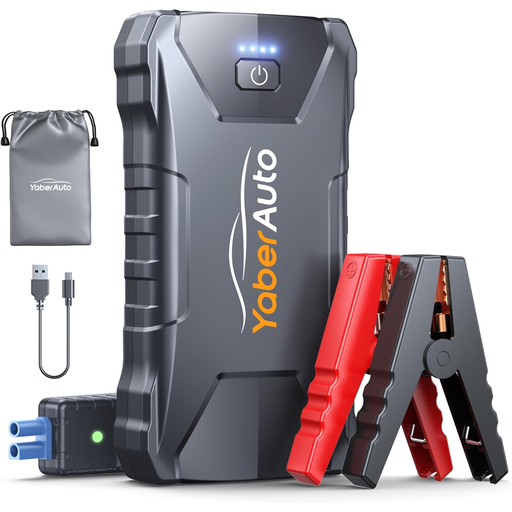
Why we love it: Perfect for drivers of city cars or compact sedans who want a reliable backup solution without breaking the bank. Its ultra-compact size slips right into the glove box, so it's always within reach.
It doesn't over-promise. Its power is calibrated for petrol engines up to 7.0L and diesel engines up to 5.5L, covering the vast majority of cars on the road. The focus is on its 10 safety protections, a crucial feature often sacrificed for a lower price.
Its feather-light weight (340g) and slim design make it one of the most portable models on the market, without compromising on essential safety features.

Why we love it: Built for owners of large SUVs, commercial vans, RVs, or vehicles with powerful diesel engines (up to 10.0L). It's the ultimate robust tool for those who demand maximum power and rock-solid reliability.
Here, the 4000A peak current isn't just for show: it's backed by its ability to start any petrol engine and diesel engines up to 10.0L. It bypasses the poor-quality trap with 100% metal clamps and a reinforced, built-to-last casing.
Its raw power and ultra-rugged build. It also features a "BOOST" mode to force-start stubborn or completely dead batteries.
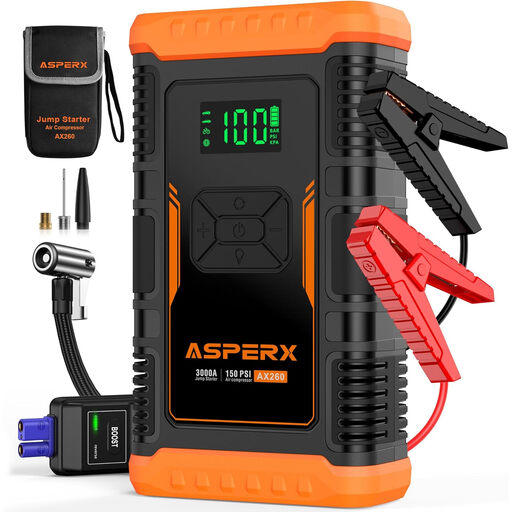
Why we love it: The driver's Swiss Army knife, for those who are heading out on an adventure or simply want to be prepared for anything. It combines a powerful jump starter, a 150 PSI air compressor, a flashlight, and a power bank.
It avoids the "gimmick" pitfall by integrating a genuinely high-performance air compressor (35 L/min) with an auto-stop function—a truly useful and well-designed feature. Its 3000A power is still suitable for large engines (10L petrol / 8L diesel), proving that versatility doesn't come at the expense of its primary function.
The ultimate in versatility: a jump starter with a compressor that handles both dead batteries and under-inflated tyres. The all-in-one, without compromise.
We have curated a full range of jump starters that meet our quality criteria and safety standards.
On average, a lithium jump starter has a lifespan of 3 to 5 years. It all depends on the frequency of use and, most importantly, its maintenance. To preserve its internal battery, it's crucial to recharge it every 2 to 3 months, even if it's just sitting in your trunk.
Yes, most models are designed for this. They can typically withstand temperatures from -20°C to 60°C (-4°F to 140°F). As a precaution, during a heatwave or deep freeze, it's better to keep it in the passenger cabin rather than the trunk, where temperature swings are more extreme.
No, that would be overkill. Such a high peak current is reserved for large diesel engines or commercial vans. For a city car or petrol sedan, a model with a peak current between 1500A and 2000A is more than enough. There's no need to pay more for power you'll never use.