
Livraison le jour même ou le lendemain

Qualité garantie

Débloquez vos offres de bienvenue: Livraison GRATUITE | Jusqu'à -80 % | 30 jours d'essai gratuits à JoyPlus
Téléchargez l'application
A dead battery: one of the most common and frustrating hassles for any driver. On a frigid winter morning or just after returning from holiday, that dreaded "click" from an ignition that refuses to turn over is enough to ruin your day. Fortunately, traditional jumper cables, which require finding a second vehicle, have now been dethroned by a much smarter solution: the battery jump starter.
Compact, powerful, and versatile, this device is your ticket to peace of mind. But with a crowded market, how do you find your way? To help you make the right choice, we're breaking down the criteria that really matter and presenting our selection of the best models available today.
Before you settle on a model, let's review the features that truly make a difference. Here are the three essential points to check to find the device perfectly suited to your needs.
This is THE number one criterion. Expressed in amps (A), the peak power determines the jump starter's ability to deliver the necessary juice to start your engine. Logically, a jump starter for a diesel engine or a large displacement vehicle (SUV, utility van, RV) will need to be much beefier than a model for a small petrol city car.
A modern car starter does more than just wake up your battery. Most models are true Swiss Army knives for drivers, packing a range of handy features.
A good jump starter is, above all, a safe device. It must include multiple protections to prevent any risk of damage to your car's electronics or the jump starter itself. Make sure it is protected against short circuits, reverse polarity, overcharging, and overheating.
The battery technology also plays a role. While most models run on lithium-polymer, new technologies like sodium-ion are emerging. Their advantages? A wider operating temperature range and enhanced safety.
After poring over spec sheets and reviews, here are the models that caught our eye, each tailored to a specific user profile.
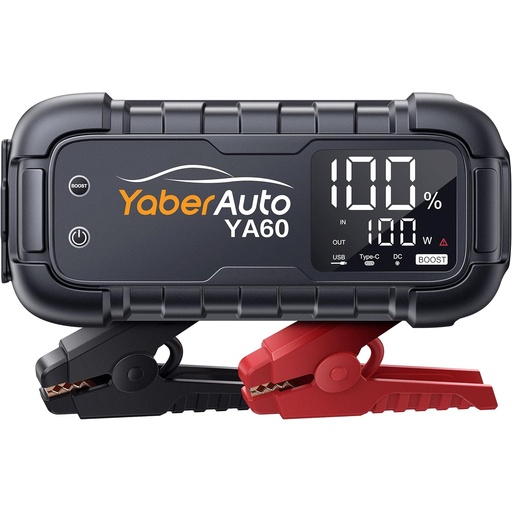
Why it stands out The YaberAuto YA60 impresses right out of the box with its 8,000 A peak power, enough to start any petrol engine and diesel engines up to 12.0L. Its 65W two-way fast charging feature is a real game-changer: it recharges itself in 1.5 hours and can power a laptop at full speed.
The pros
Who is it for? For owners of large SUVs, utility vans, RVs, or high-displacement diesel vehicles. It's also the perfect choice for nomadic tech enthusiasts who need a fast and powerful source for their laptop and other gadgets.
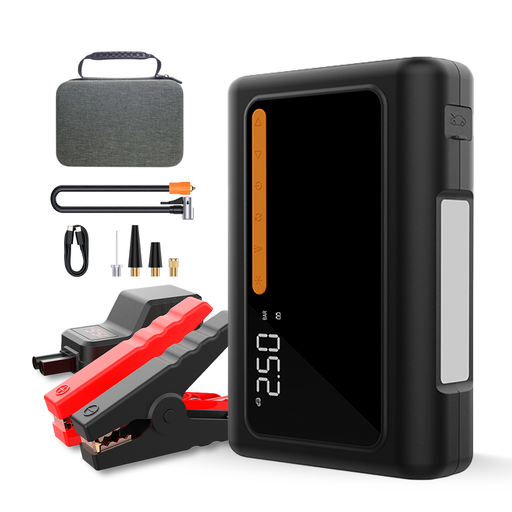
Why it stands out This model stands out from the crowd thanks to its sodium-ion battery technology. Unlike lithium, it poses no risk of thermal runaway (and therefore no fire hazard), making it intrinsically safer. It withstands extreme temperatures (from -40°C to 80°C) and its self-discharge rate is so low that it remains operational even after years stored in the boot.
The pros
Who is it for? For the driver who seeks peace of mind above all else. It's the ideal jump-starting aid for those living in regions with extreme climates or who simply want a reliable, maintenance-free device to keep permanently in their boot.
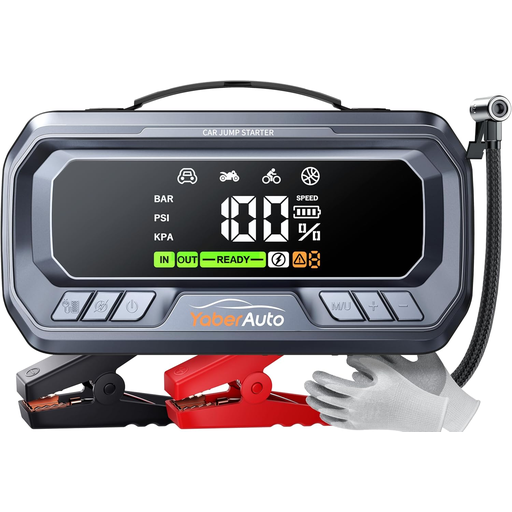
Why it stands out The YA90 is the perfect example of a multifunctional device. It combines a powerful 6,500 A battery starter, a high-performance 160 PSI jump starter with compressor, and a large 3.3-inch LCD screen for easy control. Its exclusive continuous DC output feature is a real bonus, allowing you to power devices even when the engine is off.
The pros
Who is it for? The ideal road trip companion for fans of road trips, camping, and anyone who wants an all-in-one tool for maintenance and unexpected situations. Its versatility makes it an excellent investment for absolute peace of mind on the road.
If these models aren't exactly what you're looking for, or if you're simply curious, take a look at our selection of gadgets for husbands. You'll find a treasure trove of ideas for tools and equipment for the car and everyday life.
A diesel engine is more demanding to start, especially in winter, due to its higher compression. For common engines (up to 3.0L), opt for a model with at least 1,500 A to 2,000 A. For larger vehicles (utility vans, 4x4s, RVs), aim for 3,000 A or more to be on the safe side.
Yes, but with some caveats depending on the technology. Sodium-ion models like the GOKKCL GK01 are designed for this: they can withstand temperatures from -40°C to 80°C and can be left in the boot without any issues. For lithium models, it's a bit trickier. It's best to avoid leaving them in a hot car during summer, as extreme heat can degrade their battery over time. Always check the manufacturer's recommendations.
Thanks to built-in protections, the process is simple and risk-free if you follow the steps. Here is the standard procedure:
In any case, reading the user manual before the first use is never a bad idea.