
Livraison le jour même ou le lendemain

Qualité garantie

Débloquez vos offres de bienvenue: Livraison GRATUITE | Jusqu'à -80 % | 30 jours d'essai gratuits à JoyPlus
Téléchargez l'application
Dead silence. That's the only sound you hear after turning the ignition key. Your car battery is flat, and you're stranded, whether in your own car park or in the middle of nowhere. Fortunately, there's a solution to this frustrating and anxiety-inducing situation: a simple and compact device, the battery jump starter.
A far cry from bulky jumper cables that require a second vehicle, the portable jump starter is a modern, self-contained, and much safer alternative. But with an overwhelming number of options on the market, how do you find your way? This guide is here to clear things up and help you choose the perfect model for your needs. Our goal: to make dead batteries nothing more than a bad memory.
Before diving into our selection, let's review the essential criteria to ensure you make the right choice.
The starting power, expressed in peak amps (A), is arguably the most important criterion. This value determines the booster's ability to start your engine.
Always check the petrol/diesel compatibility and the maximum engine size supported by the booster—information that is always provided by the manufacturer.
Modern jump starters are true Swiss Army knives. The power bank function is now a standard feature. Check for the presence and type of USB ports (USB-A, USB-C) to charge your electronic devices (phone, tablet, laptop). Some models offer fast charging, a significant advantage when you're on the go.
An integrated LED torch with different modes (solid, strobe, SOS) is also a very practical feature for night-time emergencies or for signalling your presence in an emergency.
A good emergency jump starter must be simple and safe to use, even for a complete novice. Opt for a model equipped with smart clamps that feature multiple protections:
These safety features prevent any incorrect use and protect both your vehicle's battery and the jump starter itself.
Our editorial team has analysed dozens of models to bring you a balanced selection that will meet most needs and budgets.
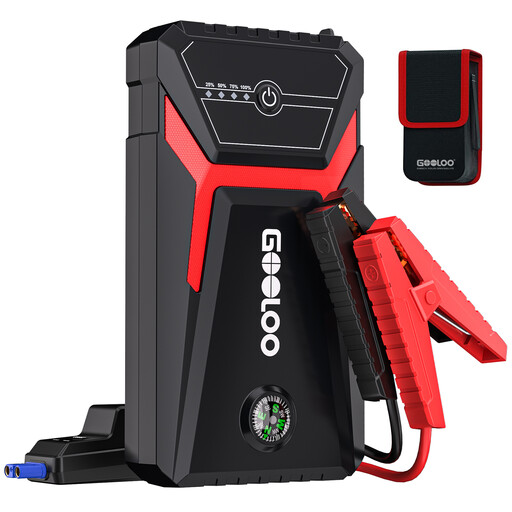
Why it stands out: The GE1500 offers an excellent balance of power, compactness, and features. It's a reliable device for most drivers.
Pros:
Who is it for? The prepared driver who owns a city car, a sedan, or a small SUV. It's the ideal companion for daily commutes.
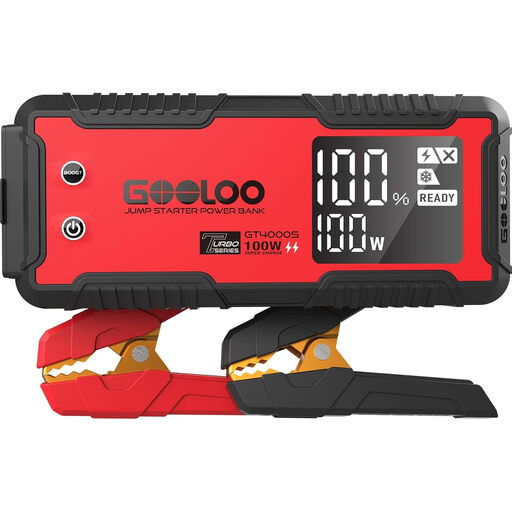
Why it stands out: With its colossal power and ultra-fast 100W two-way charging, the GT4000S is built for the most extreme situations.
Pros:
Who is it for? Owners of large SUVs, vans, motorhomes, or boats, as well as road professionals looking for an ultra-reliable and powerful jump-starting solution.
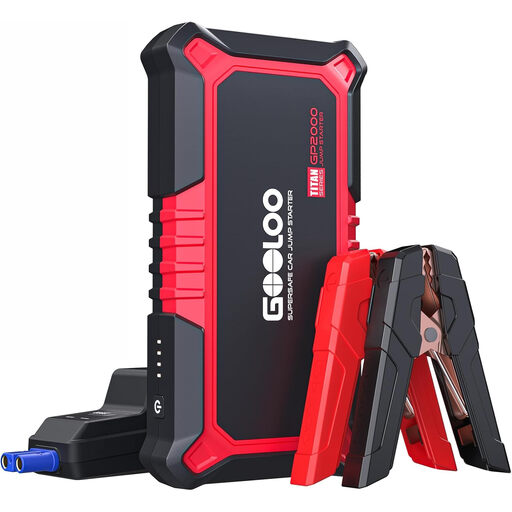
Why it stands out: The GP2000 proves that you can combine high power with a pocket-sized design, all at an affordable price.
Pros:
Who is it for? The driver looking for a high-performance yet discreet portable car jump starter, ideal for family cars, motorcycles, or as a smart and reassuring gift for a loved one.
This selection focuses on versatile models, but your needs might be more specific. If you are looking for particular features or other types of accessories for your vehicle, many other solutions are available.
To explore more options, feel free to discover our full range of car and high-tech accessories, where you'll find a wider selection of equipment for the road and for leisure.
A battery booster (or portable jump starter) provides a very intense but brief burst of current, just enough to start an engine with a flat battery. In contrast, a battery charger plugs into a wall socket to slowly but fully recharge a battery over several hours. The former is an emergency solution, while the latter is a maintenance tool.
Most modern lithium jump starters have a very low self-discharge rate. Models like the GOOLOO GP2000 can hold their charge for 18 to 24 months. However, it is recommended to check the charge level every 3 to 6 months and top it up if necessary to ensure it's always ready for use.
No, it is crucial to check for compatibility. The majority of consumer jump starters are designed for 12?V electrical systems, which are found in almost all cars, motorcycles, and recreational vehicles. Heavy-duty trucks and some agricultural machinery use 24V systems and require specific boosters. Finally, as we've discussed, the amperage must be appropriate for the engine size and type (petrol or diesel) of your vehicle.