
Livraison le jour même ou le lendemain

Qualité garantie

Débloquez vos offres de bienvenue: Livraison GRATUITE | Jusqu'à -80 % | 30 jours d'essai gratuits à JoyPlus
Téléchargez l'application
It's the nightmare scenario every driver dreads: you're in a hurry, you turn the ignition key, and... nothing. Just that frustrating clicking sound, signalling the end of your trip before it even began. Gone are the days of relying on a kind stranger and fumbling with bulky jumper cables! The battery booster, also known as a portable car jump starter, has become the essential accessory to get you back on the road in minutes, completely on your own.
But with a jungle of models on the market, how do you find your way? Power, versatility, safety... This guide breaks down the key factors for you and presents our selection of the best devices to help you make the right choice.
To ensure you make the right decision, here are the criteria to scrutinize before you buy.
This is the number one criterion. Expressed in amperes (A), the power determines if the booster has enough "juice" to wake up your engine.
Modern boosters are true Swiss Army knives for the road. The best models combine several ultra-practical functions:
Handling a car battery is never a trivial matter. Fortunately, modern boosters are packed with safety features for 100% safe use, even if you know nothing about mechanics. Check that the device is equipped with systems that protect against:
We have selected three models that stand out from the crowd, each meeting a specific need.
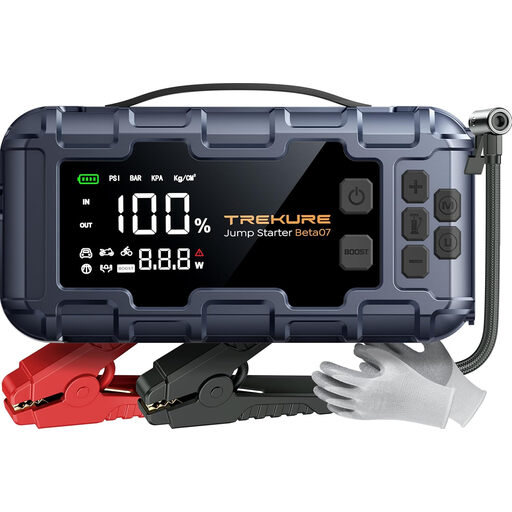
Why it stands out: The TREKURE Beta07 is the heavyweight of our selection, a powerhouse designed for those who want no compromises. With its 6000A peak current, it can handle anything, including starting the largest engines up to 12L diesels. Add a 160 PSI air compressor and a large 3.3-inch screen, and you have the ultimate roadside emergency tool.
Pros:
Who is it for? For adventurers, owners of large-displacement vehicles (gas or diesel), and anyone looking for an all-in-one emergency solution: starting, inflating, and charging.
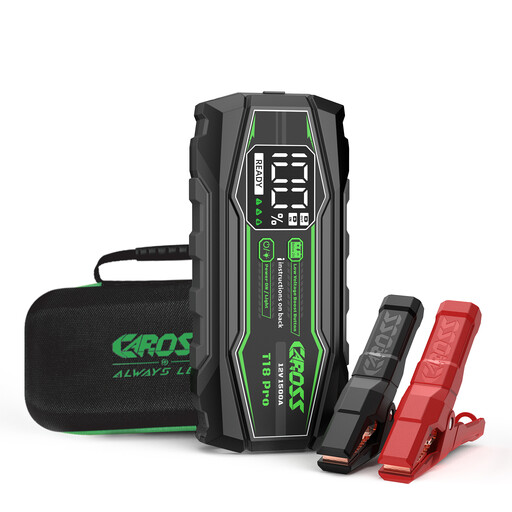
Why it stands out: The CAROSS focuses on simplicity and safety. Its 1500A and 16,000 mAh battery are more than enough for most cars. Its real bonus is a "Boost" function capable of reviving even the most stubborn batteries. Its comprehensive protections, including anti-spark technology, make it a particularly reassuring device.
Pros:
Who is it for? The perfect ally for the everyday driver (car, SUV, motorcycle). It's the sensible choice for anyone looking for a compact, easy-to-use, and ultra-secure device.
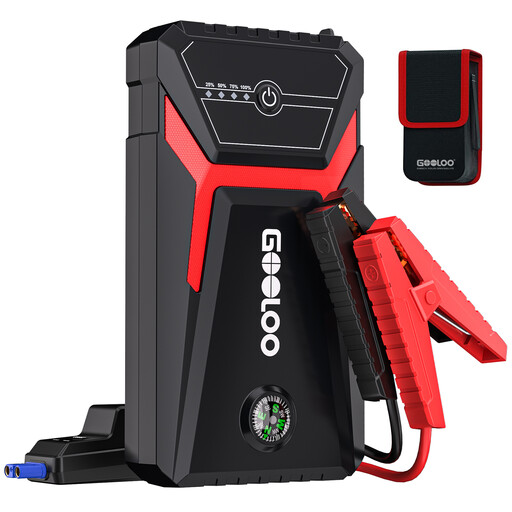
Why it stands out: The GOOLOO GE1500 strikes the perfect balance between power, compact size, and reliability. Its 1500A peak current covers most needs (up to 6.0L gas and 4.0L diesel engines). Lightweight and easy to store, it fits in the glove box and delivers the essentials: starting your car and charging your devices.
Pros:
Who is it for? The smart choice for drivers of city cars, sedans, and small SUVs who want an effective and easy-to-store portable car starter without being weighed down by unnecessary features like a compressor.
Our selection is designed to meet the most common needs, but the perfect model for you might be found elsewhere! If you have specific requirements (more power, special features, etc.), feel free to explore our full catalog.
? Discover our complete range of battery boosters to find the device that's right for you.
1. Can a jump starter recharge my car battery? No, be careful not to confuse the two! A jump starter is designed to deliver a very strong pulse of current to start the engine. It does not work like a battery charger, which slowly restores the charge. Once your engine is running, the alternator takes over to recharge the battery as you drive.
2. Can I leave the jump starter in my car permanently? Absolutely, that's what it's made for! You just need to follow the storage temperatures recommended by the manufacturer (extreme heat or cold can damage its internal battery). A good habit is to recharge it every 3 to 6 months to ensure it's always ready when you need it.
3. What's the difference between peak amps and starting amps? It's a bit of a marketing numbers game. Peak Amps is the maximum current the booster can send for a very short moment. It's the most prominently displayed value. Starting Amps (or Cranking Amps, CA), a more realistic measure, is the current the device can sustain for 30 seconds at 32°F (0°C). Unfortunately, this data is less commonly shared. In short: a high peak amperage is a good indicator of power, but it isn't everything.