
Livraison le jour même ou le lendemain

Qualité garantie

Débloquez vos offres de bienvenue: Livraison GRATUITE | Jusqu'à -80 % | 30 jours d'essai gratuits à JoyPlus
Téléchargez l'application
Every driver's worst nightmare? Finding yourself with a dead battery or a flat tyre in the middle of nowhere. The battery booster with compressor has emerged as the all-in-one miracle solution. The problem: the market is flooded with marketing promises that too often lead to a disappointing purchase. As the Head of Product Recommendations at Joybuy, my mission is to help you decode the technical jargon to make a truly informed decision that's perfectly suited to your needs.
Before pulling out your credit card, beware of these three classic pitfalls that can turn a promising purchase into a gadget destined for the bin after just a few months.
To choose a reliable device, focus on these three essential parameters.
Forget the peak amps on the box. Instead, check the manufacturer's recommended compatibility with your engine's displacement (in litres) and type (petrol or diesel). A portable car starter for a small petrol city car is worlds apart from what's needed for a large diesel SUV. Diesel engines, being more demanding, require a much beefier starting current, especially in winter. Ensure the model is explicitly advertised as compatible with your vehicle.
A good integrated car tyre inflator must be both powerful and fast.
A good booster is much more than a simple emergency starter kit. It should also serve as a car power bank to recharge your smartphone and tablet via its USB ports, preferably with fast charging. An integrated LED light with multiple modes (torch, strobe, SOS) is now an indispensable standard.
Finally, safety is non-negotiable. A 5-in-1 multifunction booster worth its salt must include at least the following protections:
Here are a few options that cater to distinct user profiles, taking into account performance and safety criteria.
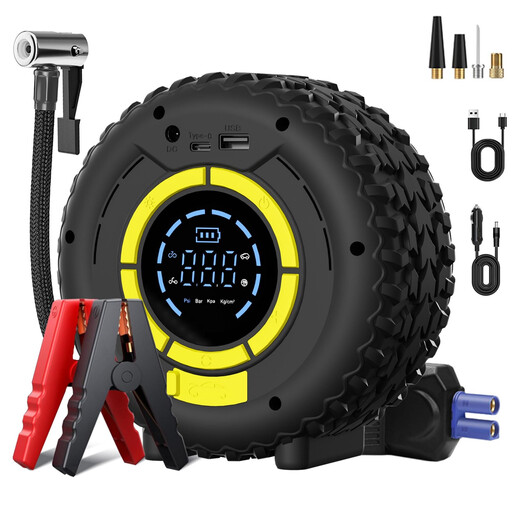
Why it's a great choice: Perfect for drivers of city cars and compact saloons. A simple, discreet emergency solution to slip into the glove compartment for daily commutes and weekend getaways.
Its 150 PSI compressor with 5 modes and auto-shutoff avoids the sluggish inflator trap. Its compact size and light weight (600 g) make it truly portable, unlike bulkier models.
Compact Versatility: It combines a jump starter, 150 PSI compressor, 8000 mAh power bank, and LED light in a featherlight package. Intuitive Handling: The LCD screen and smart modes make it accessible to everyone.
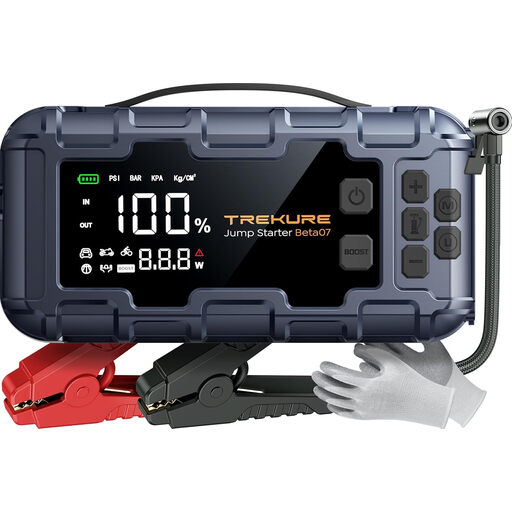
Why it's a great choice: Designed for owners of large engines (petrol or diesel up to 12L), SUVs, and motorhomes. In short, for anyone who racks up the miles and demands rock-solid power and reliability.
It sidesteps the marketing amps trap with a genuine 6,000 A peak power, built for engines up to 12L. Its 160 PSI compressor, with a healthy 45 L/min flow rate, is a real asset.
Raw Power: Capable of starting any petrol engine and diesel engines up to 12L. PD 45W Fast Charging: It recharges at lightning speed and can even power a laptop, in addition to smartphones and tablets.

Why it's a great choice: For those who want a device they can literally forget in their car, without worrying about recharging it every three months. Ideal for a second home, a recreational vehicle, or simply for fans of "zero-hassle" who prioritise durability and safety.
It shatters the disappointing battery life pitfall thanks to its sodium-ion battery technology. A single charge provides up to 5 years of standby time, whereas a conventional lithium battery needs recharging every 3 to 6 months.
Sodium-Ion Technology: Near-zero self-discharge, a lifespan rated for 6,000 cycles, and resistance to extreme temperatures (-40°C to 80°C). Enhanced Safety: This battery's chemistry does not release oxygen, drastically reducing the risk of fire.
We have curated a full range of products that meet our performance criteria and current safety standards.
The easiest way is to follow the manufacturer's recommendation. As a rule of thumb, for a city car or a petrol saloon (up to 3.0L), a model with 1,500 A to 2,000 A peak is sufficient. For large petrol engines, SUVs, and diesel engines (up to 6.0L), opt for models from 2,500 A to 4,000 A. For anything larger, like commercial vans or motorhomes, aim for 4,000 A and above.
The majority of lithium-ion battery boosters require recharging every 3 to 6 months to compensate for their natural self-discharge and remain operational. Some newer models, particularly those with sodium-ion batteries, stand out for their very low self-discharge and can hold their charge for several years with almost no maintenance.
An excellent and crucial question. Always check the operating and storage temperature range specified by the manufacturer. Lithium-ion batteries do not like extremes. Excessive heat (above 60°C) can damage them irreversibly and pose a safety risk. Conversely, extreme cold (below -20°C) can cripple their performance. Models designed for extended ranges, such as -40°C to 80°C, offer much better peace of mind if you plan to leave it in your vehicle permanently.