
Livraison le jour même ou le lendemain

Qualité garantie

Débloquez vos offres de bienvenue: Livraison GRATUITE | Jusqu'à -80 % | 30 jours d'essai gratuits à JoyPlus
Téléchargez l'application
It's every driver's nightmare: a dead battery first thing in the morning, or a flat tyre miles from the nearest service station. The battery booster with a compressor emerges as the miracle solution, the all-in-one tool that brings you peace of mind. The problem? The market is flooded with models making often-outlandish claims. As a Product Manager and expert at the Joybuy Lab, my mission is simple: to teach you how to read between the lines of spec sheets to make the right choice, without getting it wrong.
Navigating the jungle of options is a real headache. Some manufacturers play on technical specifications that, if misinterpreted, lead straight to buyer's remorse. Here are the 3 most common scams to watch out for:
To sort the good from the bad, forget the marketing and focus on the only data that measures the real performance of a jump starter and tyre inflator.
Never confuse them; the difference is crucial. Peak current (peak amps) is the sprint: an instantaneous maximum power burst. Starting current (or cranking amps), often buried in the spec sheet, is the marathon: the power the booster can sustain for several seconds to actually turn the engine over.
A good petrol and diesel car battery booster is therefore judged on its starting current, far more than on a flashy peak current figure.
Expressed in Watt-hours (Wh)—a much more reliable metric than mAh—the battery's capacity determines the true runtime of your portable power station. The higher it is, the more jump-starts you can perform or the more times you can fully recharge your smartphone.
When it comes to a 12V portable air compressor, there are two numbers to scrutinise:
Because every driver is unique, here are 3 models that meet specific needs, selected based on their real-world performance, not their promises.
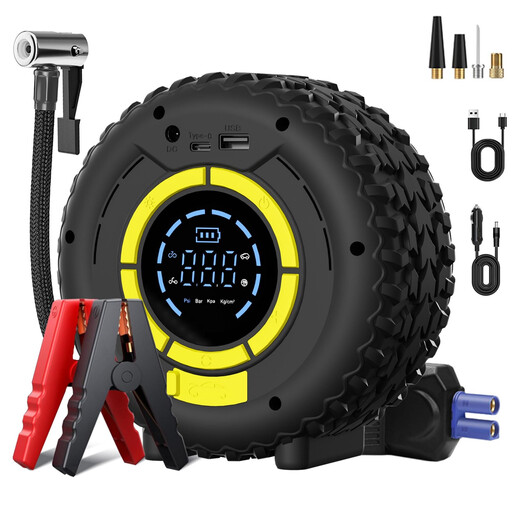
Why we recommend it: Perfect for city cars and compacts. It's the compact and effective backup solution to slip into the glove box to handle everyday hassles.
No outrageous numbers here. This model focuses on balance: 120W of power designed for standard 12V vehicles and a 150 PSI compressor with smart modes. It does what it says on the tin, no frills.
Ultra-compact (600g) and equipped with a very clear dual LCD screen (for pressure and battery), it's incredibly simple to use, even for beginners.
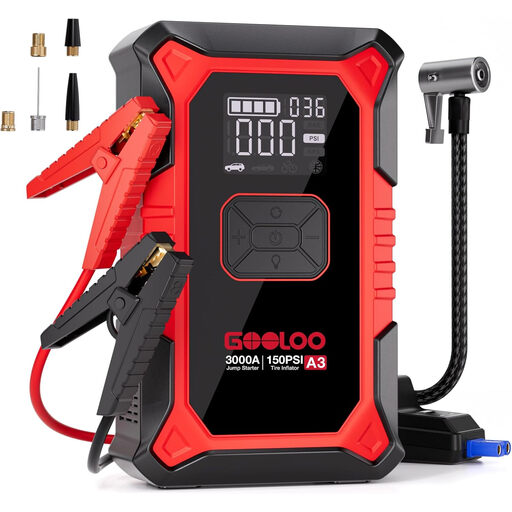
Why we recommend it: The ideal road trip companion for owners of SUVs, vans, and other road-trip enthusiasts. Its power and fast compressor make it a reliable ally for large vehicles and leisure activities (tyres, air mattresses, balls, etc.).
Here, the focus is on compressor efficiency. The 35L/Min air flow rate is a clear spec that ensures fast inflation and puts an end to the ordeal of underpowered compressors. Its "BOOST" mode for completely dead batteries is a real plus.
Its 7-in-1 versatility and 5 preset inflation modes transform it into a true Swiss Army knife. The LED screen that displays real-time pressure makes the operation ultra-simple.
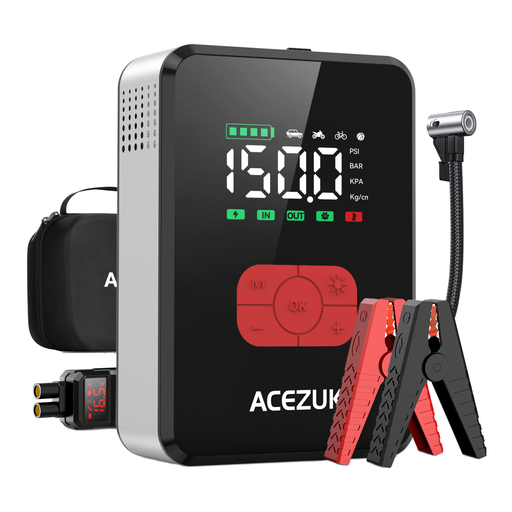
Why we recommend it: For those who refuse to compromise on power. This is the choice for peace of mind for large 4x4s, vans, motorhomes, or for professional use where every minute counts.
The 7000A figure might seem like marketing, but it's backed by its advertised compatibility with diesel engines up to 12L. This is a guarantee of raw performance that goes beyond slogans. The smart clamps with an integrated screen are a real bonus for safety and control.
Its colossal power, capable of starting almost any 12V vehicle. Its large 3.3-inch screen dedicated to the compressor and its multiple safety features make it a powerhouse, but a controlled one.
Discover our full selection of 12V accessories that meet our criteria for performance, reliability, and safety.
It all depends on the size and type of your engine (petrol or diesel).
Good lithium-ion boosters have a very low self-discharge rate and can hold a charge for 6 to 12 months without issue. As a precaution, check the charge level every 3-4 months and top it up if needed. A portable car starter is only useful if it's charged!
This is a critical point. Always check the operating temperature range recommended by the manufacturer. Lithium batteries hate extremes. Leaving it in a scorching hot car in summer (+60°C) or during a hard freeze in winter (-20°C) can irreversibly damage it and shorten its lifespan. If possible, store it in a temperate location.