
Livraison le jour même ou le lendemain

Qualité garantie

Débloquez vos offres de bienvenue: Livraison GRATUITE | Jusqu'à -80 % | 30 jours d'essai gratuits à JoyPlus
Téléchargez l'application
A dead battery: every driver's nightmare. Fortunately, a portable battery booster can save the day and help you avoid an endless wait or the cost of roadside assistance. The problem is, the market is flooded with models making tempting promises that often fall short. As the editorial team's product expert, my mission is to help you decode the spec sheets to make the right choice. Here are the 3 most common pitfalls to avoid before you buy.
Don't be impressed by the staggering figures like 3000?A or 4000?A that manufacturers highlight. This number represents the peak current, an ultra-short burst of energy. What really matters is the starting current: the power the booster can deliver continuously for several seconds to start your engine. A device with a starting current that's too low will be completely useless, especially for a diesel engine or in freezing weather.
A booster with a compressor, flashlight, and car power bank function might seem like the deal of the century. Be wary! More often than not, these extra features are low-quality gimmicks. A compressor that struggles to add a few PSI to a tire or a flashlight barely brighter than your smartphone's flash will be of no use in an emergency. The reliability of the primary function, jump-starting, must remain your sole priority.
A cheap portable car starter often skimps on essential safety features. The lack of protection against reverse polarity, short circuits, overheating, or sparks can not only damage the booster itself but, more importantly, your vehicle's expensive electronic system. A reliable device must include an intelligent management system to ensure completely risk-free operation.
To avoid making a mistake, focus on these key technical specifications that make all the difference in performance and reliability for your next battery jump starter.
Starting Power and Engine Compatibility: This is the most critical factor. Ensure the booster's power is suitable for your engine's size (in liters). Diesel engines, which are more power-hungry, generally require more power than gasoline engines. A good starting point is to check the manufacturer's recommendations for gasoline (L) and diesel (L) engines.
Battery Capacity (mAh): Expressed in milliampere-hours, this determines the device's autonomy. A high capacity will allow you to perform multiple jump-starts before needing to recharge the booster and will serve as a more durable power bank for charging your electronic devices.
Features and Design: Beyond jump-starting, weigh the actual usefulness of additional functions. A good booster with a compressor should display the pressure in real-time and have an automatic shut-off. If you're looking for a maintenance solution, a device that combines the functions of a car battery charger and a battery maintainer can be a compelling option, although this is a separate product category from a pure jump starter.
Rather than an endless list, here is our selection of products that meet specific needs, all chosen with the pitfalls and essential criteria we've just covered in mind.
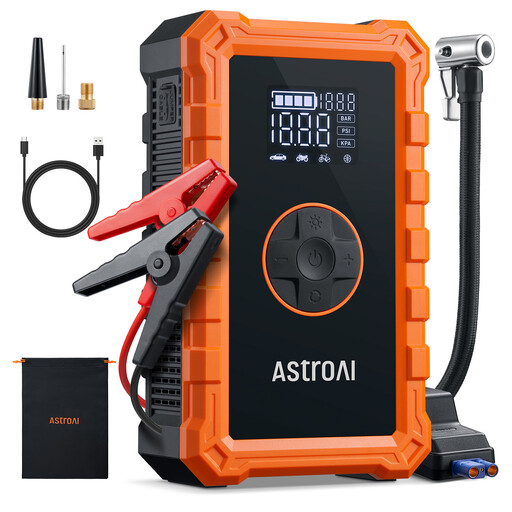
Why we chose it: The balanced all-in-one solution for drivers of standard vehicles (gas up to 6.0 L, diesel up to 3.0 L) who want to be ready for the two most common breakdowns: a dead battery and a flat tire. Its compact design allows it to be easily stored in the glove box.
It avoids the "gimmicky versatility" trap by integrating a 150 PSI (10.3 bar) compressor with auto-shutoff: a genuinely useful and high-performing feature in addition to a reliable jump starter.
Its large 2.4-inch screen clearly displays the charge level and tire pressure, making it very intuitive to use, even for beginners.
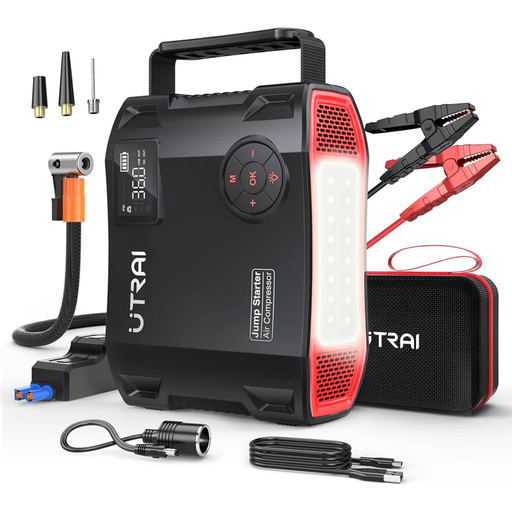
Why we chose it: Built for large vehicles (RVs, 4x4s, vans, boats) and engines up to 10.0 L diesel. Its power and 27000 mAh capacity make it a tool suited for demanding applications and situations where reliability is critical.
It counters the "overstated power" trap by delivering a massive 6000 A starting current, capable of starting the most power-hungry engines where more modest models would fail.
Its 160 W DC output can directly power other 12 V devices (coolers, car vacuums...), turning it into a true portable power station, ideal for camping or professional use.
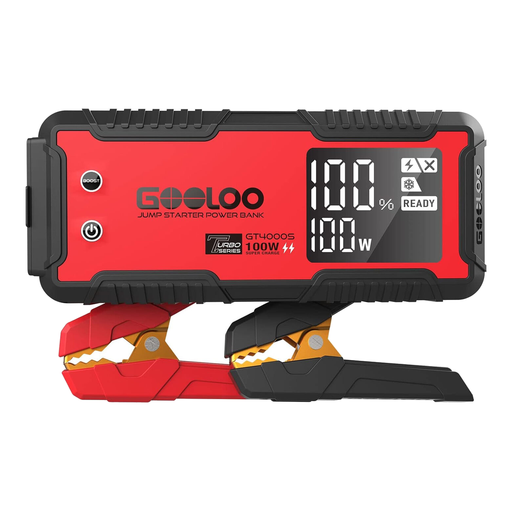
Why we chose it: For those who demand performance and speed above all else. This device stands out with its two-way fast-charging technology that shatters wait times, whether for charging the booster itself or for powering other devices.
It avoids the trap of mediocre extra features by offering true 100 W fast charging via its USB-C port, capable of powering a laptop as effectively as its original wall charger.
Its ultra-fast charging: according to the manufacturer, 5 minutes of charging is enough for an emergency jump-start, and it fully recharges in just 1.2 hours with a compatible charger.
Discover our complete selection of products that meet our strict selection criteria and current safety standards.
The lifespan of a lithium booster depends on its build quality and maintenance. Generally, a good model will remain effective for 3 to 5 years. To preserve its battery, it's recommended to recharge it every 3 to 6 months, even if it's not being used.
Yes, they are designed to be kept in a vehicle. You just need to avoid exposing them to extreme temperatures for prolonged periods. In the summer, avoid leaving it in direct sunlight on the dashboard. In the winter, extreme cold can temporarily reduce its performance: it will still work, but with a little less power than at room temperature.
These three devices have very distinct functions:
jump starter) is a portable battery that delivers an intense peak current to start an engine when the vehicle's battery is dead. It's an emergency solution.