
Livraison le jour même ou le lendemain

Qualité garantie

Débloquez vos offres de bienvenue: Livraison GRATUITE | Jusqu'à -80 % | 30 jours d'essai gratuits à JoyPlus
Téléchargez l'application
By the Joybuy editorial team, your product expert – August 26, 2026
A dead battery: every driver's nightmare, especially on a freezing morning or when stranded at a motorway service area. The battery booster has become the modern driver's guardian angel, making old-school jumper cables a thing of the past. The catch? The market is flooded with often misleading marketing claims. To avoid investing in a device that will fail you at the worst possible moment, it's crucial to know how to avoid the most common pitfalls.
Choosing a jump starter isn't something to be taken lightly. Many manufacturers flaunt impressive numbers that often hide deal-breaking weaknesses. Here are the two mistakes you must not make.
Peak Amps is the headline figure displayed prominently on the box. While it looks reassuring on paper, this number is primarily a marketing gimmick that says nothing about the device's real ability to start an engine. A 2000?A peak is useless if the starting current (the continuous power delivered over several seconds) is too low. It's this starting current that actually turns the engine over, not the fleeting initial peak.
Capacity, measured in milliampere-hours (mAh), indicates how much energy the battery can store. You might be tempted to think that a 20,000?mAh power bank is automatically a powerhouse. Big mistake. In reality, the advertised gross capacity never matches the actually available capacity. A portion of the energy is inevitably lost during conversion and discharge. A quality device will distinguish itself by mentioning its usable (or nominal) capacity, which is often 20-30% lower than the advertised value. A booster with an overstated capacity and low-quality components will only give you one or two starts and will struggle with a stubborn engine.
To choose a portable battery charger that truly delivers, rely on objective technical criteria, not advertising slogans.
This is the absolute starting point. Diesel engines require much higher compression than petrol engines, and therefore a more powerful starting current.
This is an inseparable duo. The right balance is the key to performance. For frequent use or large vehicles (SUVs, vans), start with a solid foundation: a usable capacity of at least 15,000?mAh, coupled with a sufficient starting current. This will give you not only the power needed to start the engine but also a comfortable reserve for multiple attempts or for charging your portable devices.
A portable car starter worthy of the name must come with smart clamps. Ensure it includes the following protections:
These safeguards protect your vehicle's electronics, the booster itself, and, most importantly, the user.
Rather than a long list, we've selected one product that checks all the boxes of the objective criteria defined above and meets a specific need.
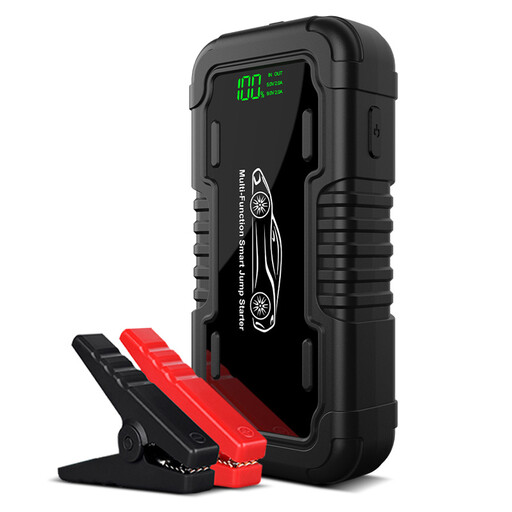
Why it stands out: This model is the Swiss Army knife for drivers. It covers the needs of petrol and diesel cars, as well as SUVs, vans, and motorcycles. It combines serious starting power with a fast power bank function, making it both an essential piece of safety equipment and a perfect travel companion.
It's transparent: it advertises a starting current of 800 A, perfect for diesels, and a usable capacity of 16,000 mAh, which is much more meaningful than the gross figure of 20,000 mAh.
Compatible with all 12V vehicles (petrol and diesel). Features a QC3.0 18W power bank to charge your devices at top speed. LCD screen to know the exact battery level.
Discover our full selection of products that meet our rigorous selection criteria and current safety standards.
For a diesel engine, the only figure that really matters is the starting current. Aim for a minimum of 800?A starting current for most cars and SUVs. For larger engines (over 3.0L) or vans, 1000?A or more is a safe bet, especially in cold weather when batteries lose efficiency.
A good model will hold its charge for 6 to 12 months without issue. However, it's advisable to check its battery level every 3 to 4 months and top it up so it's always ready for use. As for recharging, expect 4 to 6 hours for a full charge via USB-C or a wall adapter.
Yes, most boosters are designed to be kept in a vehicle. Be careful, though: extreme temperatures (both intense cold and high heat) can degrade the performance of the lithium-ion battery and reduce its lifespan. Be sure to check the operating and storage temperature range recommended by the manufacturer. A model with a sturdy, IP44-rated (or higher) casing will better withstand the rigours of life in a glove box.