
Livraison le jour même ou le lendemain

Qualité garantie

Débloquez vos offres de bienvenue: Livraison GRATUITE | Jusqu'à -80 % | 30 jours d'essai gratuits à JoyPlus
Téléchargez l'application
By the Joybuy Team, your product expert | Published August 26, 2026
A dead battery: every driver's nightmare, especially when you're in a hurry or far from help. The portable battery booster seems like a lifesaver, allowing you to restart your car without assistance. The only problem is that the market is flooded with often misleading marketing claims. Before you make a purchase, it's crucial to read between the lines to avoid ending up with a useless gadget when you need it most.
As a Product Specialist at Joybuy, my mission is to cut through the noise for you. Here are the 3 most common traps and, more importantly, how to avoid them.
To ensure you invest in a reliable car jump starter, forget the marketing slogans and focus on these key technical points.
The first thing to check is compatibility with your engine type: petrol or diesel. A jump starter for a diesel battery requires significantly more power due to a higher compression ratio.
The majority of boosters use Lithium-ion batteries. But new technologies like Sodium-ion batteries are a game-changer, offering significant advantages:
A good booster does more than just start your car. The most versatile models become true Swiss Army knives for drivers:
We have selected several models that meet different needs, based on the performance and reliability criteria mentioned above.
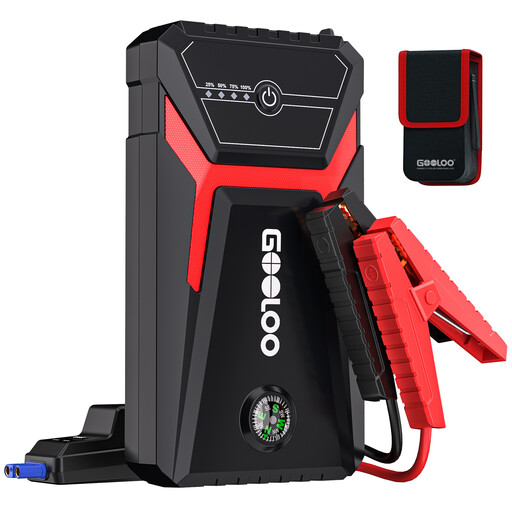
Our take : For drivers of city cars, petrol saloons, or small diesel vehicles who want a simple, compact, and affordable backup solution. It delivers just the right amount of power for common vehicles, without the frills that drive up the price.
This model doesn't overpromise. Its 1500 A are perfectly calibrated for its target audience (up to 6.0 L petrol and 4.0 L diesel engines), offering realistic and more than sufficient power for daily use.
Compact and lightweight, it slips easily into the glove box. It includes all essential safety protections and a power bank function with two USB ports.

Our take : Designed for owners of SUVs, 4x4s, vans, or motorhomes with large diesel engines (up to 10.0 L). This is the choice for peace of mind for those who refuse to make any compromises on power.
It tackles the lack-of-power trap head-on. With its 4000 A peak current and robust design, it delivers the high, sustained cranking current essential for large diesel engines, even in extreme cold (effective down to -20 °C).
Serious firepower to start any 12V vehicle. It features a "Boost" function for completely dead batteries and all-metal clamps, a guarantee of durability.

Our take : For long-distance travellers, families, and anyone who likes to be prepared for any eventuality. It combines a powerful jump starter with a digital air compressor, making it the ultimate driver's Swiss Army knife.
It avoids the trap of being a single-function device. Instead of buying a separate jump starter AND compressor, this booster with compressor combines both functions effectively, with a handy digital display and auto-shutoff.
Its 150 PSI digital air compressor with preset modes. Its colossal 4500 A starting power is compatible with very large petrol (up to 9.0 L) and diesel (up to 8.0 L) engines.

Our take : For the user who prioritises safety, longevity, and peace of mind above all else. Its Sodium-ion technology makes it a future-proof choice for those who want a device that's always ready to use for years to come, regardless of the conditions.
It shatters the two biggest traps: self-discharge and temperature sensitivity. According to the manufacturer, its Sodium-ion battery can remain on standby for up to 5 years and operate from -40 °C to +80 °C. No more need for regular recharging or fear of leaving it in the car.
Its cutting-edge battery technology provides unparalleled lifespan and safety. It also includes a compressor and PD60W fast charging, making it a tool that is as versatile as it is durable.
We have curated a complete selection of boosters that meet our selection criteria and the strictest safety standards.
For a standard Lithium-ion booster, it's not recommended. Extreme temperatures (heatwaves in summer, frost in winter) can degrade the battery and its performance. However, models with Sodium-ion technology are specifically designed to withstand a much wider temperature range (e.g., from -40?°C to +80?°C), making them perfectly suited to be kept in a vehicle permanently.
Diesel engines are more demanding. As a general rule, for a diesel SUV or van, it is advisable to choose a jump starter for a diesel battery with at least 2500?A to 3000?A peak current. The safest bet is to check the manufacturer's specifications, which always indicate the maximum compatible engine displacement (e.g., "for diesel engines up to 8.0?L").
For a classic lithium model, most manufacturers recommend recharging every 2 to 3 months. This is the minimum required to compensate for its natural self-discharge and ensure it will be operational when needed. Newer models, especially those based on Sodium-ion, are a game-changer. Their self-discharge rate is so low that they can hold a charge for over a year, or even several years depending on the brand. This makes them virtually maintenance-free.