
Livraison le jour même ou le lendemain

Qualité garantie

Débloquez vos offres de bienvenue: Livraison GRATUITE | Jusqu'à -80 % | 30 jours d'essai gratuits à JoyPlus
Téléchargez l'application
A dead battery: every driver's nightmare. On a freezing winter morning, or after a long parking spell during a holiday… being stranded is an ordeal we'd all rather avoid. Fortunately, the battery booster, also known as a portable jump starter, is the modern solution to get back on the road independently, without relying on another vehicle or a tow truck.
The problem? The market is flooded with models featuring technical specs that are often vague, if not misleading. As the head of product selections at Joybuy, my mission is to help you decode this jargon to make a truly informed choice. Follow this guide to avoid the pitfalls and identify the criteria that really matter.
Before you jump on the first model you see, learn to spot the marketing claims that often hide real weaknesses.
To be sure you're choosing the right battery booster, focus on these three essential parameters.
This is THE number one technical criterion. Peak Amperage (Peak Amps) indicates the maximum discharge the booster can deliver in a split second to start the engine. The starting current is the power maintained for a few seconds.
Always check the maximum engine displacement (in litres) recommended by the manufacturer for both petrol and diesel engines. This is critical information that must match your vehicle, otherwise the booster could be ineffective or even get damaged.
A good portable battery booster must include an arsenal of protections: against short circuits, reverse polarity, overcharging, overheating, and more. The clamps, for their part, must be robust and perfectly insulated.
Some models transform into a true driver's Swiss Army knife with very practical features:
Here is our selection of models that meet different needs, all validated against our performance and safety criteria.
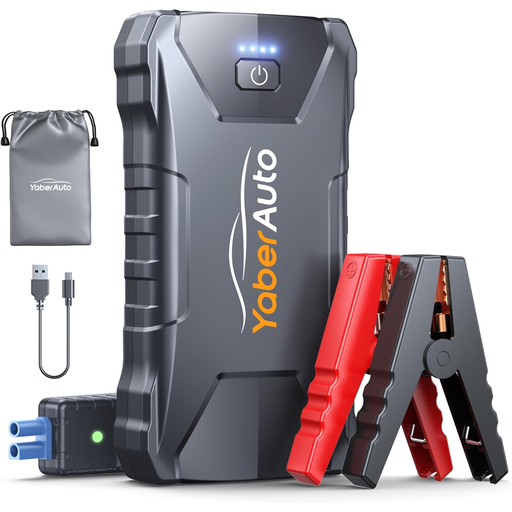
Why we recommend it: Perfect for drivers of city cars or compact saloons who want a reliable backup solution without breaking the bank. Its ultra-compact design ensures it has a prime spot in the glove box.
It doesn't promise the moon. Its spec sheet is transparent about its compatibility (petrol engines ≤ 7.0 L, diesel ≤ 5.5 L), allowing you to check at a glance if the model fits your vehicle and avoid the "universal" false promise trap.
Its excellent power-to-size ratio. With 2000 A of peak current in a feather-light 340 g package, it offers a high-performance emergency solution that you'll forget is even there once stored.
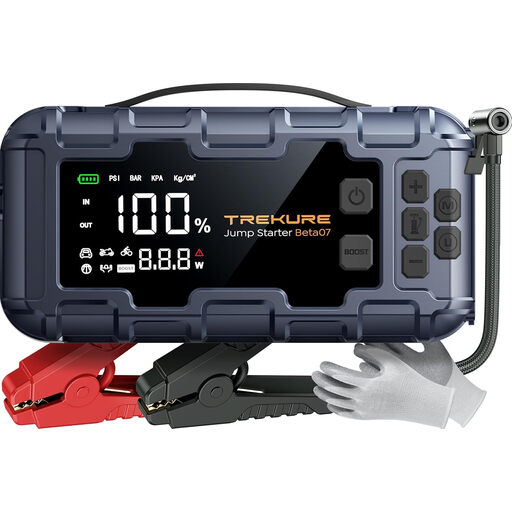
Why we recommend it: For those seeking the ultimate driver's Swiss Army knife. It combines colossal starting power with an efficient air compressor, making it the ideal companion for long journeys, camping trips, or managing a fleet of vehicles (car, motorbike, RV).
It's not just versatile on paper. Each function is backed by solid numbers: instead of drowning the user in mAh, it clearly states a 6000 A peak amperage and 160 PSI pressure for the compressor. These are concrete specs that guarantee its effectiveness in the field.
The combination of immense starting power (capable of starting a diesel engine up to 12 L) and a fast air compressor (160 PSI). Everything is controlled via a 3.3-inch smart screen for total control.
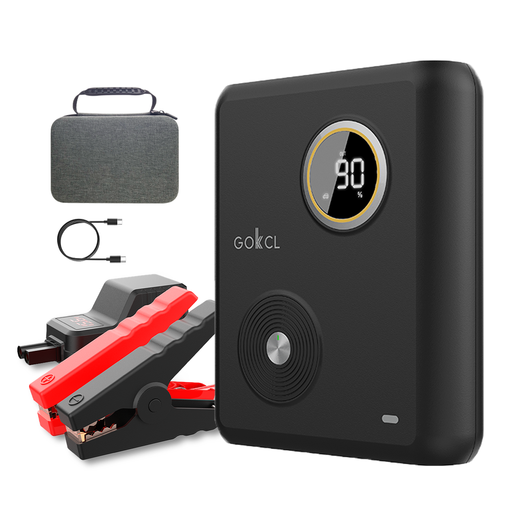
Why we recommend it: For the driver who puts reliability and safety above all else. Thanks to its sodium-ion battery, it can stay in the car all year round without skipping a beat, whether in the summer heat or winter frost, and without needing regular recharges.
It tackles the battery technology pitfall head-on. By offering an alternative to lithium, it highlights its bulletproof chemical safety (no risk of fire or explosion) and record-breaking longevity (6000 cycles, 5-year standby time). These are compelling, concrete, and verifiable arguments.
Its sodium-ion battery technology. It ensures an extreme operating range (from -40 °C to +80 °C) and near-zero self-discharge (~1% per month). In practical terms? It will always be ready to use, even if you forget it in your boot for months.
Explore our full, up-to-date selection of boosters that meet our strict selection criteria and European safety standards.
A diesel engine is more demanding to start than a petrol engine of the same displacement. For a diesel up to 5.0?L, a booster with a peak amperage of at least 2000?A is recommended. For larger engines (vans, RVs), it's safer to opt for a model rated at 3000?A and above. In all cases, rely on the manufacturer's recommendations.
The longevity of a booster depends on its technology and maintenance. A standard lithium model will last a few hundred charge cycles and should be recharged every 3 to 6 months to preserve its battery. Newer models, such as those based on sodium-ion, can reach several thousand cycles and have such a low self-discharge rate that a single charge can last for several years on standby.
It all depends on its battery technology. Traditional lithium boosters are sensitive to extreme temperatures. Leaving them in a car in the scorching summer sun or in the freezing cold of winter can not only degrade the battery but also pose a safety risk. Conversely, models designed to withstand wide temperature ranges, like sodium-ion battery boosters (stable from -40?°C to +80?°C), are made to be kept in a vehicle in any season, without any worries.