
Livraison le jour même ou le lendemain

Qualité garantie

Débloquez vos offres de bienvenue: Livraison GRATUITE | Jusqu'à -80 % | 30 jours d'essai gratuits à JoyPlus
Téléchargez l'application
A dead battery: every driver's nightmare. On a frosty winter morning, or after a long parking spell while on holiday... you turn the key, and nothing. An agonizing silence. Fortunately, there's a solution to ensure you never face this situation again: the battery booster, also known as a car starter or jump starter.
But faced with a jungle of models making often exaggerated claims, how can you navigate the options? To guide you toward the right choice, our editorial team has dissected the spec sheets to identify the pitfalls to avoid and the true criteria for performance.
Marketing is king, and it's easy to fall for technical specifications that look impressive on paper but prove disappointing in practice. Here are the points where you need to be particularly vigilant.
Manufacturers love to display spectacular peak amperage (expressed in amps, A). Be careful, as this number only represents the maximum current the booster can deliver for a microsecond. While it's an indicator, it in no way guarantees the real ability to turn over a stubborn engine. A much more reliable criterion is the starting current (sometimes called cranking amps). This more stable value measures the booster's true power to start the engine, a crucial point for a diesel battery booster, which is much more power-hungry.
Another key figure that's often highlighted is the capacity, expressed in milliampere-hours (mAh). It's supposed to reflect the device's autonomy, especially for its function as a car power bank. The catch? This value corresponds to the raw capacity of the internal battery cells, not the energy you can actually use. A significant portion is lost during the voltage conversion needed to charge your devices. For a fair comparison between two models, a rating in Watt-hours (Wh), if available, is far more telling because it measures the total energy actually stored.
A booster with a built-in compressor, a flashlight, a plethora of USB ports... on paper, it's appealing. In reality, the quality of these extras is often mediocre. The compressor will take forever to inflate a tyre, and the USB ports will offer a charge so slow that your smartphone will run out of patience. Our advice: prioritise a device that excels at its primary mission—emergency starting. The rest is just a bonus and should not be the main criterion for your choice.
To be sure you're choosing a reliable emergency starter, here are the three key points to scrutinize.
This is the number one criterion. The required power depends on the displacement and type of your vehicle's engine (petrol or diesel).
Here, we're talking about the number of starting attempts you can make on a single charge, as well as its autonomy as a portable battery charger. A capacity between 10,000 and 20,000 mAh represents an excellent balance for most users. If you plan to use it often to charge your smartphone or tablet, make sure it has fast-charging USB ports (like Quick Charge 3.0 or Power Delivery).
A good jump starter must include multiple protections to prevent any damage to the vehicle's electronics or the user. The essential safety features are:
Rather than an exhaustive and overwhelming list, we've chosen to select a few models that correspond to specific user profiles, based on our strict criteria for performance and safety.
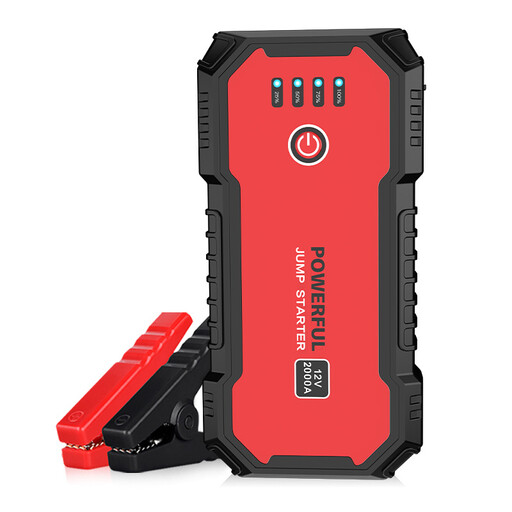
The profile: Ideal for drivers of city cars and petrol sedans looking for a compact and affordable backup solution. Its feather-light design ensures it has a prime spot in the glove compartment, always within reach.
It doesn't overpromise. Its 1500 A peak is perfectly calibrated for the majority of passenger vehicles. There's no need to pay for power you won't use.
Its excellent power-to-size ratio. The 18W QC 3.0 fast-charging port makes it a truly effective 2-in-1 tool for daily use.

The profile: Designed for owners of SUVs, vans, RVs, or any vehicle with a large diesel engine (up to 10.0L according to the manufacturer). It provides guaranteed peace of mind with a colossal power reserve.
Here, the advertised 4000 A isn't just marketing. The power is real, supported by sturdy, all-metal clamps and a "BOOST" function to revive even the flattest batteries. The performance is there.
Its impressive power and versatility across almost the entire 12V vehicle fleet make it the go-to choice for the most demanding needs.
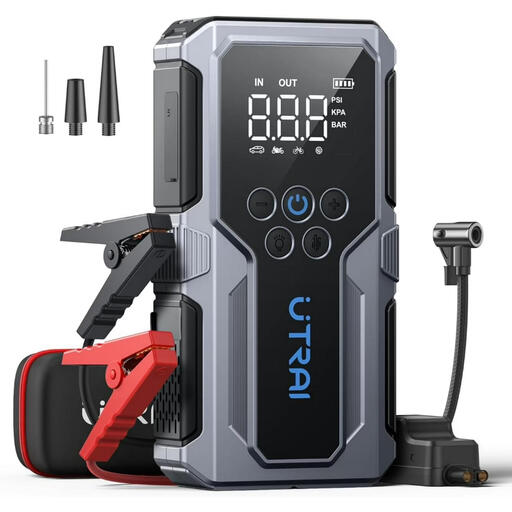
The profile: The ideal companion for outdoor enthusiasts, campers, and road-trippers looking for a true Swiss Army knife. It combines a heavy-duty starter with an air compressor for tyres, as well as air mattresses or balls.
It avoids the "gimmick" trap by offering a 150 PSI digital air compressor with auto-shutoff that really gets the job done. It's not a cheap accessory, but a useful and effective feature on top of an already very robust 3000 A starter.
Its 5-in-1 versatility (starter, compressor, power bank, LED light, LCD screen) makes it the ultimate road trip companion for handling (almost) any eventuality.
Discover other battery booster models, all rigorously selected for their performance and safety.
The lifespan of a booster, typically equipped with a lithium-ion battery, depends on its use and maintenance. It's measured in charge cycles (from several hundred to over a thousand for the best models). The trick to making it last: remember to recharge it every 3 to 6 months, even if it's just sitting in your trunk. This prevents deep discharge, the sworn enemy of lithium batteries.
Excellent question. Lithium batteries are sensitive to extreme temperatures. Most manufacturers specify an operating temperature range (e.g., from -20 °C to +60 °C / -4 °F to 140 °F). Leaving the booster permanently in an overheated car cabin in summer or a freezing one in winter can degrade its performance and reduce its lifespan. Ideally, store it at a milder ambient temperature when not in use for an extended period.
The rule of thumb: check the booster's spec sheet. Manufacturers always indicate the maximum engine displacement they are compatible with, distinguishing between petrol and diesel (e.g., "up to 8.0L petrol / 6.0L diesel"). Diesel engines, with their higher compression ratio, are more demanding and require more "juice" to start. When in doubt, apply the golden rule: it's better to have more power than you need. Opt for a more powerful model to have a safety margin.