
Livraison le jour même ou le lendemain

Qualité garantie

Débloquez vos offres de bienvenue: Livraison GRATUITE | Jusqu'à -80 % | 30 jours d'essai gratuits à JoyPlus
Téléchargez l'application
A dead battery. It's every driver's nightmare, especially when it happens at the worst possible moment: on a freezing morning, in a deserted car park, or just before a crucial meeting. A battery booster might seem like the obvious saviour, but the market is saturated with marketing promises that can easily mislead you.
As a product expert for Joybuy, my mission is to help you see clearly. Together, we'll dissect the misleading claims and common pitfalls, enabling you to make a truly informed choice, far from the siren song of marketing and inflated technical specs.
Before you even start comparing spec sheets, it's crucial to recognise the traps that render many boosters useless, or even dangerous, after just a few months of use.
To make the right choice, focus on these three pillars that define a booster's performance, reliability, and safety.
The battery technology is the heart of the device. While lithium-ion still dominates the market, a new technology is changing the game: the sodium-ion car jump starter.
The required power depends on your vehicle's engine.
Capacity, expressed in milliamp-hours (mAh), determines the device's autonomy. A 27,500 mAh model can not only perform multiple starts on a single charge but also transform into a power bank to recharge your devices (smartphone, laptop) via fast-charging ports (e.g., PD 60W). The inclusion of an LED light is also a real plus for nighttime emergencies.
Rather than a long list, we've chosen to highlight one model that checks all the boxes for the most discerning users: those who prioritise peace of mind above all else.
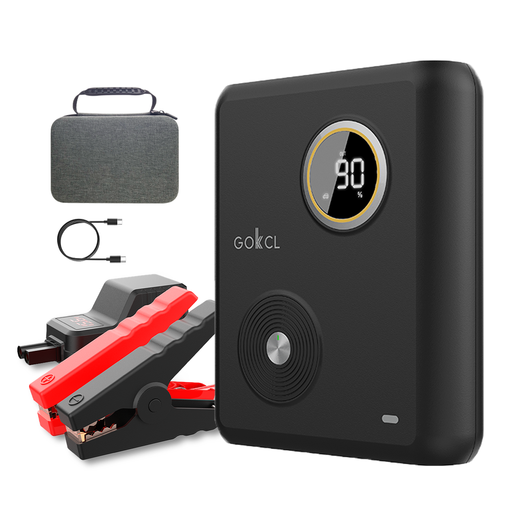
Why it stands out: Perfect for drivers who manage multiple vehicles (car, SUV, motorcycle, campervan) or live in regions with contrasting climates. It's the ultimate "set it and forget it" solution, designed for those who place safety and reliability above all else, with zero maintenance constraints.
Its sodium-ion technology eliminates any fire risk associated with lithium and ensures stable operation from -40°C to +80°C. Its virtually non-existent self-discharge (up to 5 years of standby time, according to the manufacturer) frees you from the chore of regular recharging.
Safety and Longevity: Its battery is designed not to ignite, even if punctured. With a rated lifespan of over 6,000 cycles, it far surpasses lithium alternatives. Bonus: it can even be reactivated after a complete discharge.
Explore our complete selection of products that meet our strictest safety and performance criteria.
Diesel engines, with their higher compression ratio, require more power to start. For a booster compatible with both petrol and diesel, a model with at least 1500A of peak current is highly recommended. Always check the compatibility with your engine's displacement, an information provided by the manufacturer (e.g., "up to 8.0L Diesel").
Yes, and that's not just marketing. From a purely chemical standpoint, sodium-ion technology offers undeniable safety advantages. The absence of oxygen release in case of damage or overheating drastically reduces the risk of fire, unlike conventional lithium-ion batteries. Its stability over an extreme temperature range also makes it much more reliable for permanent storage in a vehicle, summer or winter.
It all depends on the battery technology and its manufacturing quality. Entry-level lithium models can lose a significant portion of their charge in just 3 to 6 months. Conversely, higher-performance models, especially those with sodium-ion technology, exhibit very low self-discharge. Some, like the GOKKCL GK03, can remain on standby for several years. This is what makes it a true long-lasting battery booster, ready to serve when the unexpected happens.