
Livraison le jour même ou le lendemain

Qualité garantie

Débloquez vos offres de bienvenue: Livraison GRATUITE | Jusqu'à -80 % | 30 jours d'essai gratuits à JoyPlus
Téléchargez l'application
A dead battery. It's every driver's nightmare. A frosty winter morning, headlights left on all night… and the car refuses to start. It's a hassle we'd all rather avoid. The battery booster, also known as a portable jump starter, has become an essential piece of equipment. But with a market saturated with marketing promises, it's hard to know what to choose.
As a product expert for Joybuy, my mission is to help you cut through the noise. Let's break down the pitfalls to avoid and the real technical criteria to consider so you can make an informed choice, far from the siren song of marketing.
Before you even start comparing models, it's crucial to know how to spot a deal that's too good to be true. Many products look appealing on paper but prove disappointing, or even useless, in real-world use.
To make the right choice, focus on these few objective characteristics. They will ensure you get a reliable emergency jump starter kit that is truly suited to your vehicle.
Forget peak amperage and look for engine compatibility instead. A reputable manufacturer will always indicate which engine types (petrol/diesel) and what displacement (in litres) their device is designed for.
The capacity, expressed in milliamp-hours (mAh), determines the device's autonomy, especially for its power bank function. A comfortable capacity (over 15,000 mAh) will allow you to recharge your smartphone or tablet several times.
If you opt for a model with a compressor, check its maximum pressure (in PSI or bars) and its air flow rate (L/min). A good compressor should be able to inflate a tyre in a few minutes, not half an hour.
A modern jump starter must include multiple protections. This is a non-negotiable criterion. Check for the presence of the following safety features:
Here is a selection of models that cater to different user profiles, chosen based on objective performance and safety criteria.
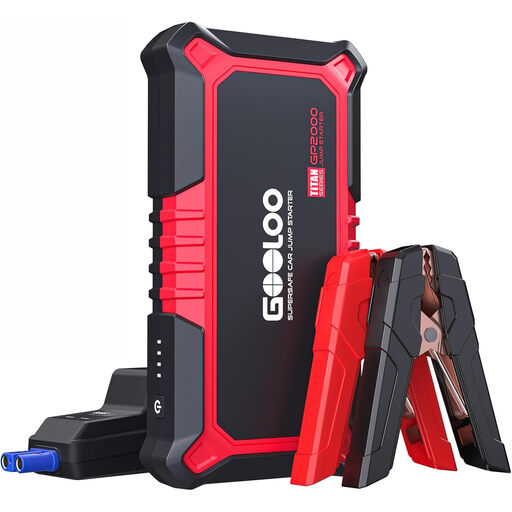
Why we recommend it: Perfect for drivers of city cars, compacts, and petrol sedans who are looking for a reliable and affordable emergency solution. It offers an excellent balance of compactness, sufficient power for the majority of vehicles, and comprehensive safety features.
It doesn't rely solely on a peak amp figure. Its power is clearly calibrated for engines up to 8.0L petrol and 6.0L diesel, a realistic and verifiable performance for its class.
100% metal clamps and 10 integrated protection levels. Power bank function with two USB ports, including one for fast charging.

Why we recommend it: Ideal for owners of SUVs, utility vehicles, or vanlife enthusiasts. It combines high starting power with a high-performance digital air compressor (150 PSI), making it a true Swiss Army knife for the road and recreation.
It avoids the trap of being a gimmicky all-in-one device. Here, the compressor is a genuine, standalone feature with preset modes and auto-shutoff. The starting power is not sacrificed for it.
150 PSI compressor with LCD screen and auto-shutoff. Power suitable for large engines (up to 9.0L petrol / 8.0L diesel).

Why we recommend it: Designed for those who make no compromises on power. It's aimed at owners of large 4x4s, trucks, RVs, or vehicles with large-displacement diesel engines (up to 10.0L) who demand rock-solid reliability.
Its high peak amperage is justified here by a design and capacity capable of effortlessly starting all petrol engines and diesels up to 10.0L. It features a "BOOST" mode to force-start even the most stubborn batteries.
Very high starting power for the most demanding vehicles. Robust 100% metal clamps and a reinforced shell for maximum durability.
We've curated a full selection of jump starters that meet our strict selection criteria and current safety standards.
The lifespan of a booster depends on the quality of its lithium-ion battery and its maintenance. On average, a good device can withstand several hundred charge/discharge cycles. To preserve its longevity, it is advisable to recharge it every 2 to 3 months, even when not in use. A quality model can thus remain effective for 3 to 5 years, or even longer.
Yes, most boosters are designed to be stored in a vehicle. They tolerate a wide range of temperatures (often from -20°C to 60°C). However, prolonged exposure to extreme temperatures (heatwaves, deep freezes) can affect the battery's performance and lifespan. It's best to store it in the glove compartment or boot, out of direct sunlight.
The easiest way is to check the manufacturer's recommendations. They always specify the maximum engine displacement (in litres) for compatible petrol and diesel engines. As a general rule: