
Livraison le jour même ou le lendemain

Qualité garantie

Débloquez vos offres de bienvenue: Livraison GRATUITE | Jusqu'à -80 % | 30 jours d'essai gratuits à JoyPlus
Téléchargez l'application
A small bathroom can quickly become difficult to organise: bottles lined up around the sink, towels piled on a chair, products falling in the shower and everyday accessories with nowhere to go. When choosing bathroom storage, it’s worth looking beyond style and marketing claims.
A few common pitfalls are worth watching out for:
Before placing your order, measure the available space, identify the type of wall and make a list of what you want to store: shampoo, towels, toiletries, shaving accessories or cleaning products.
In a small room, a narrow bathroom cabinet or compact design can free up floor space. Always check all three dimensions: width, depth and height. Remember to allow enough room for doors and drawers to open.
A bathroom storage tower makes use of vertical space rather than width. It’s particularly useful for renters and families who want to keep towels, toiletries and cleaning accessories separate. Adjustable shelves let you customise the space to fit bottles of different sizes.
A unit made from MDF can work well in a well-ventilated bathroom, as long as it isn’t repeatedly exposed to splashes. Pay particular attention to the edges and parts close to the floor: standing water can speed up material damage.
In the shower, choose a rust-resistant bathroom shelf or an organiser whose product details clearly state that it’s moisture-resistant. Open baskets help water drain away and reduce the build-up of soap residue.
A no-drill shower shelf is handy in rented homes, but it won’t attach in the same way to every surface. Suction cups generally work best on glass, smooth tiles, metal or acrylic. Avoid grout lines, uneven tiles, wallpaper and porous walls.
Check the stated maximum load, too. This is especially important for a suction-cup shower basket filled with glass bottles or larger products. For a tall unit, install the anti-tip device according to the instructions and secure it to a suitable support.
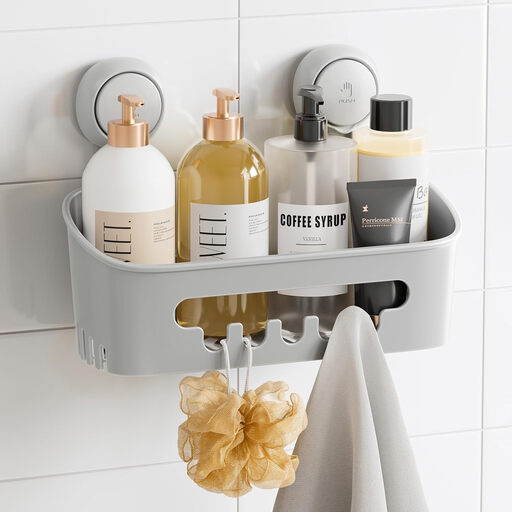
Why it suits this type of shopper : This caddy is a good choice for a first-time set-up, a student room or a rented home. No screws, nails or glue needed.
The fitting requirements are clearly stated: the surface must be smooth and non-porous, away from grout lines and uneven areas. The fixing can be repositioned and removed for easier cleaning.
Two baskets made from ABS and TPE, drainage holes, stated dimensions of 27,4 × 9,4 × 7,4 cm per basket and a stated maximum load of 10 kg.
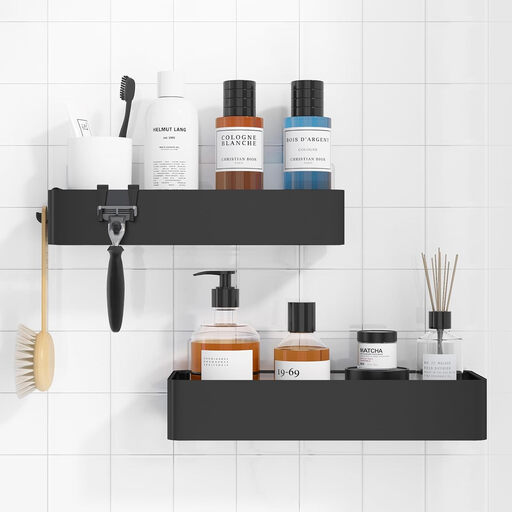
Why it suits this type of shopper : This set lets you organise several areas in the shower while keeping installation drill-free.
The two-piece design means you don’t have to cram all your bottles onto one shelf. Be sure to check that the surface is suitable before fitting.
Set described as rust-resistant, with four hooks and a no-drill design.
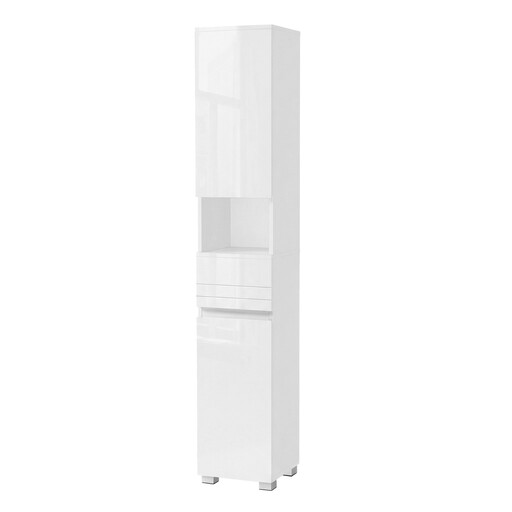
Why it suits this type of shopper : This white bathroom cabinet is a good fit for households that need to organise several types of item while keeping floor space to a minimum.
Its stated dimensions of 30 × 30 × 170 cm make it easy to check exactly how much space it will take up. The manufacturer recommends keeping it away from splashes and using the anti-tip kit.
Six storage compartments across shelves, drawers and cupboards, adjustable shelves, reversible doors and a stated static load capacity of 10 kg per shelf and drawer.
We’ve put together a comprehensive selection, updated in real time, of products that meet these exacting criteria while complying with European safety regulations.
To install a shower organiser or suction-cup shower basket, clean the surface and dry it thoroughly. Don’t place the fixing over a grout line. After fitting, check the grip regularly and remove soap residue with warm water and a mild cleaner.
In a storage tower, put heavier items on the lower shelves. Don’t exceed the stated load limit, and secure the unit to the wall if the manufacturer supplies an anti-tip kit. Regularly ventilating the room can also help reduce condensation.
No. Suction cups generally need a smooth, flat, non-porous surface. Glass, smooth tiles, acrylic and metal are more suitable than grout lines, rough surfaces or painted walls.
Group the products you use every day in an easy-to-reach basket. Keep refills and larger bottles in a closed cabinet or on a low shelf. Open baskets help water drain away and let items dry after a shower.
Start by measuring the available depth. A vertical storage tower with a depth of 30 cm can make use of the height without taking up much floor space. If there’s no room for a cabinet, a no-drill wall shelf or compact organiser can add storage without permanent alterations.