What should you check before choosing?
The right set-up mainly depends on how much you regularly freeze. Then compare the compartments and installation requirements of specific models.
Small freezer compartment
Consider this if: you mainly store fresh food and only freeze a few portions.
Bear in mind: check that the compartment can fit your containers and your usual frozen supplies.
Fridge-freezer
Consider this if: you need space for fresh food and a regular supply of frozen food, all in one place.
Bear in mind: the space allocated to each function varies by model, so don’t rely on the total capacity alone.
Two separate appliances
Consider this if: your frozen batches often exceed the space available in a fridge-freezer and you can install a dedicated freezer.
Bear in mind: you’ll need room and a continuous power supply for a second appliance, in conditions that meet the requirements in its manual.
| Criteria | What to check | Think about your needs |
|---|
| Capacity split |
Check the fridge and freezer capacities separately on the label or product specification. Make sure the drawers are the right size and easy to access with your containers. |
I keep several dishes chilled, but how many portions do I actually need to freeze between batches? |
| Usable capacity |
Compare the capacity with the shopping you store at once and the size of your dishes. Que Choisir suggests 100 to 150 L for one person, plus 50 L for each additional person as a starting point, to be adjusted to suit your household’s habits. |
I shop less often, so I need room for fresh food without choosing a capacity based only on a per-person rule. |
| Energy consumption and noise |
Compare the kWh/year, capacities, installation type and noise levels of similar models. The European Commission says the label for refrigeration appliances shows information including the energy class, energy consumption, capacities and noise emissions. |
If I add a freezer, I want to take its annual energy consumption into account as well as the fridge’s; ADEME points out that these appliances run continuously. |
| Installation and food storage |
Check the dimensions, door clearance, ventilation and, for a built-in appliance, the required niche. Once installed, check the temperature: ANSES recommends keeping the coldest part of the fridge between 0 °C and +4 °C. |
I need to be able to store my dishes easily without overfilling the compartments, and the appliance must open properly in my kitchen. |
Which brands can you use for comparison?
These examples of ranges and models illustrate different set-ups; their features don’t apply to every appliance from the same brand.
Bosch
To compare the space allocated to fresh and frozen food, Bosch’s product information for the freestanding KGN362WDF fridge-freezer lists 218 L of fridge capacity and 103 L of freezer capacity.
- Bosch’s product information also lists No Frost, a D energy class and 35 dB(A) for this model.
- Check the capacity, noise level, dimensions and energy consumption on the product information for the model you’re considering; these figures don’t represent the whole range.
Beko
The B1RFNE314W upright freezer is an example of a separate appliance for when your frozen stock justifies having extra space.
- Beko describes this model’s No Frost feature as a way to prevent ice from building up.
- Beko says this model can operate in an unheated room at temperatures as low as -15 °C. Check the installation conditions and climate class before choosing a location.
Electrolux
The KNT6ME18S4 built-in fridge-freezer featured by Electrolux is an example of an appliance designed for a fitted kitchen.
- Its product information lists 186 L for the fridge and 62 L for the freezer: compare the two capacities separately with your shopping and portions.
- Before ordering, confirm the niche and door-front dimensions for the exact model number. Compare the 62 L freezer capacity with your usual frozen stock.
Which fridge-freezers should you look at on Joybuy?
These Joybuy models are all fridge-freezers. Compare the space for fresh and frozen food with your shopping and prepared portions; this list alone doesn’t determine which of the three set-ups is right for you.
 Image unavailable
Haier HTW5618ENMG, 3-door 360 L fridge-freezer
Worth considering if you’re looking for one appliance for your fresh shopping and frozen portions. The model name indicates Total No Frost and an E energy class; compare the capacity of each compartment and check how much space is needed to open the doors.
View on Joybuy
 Image unavailable
Candy CFQQ5T817EPS, 4-door 467 L fridge-freezer
If you need plenty of space for a big shop, compare its stated 467 L capacity with what you actually store, separating fresh from frozen food. The model name indicates Total No Frost and an E energy class; also measure the space required for the appliance and its open doors.
View on Joybuy
 Image unavailable
CHiQ JR263LGE, 262 L fridge-freezer, 54 cm wide
Its stated width of 54 cm is worth comparing with the space in a narrow kitchen, while also allowing for the door to open and for ventilation. The model name indicates a 70/30 split and Low Frost; check how much space is available for your portions and follow the model’s defrosting instructions.
View on Joybuy
 Image unavailable
AEG NSC6M18FES, built-in TwinTech No Frost fridge-freezer
This set-up may suit a fitted kitchen if the niche and door front are right for the exact model number. The model name indicates an E energy class; check the capacity of each compartment and the total on the product information before deciding whether there’s enough room for your portions.
View on Joybuy
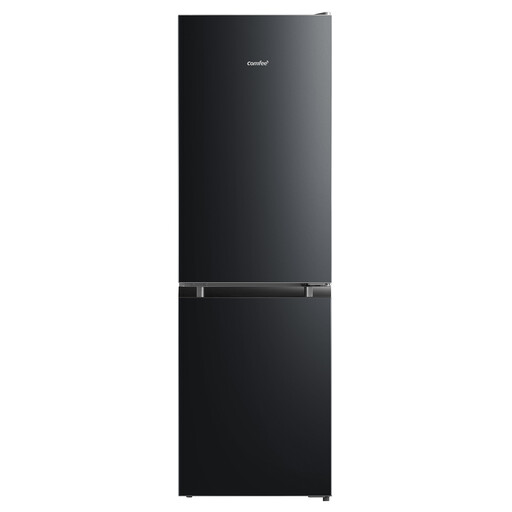 Image unavailable
Comfee' by Midea RCB230BL2EU(E), 174 L fridge-freezer
If you have a modest amount of shopping and frozen food, compare its stated 174 L capacity with the containers you usually use, rather than relying on the number of people in your household alone. The model name indicates Low Frost and a reversible door; check the compartment capacities, annual energy consumption and required clearances.
View on Joybuy
Frequently asked questions
How can I estimate the capacity I need without following a rigid per-person rule?
Start with your usual shopping, the size of your dishes and the number of portions you freeze between batches. Que Choisir suggests 100 to 150 L for one person, plus 50 L for each additional person as a starting point for fridge capacity. Adjust this to suit your habits rather than treating it as a required minimum.
What should I compare on the energy labels of two refrigeration appliances?
Compare the annual energy consumption in kWh with the compartment capacities, appliance type and installation. The European Commission says the label also shows the energy class and noise emissions; the letter alone won’t tell you whether the capacity meets your needs.
What temperature should I keep prepared dishes at in the fridge?
ANSES recommends keeping the coldest part of the fridge between 0 °C and +4 °C. It also advises against overfilling the appliance and recommends refrigerating cooked dishes within two hours of preparation, once they’re no longer hot.
Do I need to choose No Frost to freeze portions?
No, this feature isn’t essential for storing frozen portions. Beko describes the No Frost feature on some models as a way to prevent ice from building up. Check that the model you’re considering has this feature, then prioritise capacity, drawer layout and suitable temperatures.
What should I do with my old fridge or freezer?
In France, ask your retailer or local authority about a suitable collection service for waste electrical and electronic equipment. The Ministry for Ecological Transition points out that these appliances may contain substances or components that require specialist treatment.


