For storing large batches when you have enough floor space, consider a chest freezer; if you often need to find individual portions, an upright model makes organising them easier. An under-counter model suits more limited storage needs, while a fridge-freezer compartment may be enough if everyday refrigeration is your priority. In each case, match the freezer capacity to your portions and check the available space, energy use and operating conditions for the model.
Which format suits you?
People who prepare meals in advance
If you regularly freeze individual portions, consider freezer capacity, storage layout and ease of access. Bosch Electroménager France specifically lists preparing several meals among the uses to consider when choosing a capacity.
Households that buy in bulk
A chest freezer could be a good fit if you have room for the lid to open and storing large batches matters more than having immediate access to every portion. If you plan to keep it in an unheated cellar or garage, check the ambient temperatures the model is designed to operate in.
Households with a compact kitchen
Compare the freezer capacity you actually need with the space available for an under-counter appliance or a fridge-freezer. Also check how far the door swings open and how much room you need to remove the storage drawers.
How do the formats compare?
Start by choosing based on how much you need to freeze and how often you’ll need to find your portions. Then consider the room’s constraints and the features of each model.
Chest freezer
Consider it: for large batches when you have floor space to spare.
Bear in mind: reaching food stored at the bottom takes more organising.
Upright freezer
Consider it: if you organise portions and access them frequently.
Bear in mind: the capacity of a particular upright model may not suit large batches.
Under-counter freezer
Consider it: for extra storage in a kitchen where space is limited.
Bear in mind: its compact capacity may limit how many portions you can store.
Fridge-freezer
Consider it: if you mainly need refrigeration and only freeze moderate amounts.
Bear in mind: the appliance’s total capacity isn’t the same as its freezer capacity.
| Criteria | What to check | Who this matters to |
|---|
| Usable capacity |
Compare the freezer capacity in litres with the space available for your containers. For a fridge-freezer, distinguish this from the total capacity. |
If prepared meals and bulk purchases are piling up, you need enough room for your planned batches. Don’t confuse total capacity with freezer space. Around 36% of consumers would prioritise capacity. |
| Space and access |
Measure the space, delivery route and clearance needed for the door or lid to open. |
In a narrow kitchen, or if you take portions out often, being able to open the appliance and reach the food comes first. This would be a priority for around 29% of consumers. |
| Energy use and defrosting |
Check the kWh/year figure and the model’s defrosting method. Compare appliances with similar capacities and uses. |
If maintenance and the energy use of an appliance that runs continuously influence your choice, these two points come before the format. Around 21% of consumers would put them first. |
| Noise and installation room |
Check the noise level in dB and, for an unheated room, the permitted ambient temperature range. |
Near a living area, noise can be a deciding factor; in a cold outbuilding, the compatible ambient temperature is what matters. Around 14% of consumers would prioritise these installation requirements. |
Mistakes to avoid before buying
-
Choosing capacity without checking access
An appliance that suits your supplies also needs to fit through to its intended spot and be able to open once installed.
Measure the delivery route, floor space and clearance for the door or lid, and make sure you can access the storage compartments.
-
Assuming any freezer is suitable for a garage
The permitted ambient temperature varies by model. A feature advertised for one model doesn’t apply to an entire range.
For a cellar, garage or other unheated room, check the operating temperature range specified for the exact model.
-
Looking at the energy rating alone
ADEME points out that freezers run continuously. Annual energy use helps you assess an appliance, but you should consider it alongside the capacity and intended use.
Compare the kWh/year figures for models with a similar capacity and format.
-
Leaving your old appliance until delivery day
A bulky old freezer can make it harder to install the new one if you haven’t arranged for it to be removed.
Before completing your order, ask the retailer how to arrange collection of your old appliance and check the delivery details.
Brands to consider, model by model
Beko
The range includes upright freezers, with features that vary by model.
- Beko lists No Frost on some models and Freezer Guard on certain models designed for use in specific unheated rooms.
- Check the permitted ambient temperature, capacity and energy label details for the appliance you choose.
Liebherr
The range includes chest freezers as well as freestanding and built-in freezers.
- Liebherr lists a capacity of 497 L and the FrostProtect function for the CFe 2500 Pure chest freezer.
- These features apply to this model. Check the dimensions and installation requirements of the model you’re considering.
Bosch
The brand’s freezers offer storage options worth considering if you regularly access individual portions.
- Bosch lists Vario Zone and Big Box features on the GSN58AWCV.
- Check the actual layout, capacity, noise level and energy use of the model you choose rather than assuming these features apply across the range.
Whirlpool
The upright range includes models with detailed specifications you can compare with your needs.
- Whirlpool lists annual energy consumption of 292 kWh for the WHFF 6403 W4E.
- This model-specific figure isn’t enough on its own to judge whether the appliance is right for you. Also consider its capacity and where you plan to install it.
Appliances available on Joybuy
These appliances illustrate the options covered here: a fridge-freezer, an upright freezer, two chest freezers with different capacities and a small vertical freezer. Compare their freezer space and overall dimensions against your portions and the room available.
 Image unavailable
Candy CFQQ5T817EPS, 467 L fridge-freezer
Worth considering if you want everyday refrigeration and portion storage in one appliance. The product title lists a total capacity of 467 L, an E energy rating and Total No Frost. Check the freezer compartment capacity separately, along with the space needed for the four doors.
View on Joybuy
 Image unavailable
Heinrich´s, 161 L upright freezer
Its upright design suits households that want to organise portions rather than stack them in a chest freezer. The product name lists a capacity of 161 L, No Frost and a C energy rating. Before installation, check the dimensions, noise level and permitted ambient temperature.
View on Joybuy
 Image unavailable
AUCMA, 291 L convertible chest freezer
The listed capacity may appeal to households that buy in bulk and have room for a top-opening appliance. The product name mentions a removable basket, fridge and freezer modes, and an E energy rating. Check the defrosting method and room conditions before installation.
View on Joybuy
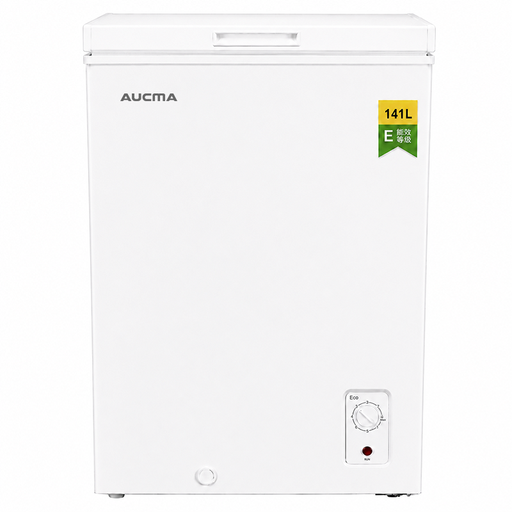 Image unavailable
AUCMA, 141 L convertible chest freezer
This chest freezer is worth considering if you want dedicated storage on a smaller scale than a large chest freezer and can reach food from above. The product name lists a capacity of 141 L, a removable basket, fridge and freezer modes, and an E energy rating. Check its floor space against the location you have in mind.
View on Joybuy
 Image unavailable
COMFEE' RCU60WH2(E), 60 L vertical freezer
Worth considering for extra storage when space is limited, rather than for regularly storing large batches. The product name lists a capacity of 60 L, a reversible door and an E energy rating. Check the dimensions and exact internal layout of this variant before choosing containers.
View on Joybuy
Frequently asked questions
Which figures on the energy label should I compare?
For appliances covered by European energy labelling, check the A to G rating, annual energy consumption and the model’s noise information. As ADEME recommends when choosing a household appliance, use the label to compare models, but compare the kWh/year figures for appliances with similar capacities and uses.
Can I put a freezer in an unheated cellar or garage?
Only choose a model after checking that its permitted ambient temperature range suits the room. Beko lists Freezer Guard down to −15 °C on the B5RFNE315G, and Liebherr offers FrostProtect on some chest freezers, but these features aren’t available on every model.
Does No Frost mean I won’t need to defrost it manually?
Beko and Bosch describe No Frost as a way to avoid manual defrosting on models equipped with the technology. Check which technology is listed for the specific model you’re considering.
How should I arrange for my old freezer to be taken away?
Contact the retailer before completing your order to arrange collection of your old appliance, if available. Confirm the collection arrangements when you book delivery and make sure there’s clear access for removal.


