Households preparing portions each week
If you regularly take out one particular meal, front access and easy-to-browse drawers matter just as much as capacity. UFC-Que Choisir includes ease of use among its criteria for evaluating freezers.


If you want to find your pre-prepared portions easily each week, choose an upright freezer for easy access and storage. If you’re freezing large batches and have enough floor space, consider a chest freezer instead. A large fridge-freezer suits a different need if you’re already replacing your main appliance, while a vacuum sealer helps package certain foods but doesn’t replace refrigeration or freezing. In every case, compare the capacity actually available for frozen food, the dimensions and the installation requirements.
If you regularly take out one particular meal, front access and easy-to-browse drawers matter just as much as capacity. UFC-Que Choisir includes ease of use among its criteria for evaluating freezers.
If you have a suitable room and freeze large quantities of food, measure the available space before considering a chest freezer. Its open compartment also calls for a way to identify portions without moving everything around.
If you’re already replacing your main fridge, check how much space a large fridge-freezer has for frozen food. If you have enough refrigeration capacity, a vacuum sealer may instead meet your packaging needs, for foods and accessories that are compatible.
Start with the need that’s currently holding back your meal prep: access to portions, capacity, room for just one appliance or food packaging. For refrigeration appliances, the European Commission says the energy label provides information including energy consumption, storage volumes and noise levels. Compare these figures across models suited to the way you’ll use them.
| What matters to you | What to check | Who it’s for |
|---|---|---|
| Finding your portions | Number and dimensions of the drawers; access to labels and dishes. | When I take out just one portion regularly, I want to find it without moving the other meals. Easy access is the top priority for around 31% of consumers. |
| Storing large batches | Frozen compartment capacity; floor space and clearance for opening. | If I freeze several large batches at once, I need enough room without obstructing movement around the room. Capacity is the top priority for around 31% of consumers. |
| Keeping fresh and frozen food together | Separate fresh and frozen storage volumes; installation dimensions and annual energy consumption. | I’m already replacing my fridge and want to store my frozen portions in the same appliance, without installing a second one. Around 23% of consumers put having one appliance at the top of their list. |
| Vacuum-sealing food | Settings suited to the food you plan to package; compatibility of bags and containers. | I have enough refrigeration or freezer space, but want to vacuum-seal portions that are suitable for it. This is the top priority for around 15% of consumers. |
The total capacity of a fridge-freezer includes the fridge section, so it won’t tell you how much food will fit in the freezer. A spacious chest freezer can also be inconvenient if meals are difficult to find.
Compare the capacity in litres of the frozen compartment, then check how your dishes will fit in the drawers or how you’ll organise them in a chest freezer.
The appliance takes up floor space, and the lid needs room to open. The temperature of the room must also be suitable for the model’s climate class.
Measure the space and clearance required in the instructions. Check the climate class if you’re considering a pantry, cellar or garage.
FoodSaver’s instructions state that perishable foods sealed under vacuum must be kept refrigerated or frozen. Moist or delicate foods may also need specific settings and accessories, depending on the model.
Check which foods, bags and containers are compatible, and continue to follow appropriate freezing and defrosting practices.
Depending on how you use them, compatible bags, rolls or containers may need to be replaced.
Appliances with different energy ratings can also vary in usable capacity, noise levels or size. The European Commission says the energy label shows several of these details.
Compare the annual energy consumption, storage capacity and noise levels of appliances that meet the same need, then check their installation dimensions.
The range includes freezers, including freestanding models with NoFrost technology.
Beko offers both chest and upright freezers: two formats to consider depending on how much you store and how you want to access it.
Bosch fridge-freezers combine fresh and frozen storage in one appliance, with some models offering a large capacity.
Depending on the model, FoodSaver vacuum sealers offer settings for moist or delicate foods, along with packaging accessories.
These Joybuy models illustrate four ways to store pre-prepared meals: keep portions in an upright freezer, combine fresh and frozen storage in a fridge-freezer, vacuum-seal food or add a chest freezer. Before deciding, check the usable dimensions and installation requirements of the model you choose.
 Image unavailable
Worth considering if you want to organise portions in a freezer with front access. The product name lists a capacity of 161 L, No Frost and a reversible-hinge door. Check that the layout accommodates your dishes and that the dimensions suit the space you have in mind.
 Image unavailable
Consider this if you’re replacing your fridge and want to keep fresh food and frozen portions in one appliance. The stated 467 L is the total capacity, so check the space available in the freezer section separately, along with the usable dimensions of its drawers. The model name lists Total No Frost and an E energy rating.
 Image unavailable
This fridge-freezer is an option if you want one appliance for fresh and frozen food, provided its freezer compartment has enough room for your portions. The model name lists a total capacity of 360 L, Total No Frost, an E energy rating and Wi-Fi connectivity. Check the freezer capacity separately, as well as the internal drawer dimensions to make sure your containers will fit.
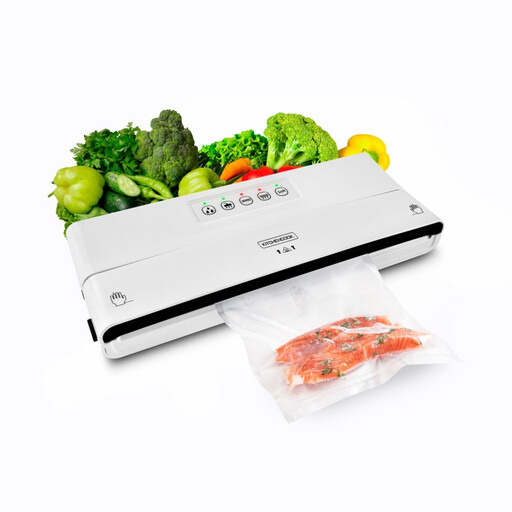 Image unavailable
Worth considering for sealing portions if you already have enough fridge or freezer space. The product name mentions a roll cutter; check that the bags and containers are compatible, and that the settings suit your moist or delicate foods. Perishable foods sealed under vacuum must still be kept cold.
 Image unavailable
This chest freezer can provide extra space for frozen batches if you have enough room for the appliance and to open the lid. The product name lists a capacity of 140 L, a basket, a counterbalanced lid and an E energy rating. Plan how you’ll find your portions and check the climate class for the room you have in mind.
According to Anses, freezing food at home at −18 °C stops bacteria from multiplying, but most microorganisms survive. Freezing doesn’t remove the need to handle and prepare food carefully, so check your appliance instructions for how to set it.
Anses advises against refreezing food once it has been defrosted. It recommends defrosting food in the fridge, in the microwave using the defrost setting, or quickly by cooking or reheating it, then eating it promptly.
No. FoodSaver’s instructions state that perishable foods must be refrigerated or frozen after vacuum sealing, and that vacuum sealing does not replace sterilisation. Choose a vacuum sealer to package suitable foods, not as a substitute for a refrigeration appliance.
The European Commission says that the label for relevant refrigeration appliances includes information such as the energy efficiency class, annual energy consumption, storage volumes and noise levels. If you’re choosing a fridge-freezer for pre-prepared meals, pay particular attention to the capacity of the frozen compartment, which is listed separately from the total capacity.