What should you check before choosing?
Start by estimating how much space your portions and shopping will take up. Then check how you’ll access them and where the appliance can operate.
| Criteria |
What to check |
What suits my needs |
| Capacity |
Compare freezer capacity, not the total capacity of a fridge freezer. UFC-Que Choisir notes that a small compartment may not be enough if you eat a lot of frozen food or want to store one to two weeks’ worth of supplies. |
I only freeze a few portions between shopping trips: the existing compartment may be enough if they fit. If I regularly buy larger quantities, I’ll work out how much space I need before choosing a separate appliance. |
| Format and access |
Measure your containers, the available floor space and the clearance needed to open the appliance. UFC-Que Choisir describes upright freezers as typically around 200 L, with some reaching 400 L; chest freezers can hold up to 600 L, while under-counter models range from 30 to 100 L. |
I want to find small portions quickly, so drawers could be useful. If I mainly store large bags or dishes, I could consider a chest freezer, as long as I organise its contents. For extra capacity in a small kitchen, I’ll look at an under-counter model. |
| Location |
Check the room’s minimum and maximum temperatures and compare them with the model’s documentation. Beko gives an ambient temperature range of 10 to 43 °C for climate class SN-T; this alone does not cover a room that falls below 10 °C. |
I’m planning to put my appliance in a cellar or garage, so I’ll check its operating range for that specific room, even if the product description mentions garage use. |
| Energy and maintenance |
Compare the energy rating and annual energy consumption of models with a similar format and capacity. ADEME gives freezers an energy rating scale from A to G; check separately whether the model has No Frost and how it needs to be defrosted. |
As the appliance will run continuously, its energy consumption matters to me. If I want to reduce frost-related maintenance, I’ll also look at the model’s features, without confusing them with its energy rating. |
| Stored food and power cuts |
Compare the stated power-cut storage time and, if you often add a lot of food at once, the freezing capacity in kg/24 h. UFC-Que Choisir assesses these as separate criteria in its freezer testing process. |
I keep a lot of food in reserve or come home with several items to freeze, so I’ll check both figures for the models I’m considering rather than relying on capacity alone. |
Brands and ranges to consider
These examples show features to look for in a specific model; they don’t indicate what you’ll find across an entire brand.
Beko
Worth considering if you plan to install your freezer in an unheated room.
- Beko says its B5RFNE315G model has a Freezer Guard function, which the brand says allows it to operate at ambient temperatures as low as −15 °C.
- Check that the specific model you choose has this feature. It doesn’t come with an SN-T climate rating alone and isn’t available on every Beko freezer.
Bosch
Worth considering if you want an upright freezer and storage options and freezing specifications matter to you.
- Bosch lists a capacity of 366 L, a 13-hour storage time during a power cut and a freezing capacity of 26 kg/24 h for its GSN58AWCV upright freezer.
- These figures apply to the GSN58AWCV. Check the climate class and installation requirements of your chosen model separately.
Liebherr
Worth considering if you’re looking for a freezer with maintenance features or one designed for a cool room, depending on the model.
- Liebherr offers NoFrost freezers and says that appliances with FrostProtect can operate at ambient temperatures as low as −15 °C.
- Not all models necessarily include FrostProtect, so check the product details and manual for the appliance you choose.
Joybuy options for stocking up
These options include a fridge freezer, an upright freezer and chest freezers. They give you a chance to consider both integrated freezing and dedicated storage. Check the freezer capacity and make sure the location is suitable for your household.
 Image unavailable
Candy CFQQ5T817EPS, 467 L fridge freezer
An integrated option if you want refrigeration and freezing in a single appliance. The 467 L figure is the total capacity, so check how much freezer space is available for your portions.
Four-door model with Total No Frost and an E energy rating. If you plan to keep it in an unheated room, check its ambient temperature range.
View on Joybuy
 Image unavailable
Heinrich´s, 161 L upright freezer
Worth considering if you want to organise portions in a dedicated appliance rather than in an open chest freezer. This model is listed with drawers, a reversible hinged door and a No Frost function.
It’s also listed with a C energy rating, LED display and alarm. Check its dimensions, storage time during a power cut and the permitted ambient temperature for your chosen location.
View on Joybuy
 Image unavailable
AUCMA, 291 L convertible chest freezer
Worth considering for larger stocks if you have room to open a chest freezer and organise food in its spacious interior.
It’s listed with fridge and freezer modes, a removable basket, a five-level digital control and an E energy rating. The word ‘garage’ in the product name doesn’t replace checking the model’s permitted ambient temperature range.
View on Joybuy
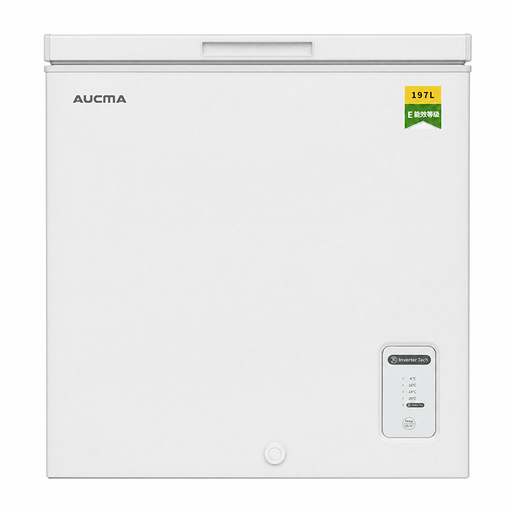 Image unavailable
AUCMA, 197 L convertible chest freezer
This 197 L chest freezer is another option for storing food in a dedicated appliance. Check that its open interior suits your containers and the way you want to find smaller portions.
It’s listed with fridge and freezer modes, a removable basket, a five-level digital control and an E energy rating. Before installing it in a cellar or garage, check the permitted ambient temperature range.
View on Joybuy
 Image unavailable
CHiQ JR99DWE, 99 L chest freezer
A chest freezer worth considering for extra capacity if 99 L is enough for the portions you want to store separately from your fridge.
It’s listed with a removable basket, adjustable thermostat and an E energy rating. The model description specifies manual defrosting; also check how much room you need to open the lid and the permitted ambient temperature range.
View on Joybuy
Frequently asked questions
Is my fridge freezer compartment big enough for batch cooking?
It may be enough for a few portions if there’s room for your containers as well as the food already stored inside. If you eat a lot of frozen food or want to store one to two weeks’ worth of supplies, UFC-Que Choisir advises against relying on a basic freezer compartment. Check its capacity before deciding whether you need a separate appliance.
What ambient temperature should I check for a cellar or garage?
Check the room’s minimum and maximum temperatures, then compare them with the range permitted for the exact model. Beko gives a range of 10 to 43 °C for climate class SN-T, which on its own isn’t suitable for a room that falls below 10 °C. Beko says some of its Freezer Guard models can operate at temperatures as low as −15 °C, as can Liebherr models fitted with FrostProtect. Check that the specific model you’re considering has the relevant feature.
Is a chest freezer better than an upright freezer for buying in bulk?
Not necessarily. A chest freezer offers open space for larger packs, while the drawers in an upright freezer can make it easier to organise and access portions. Choose according to the capacity you need, the size of your containers, the floor space available and how you plan to organise your food.
What should I compare on a freezer’s energy label?
Compare the A to G rating and annual energy consumption, taking the capacity and format of each appliance into account. ADEME gives this scale for freezers; the rating alone won’t tell you which capacity is right for your storage needs.
What should I look at besides capacity?
Check how easy it is to access food, the permitted ambient temperature, annual energy consumption and storage time during a power cut. If you often add large quantities after shopping, compare the freezing capacity in kg/24 h too. UFC-Que Choisir assesses energy consumption, storage time and freezing capacity as separate criteria.


