Who is this choice for?
The right set-up mainly depends on where you run out of room after a batch-cooking session: in the fridge, the freezer or the kitchen itself.
You store meals chilled and frozen
After cooking, you need to put away meals for the next few days and set aside other portions for later. Compare fridge and freezer capacity separately, leaving enough space for air to circulate in the fridge, as ANSES recommends.
Your freezer fills up before your fridge
If your current fridge has enough room for the meals you want to keep chilled, an upright or chest freezer could provide extra capacity. The right choice depends on the space available and how you want to access your portions.
You have a small kitchen
One appliance may be easier to fit than two, but its width, depth and height, as well as the door swing, need to suit the space. In an open-plan kitchen, compare the noise levels listed for each model too.
What should you check before buying?
Start by working out how many portions you’ll have at once after a typical batch-cooking session, then check the appliance’s dimensions and features. The European Commission lists fridge and freezer compartment capacities separately on the energy label for applicable appliances.
Fridge-freezer
Worth considering if: you need space for chilled and frozen food, but only have room for one appliance.
The trade-off: if the freezer section becomes too small, the fridge-freezer’s total capacity won’t solve the problem on its own.
Small freezer compartment
Worth considering if: you mainly keep your prepared meals in the fridge and only freeze a few portions at a time.
The trade-off: check the available freezer capacity before planning to stock up on meals for several weeks.
Separate freezer
Worth considering if: your fridge is big enough, but portions for the freezer are piling up. An upright freezer makes use of vertical space; a chest freezer is a good fit if you have room for a wider appliance.
The trade-off: a second appliance takes up extra space and adds to your electricity consumption.
| Criteria |
What to check |
What I need |
| Separate capacities |
Compare fridge and freezer capacity in litres separately on the energy label or product specifications. Check the drawers or baskets too if you sort portions by date. |
I need room for meals for the next few days and portions I’m saving for later at the same time, so I shouldn’t base my choice on total capacity alone. |
| Temperature |
ANSES recommends keeping the coldest part of the fridge at 4 °C for perishable foods and not overfilling the appliance. For home freezing, it recommends −18 °C. |
After a cooking session, I want to be able to store food in suitable areas while still allowing air to circulate. |
| Space needed |
Measure the width, height and depth, the route to the installation spot, and the space needed to open the door or lid. Check the model’s manual for installation requirements. |
A larger appliance or second freezer needs to fit in my kitchen and remain easy to access once it’s installed. |
| Everyday use |
The European Commission says the energy label provides information on energy consumption, capacity and noise. Compare these details between appliances that meet similar needs, and check how the model is defrosted. |
If the appliance is near a living area, noise matters too. If I have two appliances, I need to consider their energy consumption and maintenance. |
Which brands and models should you compare?
These models show a range of formats. The stated specifications apply to the specific models listed, not to every product from each brand.
Bosch
The KGN492IAF fridge-freezer is an example of a single upright appliance offering generous fridge and freezer capacity.
- Bosch Electroménager France lists 311 l of fridge capacity, 129 l of freezer capacity, 29 dB(A) and an A energy rating for this model.
- Its stated dimensions of 203 × 70 × 66.7 cm mean you’ll need to check the space available and the route into your kitchen.
Liebherr
The brand offers fridge-freezers as well as upright freezers. The FNe 5006 Pure NoFrost is an example of a separate freezer.
- Liebherr lists 238 l of capacity, 36 dB and a width of 59.7 cm for the FNe 5006.
- Before choosing an upright freezer as an extra appliance, check that you have room for it, that its door can open fully and that you can meet Liebherr’s installation requirements.
Whirlpool
The WFNF82EOXFR is a fridge-freezer, while the W3RHS31DW2 is a chest freezer you could consider as a separate appliance.
- Whirlpool France lists 223 l of fridge capacity and 97 l of freezer capacity for the fridge-freezer. For the chest freezer, the brand lists 308 l and three baskets.
- The W3RHS31DW2 chest freezer measures 112 cm wide and 71.5 cm deep, according to Whirlpool France. Its horizontal design also affects how easily you can reach portions stored at the bottom.
Samsung
The RB34T600CSA fridge-freezer shows why it’s worth comparing stated capacity with external dimensions.
- Samsung France lists a total capacity of 340 l and a depth of 600 mm for this model.
- To see how well it suits batch cooking, check its fridge and freezer capacities separately, along with its noise level and energy consumption.
A fridge-freezer option on Joybuy
This fridge-freezer is designed to store chilled and frozen portions in one appliance. Before deciding if it’s right for you, compare its fridge and freezer space with what you typically prepare.
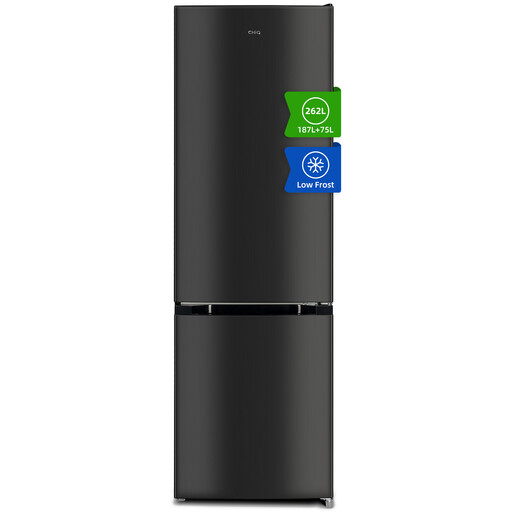 Image unavailable
CHiQ JR263LGE, 262 L 70/30 Low Frost fridge-freezer
If you want to keep chilled and frozen portions in one appliance, compare the stated 70/30 split with your actual needs. This black model has a total capacity of 262 L, is 54 cm wide and 176 cm tall. Before buying, check the capacity of each compartment, the space needed for installation and the Low Frost defrosting requirements.
View on Joybuy
Frequently asked questions
What temperature should you aim for when storing meals prepared in advance?
ANSES recommends keeping the coldest part of the fridge at 4 °C for perishable foods, including cooked meals. Avoid overfilling the appliance so air can circulate, and check the temperature in this area as directed in the manual.
Can you wait several days before freezing portions?
ANSES recommends freezing food as soon as you buy or prepare it, and gives −18 °C as the temperature for home freezing. It explains that freezing stops bacteria multiplying but does not eliminate most microorganisms. Defrost food in the fridge, in the microwave using the defrost setting, or quickly by cooking or reheating it. Do not refreeze food once it has been defrosted.
Why compare fridge and freezer capacity separately?
Because total capacity doesn’t show you which compartment your portions will fit into. The European Commission lists fridge and freezer capacities separately on the energy label, so compare each with the number of meals you’ll be keeping chilled or frozen at the same time.
Is a NoFrost appliance enough to keep meals properly?
No. NoFrost relates to frost build-up and maintenance, depending on the model; it doesn’t replace temperature checks. For prepared meals, ANSES recommends keeping the coldest part of the fridge at 4 °C and avoiding overfilling it.
What should you look for on a fridge or freezer energy label?
For applicable household appliances, the European Commission says the energy label shows a rating from A to G, energy consumption, storage capacities and noise levels. Compare this information across appliances that can hold your portions, rather than judging an appliance on its rating alone.


