Households that batch-cook several portions
You need enough space for batch-cooked meals and bulk shopping, while still being able to see what you have in stock.


If the freezer compartment in your fridge-freezer can hold your maximum stock of batch-cooked meals, one appliance may be all you need. For dedicated storage, an upright freezer makes portions easier to access, while a chest freezer offers more space but takes more organisation. If space is tight, consider a compact model too. Whatever you choose, check where it will go and the model’s annual energy consumption.
You need enough space for batch-cooked meals and bulk shopping, while still being able to see what you have in stock.
You want more freezer space without obstructing walkways or door openings. The freezer’s width, depth and net capacity matter just as much as the appliance format.
If the room temperature varies, check that the model’s stated operating temperature range covers the conditions where you plan to install it.
Start by working out the maximum number of portions you’ll need to store at once, then compare that with the freezer’s net capacity and the space available. A fridge-freezer combines refrigeration and freezing in one appliance; an upright freezer makes drawer-by-drawer organisation easy, while a chest freezer requires you to plan access to items at the bottom. A compact model is also worth considering if space is your main constraint.
| What to consider | What to check | Who is this important for? |
|---|---|---|
| Freezing capacity | Compare the freezer’s net capacity with the maximum number of portions you’ll store. If you freeze a lot of food at once, check its freezing capacity in kg/24 h too. | When batch-cooked meals and bulk shopping start to pile up, I want to store everything without losing track of what I have. Around 33% of consumers prioritise this kind of storage space. |
| Size and space | Measure the installation space, delivery route and clearance needed to open the door or lid. For a built-in appliance, check the housing space and installation instructions. | In a narrow kitchen, I’m looking for extra capacity that still keeps the appliance accessible day to day. This is the main consideration for around 25% of consumers. |
| Access to portions | Check the size of the drawers or baskets and whether there’s room for larger containers. Look at the defrosting method specified in the manual. | If I prepare different portion sizes, I want to find the oldest ones without emptying the whole freezer. Easy access and organisation are the main priorities for around 25% of consumers. |
| Installation location and power cuts | Compare the possible room temperatures with the range stated for the model. If power cuts are a concern, check the stated storage time in hours. | If I’m putting an appliance somewhere that isn’t temperature-controlled, I first need to know whether it’s suitable for that location. Keeping food cold during a power cut may matter too. Around 17% of consumers prioritise these conditions. |
ADEME reminds us that fridges and freezers run continuously. Compare the annual energy consumption in kWh/year on the energy label for models with a similar function and capacity, rather than judging them by their energy rating alone.
Some of that space is set aside for fresh food. For example, Beko lists the RCSA270K40SN as having an 87 L freezer compartment.
Compare the net freezer capacity, then make sure your tubs and dishes will fit in the compartments provided.
The climate class indicates the range of ambient temperatures the model is designed for. If the room falls outside this range, the appliance may not work properly.
Check the likely temperatures throughout the year and consult the rating plate or manual before choosing a location.
Portions at the bottom can be hard to find if the contents aren’t divided into easy-to-reach sections.
Check which baskets are included and how the lid opens, then plan an arrangement that makes it easy to find the portions you need to use first.
The rating on its own doesn’t tell you the appliance’s stated annual energy consumption or how much storage space you’ll get.
Compare the kWh/year for models with a similar function and capacity, then choose a freezer size that suits your usual stock.
Worth considering if an upright freezer with drawers and large compartments would help you keep portions separate.
Worth considering if you’re looking for a large-capacity chest freezer or a model specifically designed for a cold room.
Worth considering if you need a fridge-freezer for a narrow kitchen, but check that its freezer capacity is right for you.
Worth considering when a built-in appliance is essential and your existing housing space has specific requirements.
These fridge-freezers are suited to anyone who wants one appliance for fresh food and meals to freeze. Focus on the freezer compartment’s capacity and any installation requirements: the total capacity doesn’t tell you how much room there is for your portions.
 Image unavailable
Worth considering if you want to keep fresh food and frozen portions in the same appliance.
Stated total capacity: 467 L; Total No Frost; energy rating E. Check the dimensions and delivery route before buying.
 Image unavailable
Worth considering if you prefer a fridge-freezer for organising fresh food and portions to freeze.
Stated total capacity: 360 L; Total No Frost; energy rating E; Wi-Fi and My Zone features listed in the model name. Check that the doors can open fully in your kitchen.
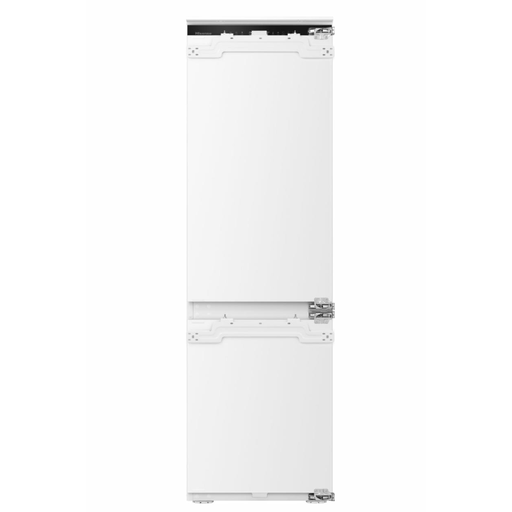 Image unavailable
Worth considering if your kitchen needs a built-in appliance and its freezer capacity is right for your portions.
Stated total capacity: 252 L; No Frost; energy rating C. Check the housing dimensions and the ventilation and installation requirements.
 Image unavailable
Worth considering for a fitted kitchen if the housing space and freezer compartment meet your storage needs.
Stated total capacity: 249 L; TwinTech No Frost; energy rating E. If annual energy consumption or storage time during a power cut matters to you, check these figures on the model’s product page.
 Image unavailable
Worth considering when kitchen width is a key factor and your stock of portions will fit in a compact freezer.
Stated total capacity: 227 L, including a 74 L freezer compartment; Low Frost; energy rating E. Check the full height, required clearances and annual energy consumption before choosing.
Compare the net freezer capacity with the maximum amount you need to store, rather than looking at the total capacity of a fridge-freezer. Count the portions and larger dishes you’ll be storing at the same time, then check the dimensions of the drawers or baskets. The number of litres alone won’t tell you whether your containers will fit.
Yes, if the model is designed to cope with the temperatures your garage may reach. According to the climate ranges listed by Beko France, class SN is suitable for 10 to 32 °C and class SN-T for 10 to 43 °C. Any suitability for lower temperatures must be explicitly stated for the model in question. Check the manufacturer’s installation instructions too.
Check the annual energy consumption in kWh/year on each energy label, taking the function and capacity of each appliance into account. ADEME reminds us that these appliances run continuously, so the energy rating alone won’t tell you which option is right for your storage needs.