
Livraison le jour même ou le lendemain

Qualité garantie

Débloquez vos offres de bienvenue: Livraison GRATUITE | Jusqu'à -80 % | 30 jours d'essai gratuits à JoyPlus
Téléchargez l'application
A barbecue meal is about more than just a grill and some food. To flip a piece of meat, sear vegetables, move skewers or clean the cooking surface, the right barbecue utensils give you precision and help you avoid risky handling.
But be wary of marketing descriptions. A very comprehensive kit isn’t necessarily suited to your appliance, and the word “durable” alone doesn’t guarantee a long-lasting design. Here are the criteria to check before buying your barbecue accessories.
A barbecue utensil kit can pile up accessories you’ll never use. For everyday cooking, a barbecue tongs, a spatula and a fork already cover the essentials. On a plancha, a wide spatula will often prove more practical than a cooking fork.
On the other hand, if you prepare chopped vegetables, prawns or small pieces of meat, a barbecue grill basket can really make a difference. The kit’s composition should above all match your usual recipes.
Not all stainless steels are the same. When the spec sheet states it, 304 stainless steel is a good indicator of corrosion resistance and food-contact suitability. That doesn’t mean you can skip drying the utensils or avoid leaving them in contact with salt or acidic residues.
The choice of handle also deserves your attention. A one-piece metal handle can quickly become hot. A wooden handle or a hollow structure sometimes limits heat transfer, but doesn’t replace sensible precautions.
A barbecue cleaning brush makes maintenance easier, but inspect it before each use. Loose metal bristles can stay on the grill and end up in your food. Throw it away if the bristles are bent, missing or poorly attached.
Baskets, skewers and other outdoor cooking accessories get very hot. Use suitable gloves or long enough utensils, and wait until the equipment has completely cooled before cleaning it.
For your cooking utensils, choose a spec sheet that clearly states the material used: 304 stainless steel, standard stainless steel, food-grade silicone or wood. A one-piece construction reduces the number of gaps where grease can build up. Welds, springs and hinges should also be sturdy enough to withstand repeated use.
Silicone is suitable for non-stick surfaces, as long as you check the maximum temperature stated by the manufacturer. A metal spatula is generally better suited to a steel grill or plancha, but it can scratch certain coatings.
A length between 32 and 40 cm offers a good compromise: your hands stay far enough from the heat without losing precision. A wide spatula makes flipping steaks, fish or burgers easier. Rounded edges are preferable to reduce the risk of scratching compatible surfaces.
For a plancha spatula, check the blade width and overall dimensions. A blade that’s too narrow means you’ll need more movements to move food, while a model that’s too wide can become awkward on a small cooking surface.
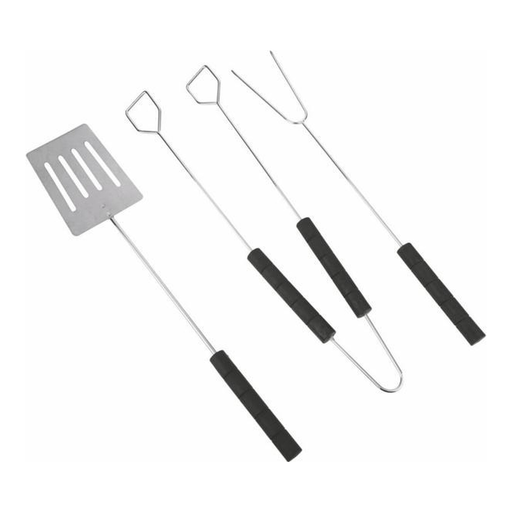
Why this choice suits this profile: This set includes a spatula, tongs and a fork in stainless steel, covering the essential tasks for a family barbecue, picnic or camping trip.
The three-piece format stops you paying for an oversized kit when your needs are limited to flipping and serving food.
A compact set of three tools, with stated dimensions of 39 x 7 x 10 cm, to be washed by hand with a soft sponge.
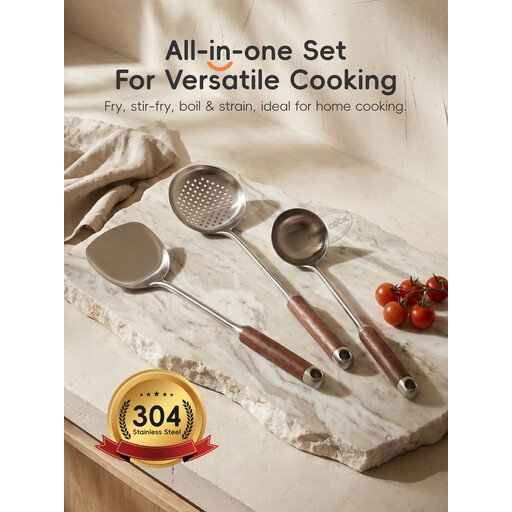
Why this choice suits this profile: This three-piece set combines 304 stainless steel heads with wooden handles: a slotted spatula, a ladle and a slotted spoon for both cooking and serving.
The spec sheet clearly states the 304 stainless steel quality and lengths of 34 to 38 cm, rather than just a vague promise of durability.
The wooden handles conduct little heat and include hooks for storage. Hand washing is recommended.
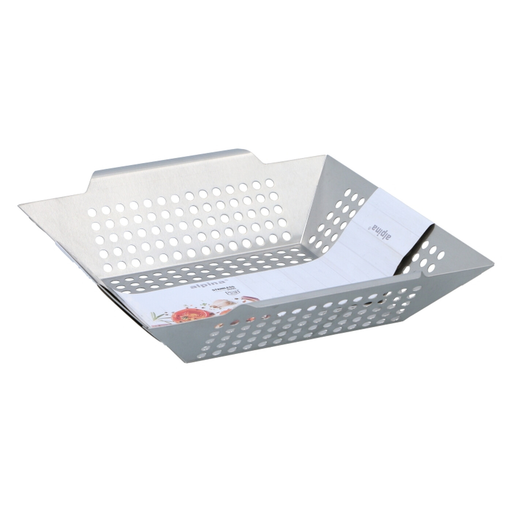
Why this choice suits this profile: This perforated basket, measuring 35 x 30.5 cm, holds vegetables, pieces of meat and delicate foods that might otherwise fall through the grill bars.
Its perforated surface holds small ingredients without you having to flip each piece individually.
A spacious format, good heat circulation thanks to the perforations, and cleaning with soapy water once the basket has cooled down.
We’ve put together a comprehensive, real-time updated list of products that fully meet these strict selection criteria and European safety regulations.
A barbecue tongs, a spatula and a fork are enough for the main tasks. Add a basket for vegetables or a skewer holder if you regularly cook small portions.
Wash them after each use with warm water, a mild detergent and a non-abrasive sponge. Dry them promptly, especially after contact with salt, marinade or acidic foods. Avoid steel wool, which can scratch the surface.
It all depends on how often you use them, how you store them and how you care for them. Regularly check the condition of the handles, hinges, welds and spatula edges. Replace any tool that is bent, rusty or has a loose part, even if the kit still looks in good condition.