Shoppers looking for a measurable reduction
You want to compare the sauce with a similar product, rather than simply avoid added sugar. According to Manger Bouger, the ‘reduced sugar’ claim refers to a comparative reduction.


To reduce your sugar intake compared with a similar sauce, look for the claim ‘reduced sugar’: according to Manger Bouger, this means at least 30% less sugar than a similar product. If your priority is avoiding added sugar, choose a sauce labelled ‘no added sugar’. It may still contain sugars naturally present in the tomatoes. A classic recipe is another option for a barbecue. In every case, compare the ingredients, allergens and nutritional values per 100 g.
You want to compare the sauce with a similar product, rather than simply avoid added sugar. According to Manger Bouger, the ‘reduced sugar’ claim refers to a comparative reduction.
You’re looking for a tomato base for dishes served at a barbecue, with no added sugar. As Anses points out, ‘no added sugar’ does not mean that the sauce contains no sugar at all.
You want to check the sugar, salt, ingredients and allergens before serving a sauce to your guests. Nutritional information per 100 g makes it easier to compare recipes.
When choosing a sauce for a barbecue, start with your main priority: a comparative reduction in sugar, no added sugar, ingredients or ease of serving. You can then choose the format and recipe without confusing them with a nutrition claim.
| Criterion | What to check | Who is it for? |
|---|---|---|
| Measurable sugar reduction | The ‘reduced sugar’ claim, the comparison stated and the sugar content per 100 g. According to Manger Bouger, the claim means at least 30% less sugar than a similar product. | I want to see a reduction in sugar compared with a similar sauce, not just read a promise on the packaging. Around 33% of shoppers would put this measurable reduction first. |
| No added sugar | The exact claim, the ingredients list and the ‘sugars’ line per 100 g; sugars naturally present may still be included. | For pasta or other barbecue dishes, I want a tomato base with no added sugar, even though tomatoes naturally contain sugars. This would be the main criterion for around 27% of shoppers. |
| Recipe ingredients | The ingredients and allergens, as well as the sugar and salt content per 100 g. | Before serving several guests, I prefer to look at the recipe as a whole rather than choosing based on a single claim. Around 20% of shoppers would prioritise this comparison. |
| Format and serving | The quantity that suits the meal and the storage instructions after opening; check the sugar criterion separately. | I’m mainly looking for packaging that’s easy to serve, without opening more sauce than I need. For around 20% of shoppers, convenience would be the main concern. |
The first claim does not rule out sugars that occur naturally. The second refers to a reduction compared with a similar product, as Manger Bouger explains.
If you’re looking for a comparative reduction, check the claim used and compare the ‘sugars’ line per 100 g.
A claim about sugar does not tell you everything about the other ingredients or allergens. For example, Carrefour’s product listing for a Heinz ‘no added sugar’ sauce states that it contains a milk flavouring.
Read the ingredients list, allergen information and nutritional values for the specific recipe before serving it.
Packaging doesn’t determine what’s in the sauce: the tube of vegetable sauce featured by Auchan lists sugar among its ingredients.
Choose the recipe according to your sugar requirements first, then pick a format that suits the way you’ll serve it.
Cooked tomato and Provençal-style sauces to consider if you want a ready-to-use recipe for pasta.
Cooked tomato and Provençal-style sauces to compare if you’d prefer a prepared recipe to tomato purée that you season yourself.
A range bringing together several tomato- and vegetable-based sauces, including Carrefour Classic’ and Carrefour Bio products.
Products to consider if you’re deciding between a sauce labelled no added sugar and packaging that’s convenient to serve.
Tomato sauce recipes to compare on their labels when the ingredients matter as much as the type of sauce.
These MUTTI tomato purées can be used as a base for pasta sauce at a barbecue, but they need to be prepared and seasoned. If reducing sugar is your main priority, check separately for a relevant claim on the packaging.
 Image unavailable
A tomato base to prepare and season for pasta at a barbecue, rather than a ready-made sauce. Check the label if you’re looking for a sugar-reduction claim.
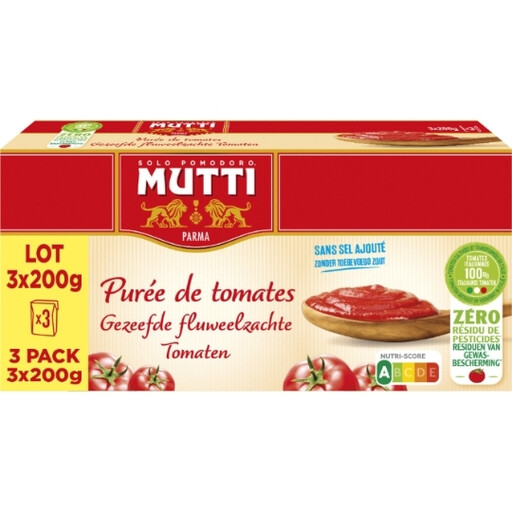 Image unavailable
This pack of three lets you choose how much purée to open when making a pasta sauce; it isn’t a ready-seasoned sauce. Check the packaging for ingredients and salt content before choosing this recipe.
Yes. It may contain sugars naturally present in its ingredients, including tomatoes, as Anses points out. Check the ‘sugars’ line in the nutritional information per 100 g.
Look for ‘reduced sugar’ and check the stated comparison with a similar product. According to Manger Bouger, this claim means at least 30% less sugar; ‘no added sugar’ does not describe the same comparison.
Check the ingredients and allergens for the specific recipe, then compare the sugar and salt content per 100 g. The format should also suit the amount you plan to serve.
Follow the storage instructions on the packaging of the sauce you choose. For its Zapetti Provence et Languedoc sauce, Auchan advises refrigerating it after opening and using it promptly; this guidance doesn’t specify how long other recipes can be kept.