Hosts keeping an eye on sugar content
You’re looking for a drink with no added sugar, without confusing this claim with being sugar-free. The ‘of which sugars’ line, shown per 100 ml, lets you compare products before deciding how much to serve.


For a barbecue, start by checking the type of drink and the ‘of which sugars’ line, rather than relying on the ‘no added sugar’ claim alone. The apple juice products listed by Auchan and E.Leclerc contain between 9.8 and 11 g of sugars per 100 ml. A fruit drink may have a lower figure, but it may also contain water or other fruit.
You’re looking for a drink with no added sugar, without confusing this claim with being sugar-free. The ‘of which sugars’ line, shown per 100 ml, lets you compare products before deciding how much to serve.
You need to have enough drinks for everyone, while also considering bottle sizes and storage instructions once opened.
You’d rather serve apple juice than a drink containing water or several types of fruit. The product description and ingredients list will help you tell these recipes apart.
When choosing drinks for a barbecue, start by distinguishing between apple juice, juice from concentrate and nectar. Then compare sugar content per 100 ml and choose a size that suits the occasion.
| What to consider | What to check | Who is it for? |
|---|---|---|
| Sugars | Check the ‘of which sugars’ line per 100 ml, then consider how much you’ll serve. | If I’m looking for a drink with no added sugar, I also want to know how much sugar is in my glass. Around 27% of consumers are said to place this distinction at the top of their list of concerns. |
| Size and storage | Check the bottle size and the storage instructions for that particular product once opened. | When serving a group, I want to have enough bottles without opening more than I can use in time. This is said to be a priority for around 33% of consumers. |
| Apple-based recipe | Compare the product description and ingredients list, particularly for other fruit or water. | If I want to serve apple juice rather than a fruit blend, the ingredients matter more than the claim on the front of the pack. Around 20% of consumers are said to make an apple-based recipe their main consideration. |
| Nectar or fruit drink | Look at the sugar content per 100 ml alongside the fruit content, where stated. | I might be happy with a drink containing water if my priority is less sugar per glass, as long as I don’t mistake it for apple juice. This is said to be a priority for around 20% of consumers. |
The claim doesn’t remove the sugars naturally present in the fruit. Auchan lists 9.8 g of sugars per 100 ml for its 1 L apple juice; E.Leclerc’s product pages for Jafaden and Bio Village list 10 g and 11 g per 100 ml respectively.
Compare the ‘of which sugars’ line on a like-for-like basis per 100 ml, and take into account how much you pour into each glass.
A lower figure doesn’t necessarily mean it’s the same kind of recipe. The JAFUN fruit drink listed by E.Leclerc contains 60.2% fruit juices from concentrate and 39.6% water.
Check the product description, ingredients and fruit content too before comparing it with apple juice.
Instructions vary by product. Auchan says to refrigerate its 1 L apple juice after opening and consume it within five days.
Work out how much you’ll serve, then follow the instructions on the bottle you choose.
Opening a bottle that’s too large for the number of glasses you plan to serve can lead to waste.
Joker describes its Le Fruit Pomme range as 100% fruit juice. The 1 L product listed on Joybuy combines apple juice from concentrate with concentrated lemon juice.
Carrefour describes its 1 L apple juice with no added sugar as 100% fruit juice made from concentrate.
The product page for Auchan’s 1 L apple juice lists apple juice from concentrate as an ingredient and gives its sugar content as 9.8 g per 100 ml.
E.Leclerc lists, among other products, a 1.5 L Jafaden pure apple juice and a 1 L Bio Village organic pure apple juice.
These two 1.5 L products are suitable if you don’t need apple to be the only fruit: one is a mixed-fruit juice, while the other is a mango and apple nectar. If you want juice made using apple alone, look at a different product.
 Image unavailable
Worth considering for a group if you’re happy with mixed-fruit juice rather than apple juice alone.
1.5 L bottle. The ‘no added sugar’ claim doesn’t tell you how much sugar is in each glass, so check the nutritional information.
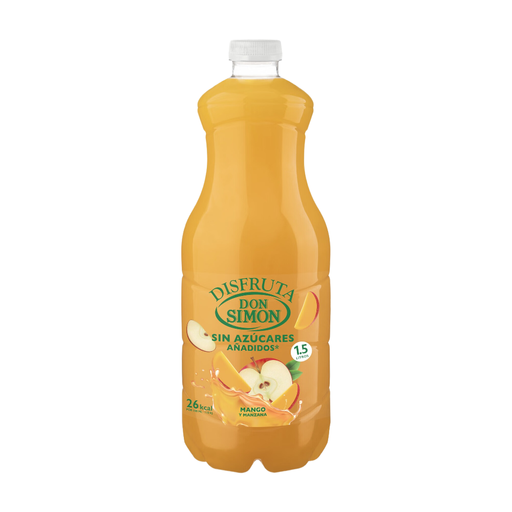 Image unavailable
Worth considering if you’d prefer a nectar combining mango and apple to apple juice.
1.5 L PET bottle. Compare the product description and ‘of which sugars’ line with those of juices before you choose.
No. Apple juice can contain sugars that are naturally present in the fruit. For comparison, the Auchan and E.Leclerc product pages for the products mentioned list between 9.8 and 11 g of sugars per 100 ml. Check the figure for the bottle you choose.
Choose pure juice if you’re looking for an apple juice recipe; a fruit drink is a different type of product. The JAFUN drink listed by E.Leclerc contains juice from several fruits and water. Compare its fruit content and sugar content per 100 ml, rather than treating it as an equivalent to apple juice.
Follow the instructions for the bottle in question. For its 1 L apple juice, Auchan advises refrigerating it after opening and consuming it within five days. This guidance doesn’t apply to every product.
Check the drink’s product description, ingredients and ‘of which sugars’ line. The DGCCRF says that the wording ‘contains naturally occurring sugars’ is reserved for fruit juices, so the claim on the front of the pack doesn’t replace checking the information on the product you buy.