
Livraison le jour même ou le lendemain

Qualité garantie

Débloquez vos offres de bienvenue: Livraison GRATUITE | Jusqu'à -80 % | 30 jours d'essai gratuits à JoyPlus
Téléchargez l'application
A bamboo chopping board can be used to prepare vegetables, slice bread or serve a selection of cheeses. But attractive photos and promises of durability are not enough to make the right choice. In a French kitchen, three common pitfalls often arise: a format that is too small, care instructions that are incompatible with the dishwasher and impractical storage.
Before buying a set of chopping boards, take the time to check the dimensions, material, stability and care instructions. A board can also serve as an aperitif serving board, cheese board or charcuterie board, provided its surface and grip are suited to the task.
A set of four boards does not necessarily mean that every piece is suitable for preparing a family meal. Dimensions of 14 × 22 cm are practical for fruit, bread or cheese, but they can quickly prove too small for slicing a courgette or preparing several ingredients.
For a large chopping board, always check the usable surface dimensions rather than those of the packaging or stand. A large board takes up more space on the worktop, but it also prevents chopped ingredients from spilling over the edges or rolling everywhere.
Bamboo and wood generally do not cope well with standing water, temperature changes or prolonged dishwasher cycles. A hand-wash-only chopping board requires a little more attention, but this care method is clearly recommended for many models.
After each use, wash the board in warm water with a mild detergent, rinse it and dry it immediately. Avoid leaving it to soak. Food-safe mineral oil can be applied regularly if recommended in the product instructions.
A board that slips on the worktop increases the risk of cuts. Place it on a flat, stable surface, using a non-slip mat if necessary. After cutting raw meat, poultry or fish, clean it thoroughly before using it for bread, fruit or ready-to-eat foods.
Peripheral grooves can collect some of the juices, but they do not replace proper washing. Similarly, a claim that a board is ‘antibacterial’ or ‘natural’ is not a guarantee of food safety: rely on the regulatory information and the manufacturer’s recommendations.
A wooden kitchen chopping board adds a warm touch and can be used for both preparation and serving. Bamboo is often appreciated for its hard surface and moderate weight. However, the quality of use depends on the finish, construction and absence of cracks or splinters.
Choose an even surface without any raised areas, as well as a thickness suited to the intended use. Thin boards are easy to store, while a thicker model generally provides a greater sense of stability.
A board with a handle is easier to carry to the table. A model with a juice groove can collect liquids when cutting certain foods. For serving, also check that the surface is large enough to arrange cheese, charcuterie, bread or dried fruit.
A chopping board with stand frees up space and keeps the different pieces within easy reach. The stand should rest on a stable base and not tip over when you remove a board. For hanging or stacked models, never cut directly on the stand.
Hand washing, immediate drying and storage in a dry place help limit warping. Inspect the board regularly and stop using it if it develops deep cracks, splinters or significant wear.
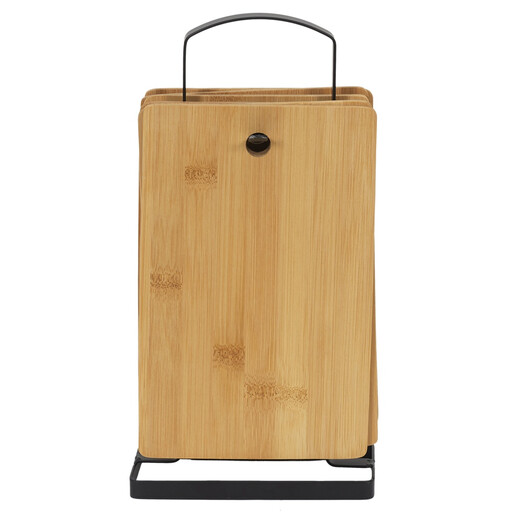
Why this choice suits this profile : This set includes four 14 × 22 cm bamboo boards and a metal stand. It is ideal for anyone who wants to keep their worktop organised and have several boards available for small preparations or appetisers.
The dimensions of each board are clearly stated, while the stand prevents them from being left stacked or scattered around. The product details specify hand washing, reducing the risk of mistakes during care.
Four pieces, a metal stand, vertical storage and the option to use them as cheese, charcuterie or appetiser serving boards.
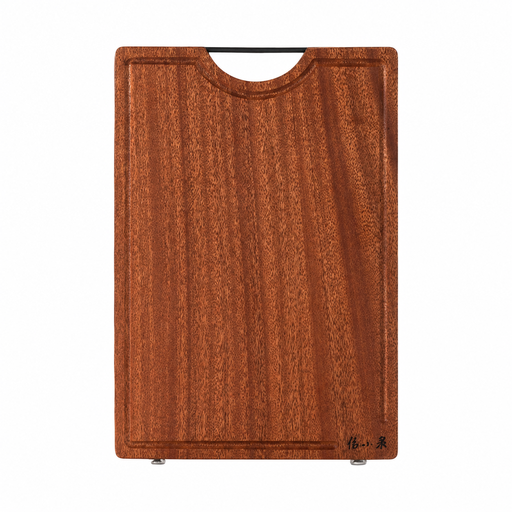
Why this choice suits this profile : Its rectangular 400 × 280 mm format is designed for people who prefer a single, generous surface for cooking or presenting several foods.
The stated dimensions let you check the available surface in practical terms before buying, rather than relying on a vague description of the format.
Advertised as a solid wood board, with a rectangular shape and a surface suited to preparations requiring more room.

Why this choice suits this profile : This set of three sizes is designed for households that alternate between food preparation, chopping bulky ingredients and serving at the table. The handles make it easier to carry the boards between the kitchen and dining room.
The three stated dimensions, handles and integrated juice grooves address the problems of insufficient surface area, inconvenient carrying and juices running onto the worktop.
Set of three boards, the largest of which is stated to measure 16 × 11,5 inches, with juice grooves, handles and hand-wash care.
We have put together a complete, regularly updated list of products that fully meet these demanding selection criteria and European safety regulations.
To preserve a bamboo or wooden chopping board:
The lifespan depends on how often the board is used, humidity and the quality of care. Even regular cleaning does not remove the need to keep uses separate or wash the board between preparing raw foods and ready-to-serve foods.
Generally, no. Heat, water and drying cycles can encourage warping and cracking. Always check the instructions for the model you have chosen. When the product details state ‘ hand wash ’, use warm water, dry the board straight away and avoid soaking it.
For everyday preparation, a medium format offers a good balance between working surface and ease of storage. A large chopping board is better suited to bulky vegetables, bread or larger quantities, provided you have enough room on the worktop.
It can be useful for collecting some of the juices when cutting food. However, it does not replace a stable surface or thorough cleaning. For versatile use, also choose handles and dimensions that are large enough to serve cheese, bread or charcuterie with ease.