
Livraison le jour même ou le lendemain

Qualité garantie

Débloquez vos offres de bienvenue: Livraison GRATUITE | Jusqu'à -80 % | 30 jours d'essai gratuits à JoyPlus
Téléchargez l'application
A bamboo chopping board can be used to prepare vegetables, slice bread, cut meat or present a selection of cheeses. But not all models are created equal, nor do they all meet the same needs. A board that is too thin risks warping, a surface that is too small quickly becomes awkward, and improper care can seriously shorten its lifespan.
Before placing an order, it is worth looking beyond the colour or a simple "natural" promise. Here are the criteria to examine in order to compare a bamboo kitchen board effectively.
A board described as "large" can lose part of its surface area due to a peripheral juice groove, integrated handles or thick edges. To carry out multiple preparations without running out of space, focus on the dimensions of the central area.
An XXL chopping board measuring around 40 × 29 cm will be far more comfortable with a large piece of meat or family-sized preparations than a small model designed for garnishes and quick tasks.
Well cared for, bamboo can easily withstand daily use. However, it remains sensitive to lingering moisture. The dishwasher, soaking in the sink and insufficient drying can encourage warping, cracking or the delamination of the strips.
An easy-to-clean board is first and foremost a board that can be washed quickly by hand and dried immediately.
Terms like "indestructible", "totally hygienic" or "wear-free" are no substitute for concrete information. Instead, look at the material, thickness, construction, dimensions and care instructions.
With raw foods, organisation in the kitchen and cleaning after each use remain essential, regardless of the material of the board.
Bamboo boards are generally made from assembled strips. A cross-grain construction can help limit movement caused by humidity variations, but it does not eliminate the need for careful maintenance. For versatile use, a thickness of between 12 and 15 mm offers an interesting compromise between stability, weight and ease of storage.
A thin board may suffice for serving or light cutting. For regular chopping, working with large pieces or using a wooden board with a juice groove, it is better to opt for a wider surface and a robust construction.
A sufficiently deep groove around the cutting area helps to catch the juice from tomatoes, citrus fruits or meat. It prevents spills on the worktop, but does encroach slightly on the central surface.
Integrated handles make it easier to carry and also allow the board to be used as a serving platter. A chopping board with handles can therefore move from the kitchen island to the table without difficulty.
For serving cheese or charcuterie, however, check that the remaining surface is generous enough to arrange the food without placing it in the groove.
Natural bamboo has a light, warm colour. Carbonised bamboo, on the other hand, has a darker colour obtained through heat treatment. According to product sheets, this process aims to improve resistance and limit moisture absorption. However, these performance claims are specific to the characteristics stated by each manufacturer.
In any case, remember three simple rules:
Do not use a board that has a deep crack, a splinter or visible delamination.
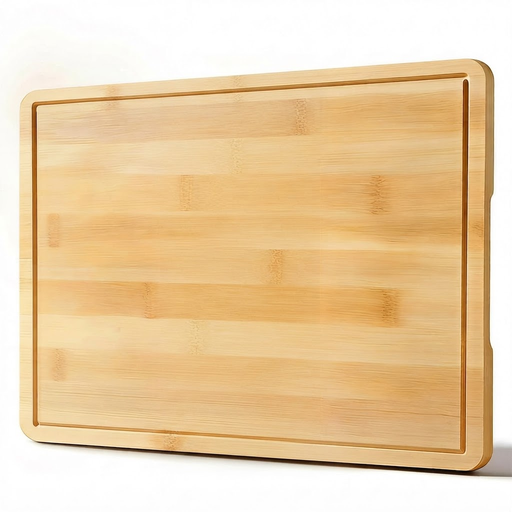
Why this choice suits this profile: With its dimensions of 406 × 292 × 12 mm, this model is suitable for everyday preparations and offers a versatile surface without needing to buy multiple accessories.
The dimensions are clearly stated. The juice groove and handles are integrated, with no removable parts that would complicate cleaning.
XL format, core made of cross-laminated bamboo strips according to the product sheet, peripheral juice groove and hand-wash care.
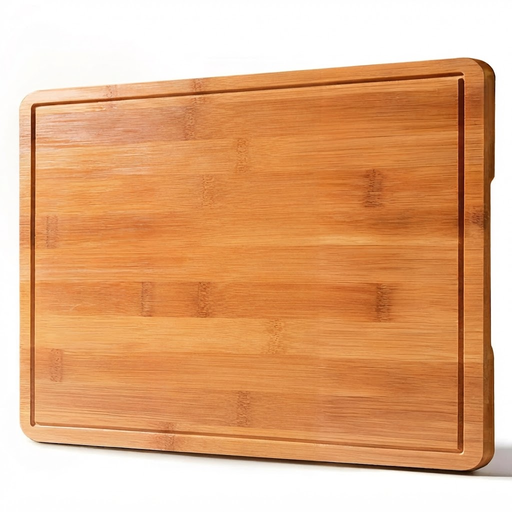
Why this choice suits this profile: This model, measuring 406 × 292 × 15 mm, combines a carbonised finish, greater thickness and a refined presentation, equally at home in the kitchen or at the table.
The product sheet clearly distinguishes the carbonised treatment, thickness and hand-wash care: you can compare precise features rather than a simple aesthetic promise.
15 mm thickness, juice groove, integrated handles and the dark colour of carbonised bamboo.

Why this choice suits this profile: The three stated sizes — 33 × 24, 37 × 27 and 41 × 29 cm — allow you to separate uses or adapt the board size to each recipe.
The set avoids using a single surface for all foods. Each board must still be washed and dried after use, especially after cutting raw meat or fish.
Three sizes, juice grooves, handles and carbonised treatment as stated on the product sheet.
To preserve a bamboo board, place it on a stable surface and avoid repeated knocks against the sink. Do not let it soak and do not put it in the dishwasher, unless the manufacturer explicitly states otherwise. A suitable oil can help limit surface drying, but it will not make the board waterproof.
To reduce the risk of cross-contamination, clean the surface thoroughly after cutting raw meat, poultry or fish. A serving board or a bamboo charcuterie board can be reserved for serving, in order to separate preparation and eating uses.
We have selected a complete, real-time updated list of products that meet these demanding selection criteria as well as European safety regulations.
Generally speaking, no. Prolonged heat and moisture can cause swelling, cracking or delamination of the strips. Hand washing, followed by immediate drying, remains the safest method.
A format of around 40 × 29 cm offers a comfortable surface for vegetables, bread and larger items. If you prepare several recipes at the same time, a set of chopping boards in different sizes will often be more practical than a single model.
Yes, provided its surface is smooth, clean and wide enough. Models with handles and a juice groove can be used to serve cheese, fruit or charcuterie. However, avoid cutting directly on a decorative board when its product sheet states it is for serving only.