
Livraison le jour même ou le lendemain

Qualité garantie

Débloquez vos offres de bienvenue: Livraison GRATUITE | Jusqu'à -80 % | 30 jours d'essai gratuits à JoyPlus
Téléchargez l'application
A balance bike for children aged 2 to 5 helps young children become familiar with steering, propulsion and balance before moving on to a pedal bike. However, not all models are equal or suited to the same needs. A saddle that is too high, a heavy frame or a fiddly conversion can quickly discourage a child and limit the toy’s usefulness.
To avoid buying a product that quickly becomes unsuitable, it is best to check the fit, weight, type of wheels and ease of everyday use first. Here are the criteria to consider before choosing a balance bike or an adaptable children’s tricycle.
The age given by the manufacturer is only a guide. Two children of the same age can have very different builds. A balance bike should allow the child to place both feet easily on the ground while keeping their knees slightly bent.
So check the saddle adjustment range, the recommended minimum height and, where available, the child’s height. An adjustable saddle will generally extend the product’s usable life, but it cannot compensate for a frame that is too large or too heavy.
EVA foam wheels or puncture-proof tyres do not require inflating and reduce the risk of punctures. They work well on hard surfaces, for rides in a courtyard or for indoor use. Some models also leave no marks on the floor.
On uneven paths, however, their comfort and grip may differ from those of inflatable tyres. Your choice should therefore depend on the type of terrain the bike will usually be used on, rather than solely on the promise of being ‘maintenance-free’.
A balance bike used in a flat, transported in the boot or taken on holiday should remain easy to move around. A folding balance bike can be a good option, provided its mechanism is simple to use and the structure remains stable when unfolded.
Assembly also deserves some attention. Clear instructions and a limited number of steps reduce the risk of incorrect installation. After assembly, always check that the handlebars, saddle and wheels are securely tightened before first use.
The saddle should be adjustable without complicated tools and remain firmly locked in place. During the first uses, the child should be able to straddle the balance bike and touch the ground with both feet. The handlebars should also allow a natural position, without the arms being excessively stretched.
On the Neuleb 2-in-1 model, the saddle is stated to be adjustable from 15.7 to 18.5 inches, or approximately 40 to 47 cm. The manufacturer recommends using it in balance bike mode for children aged 24 to 32 months, then in tricycle mode, with or without pedals, from 3 to 5 years. These indications should nevertheless be considered alongside the child’s actual height.
A lightweight balance bike makes it easier to change direction, carry out first manoeuvres and transport the bike as a parent. A model that is too heavy will be more difficult to lift after a fall or carry over a step.
Remember to check the maximum supported load as well. For the Neuleb 2-in-1, the manufacturer states a maximum load of 55 lb, or approximately 25 kg. This figure indicates the product’s capacity and, of course, does not remove the need for adult supervision.
For a children’s balance bike, pay particular attention to:
An adaptable balance bike fitted with removable pedals can support several stages of learning, but it also has more parts to check. For a child just starting out, a pedal-free model may be easier to understand and simpler to handle.
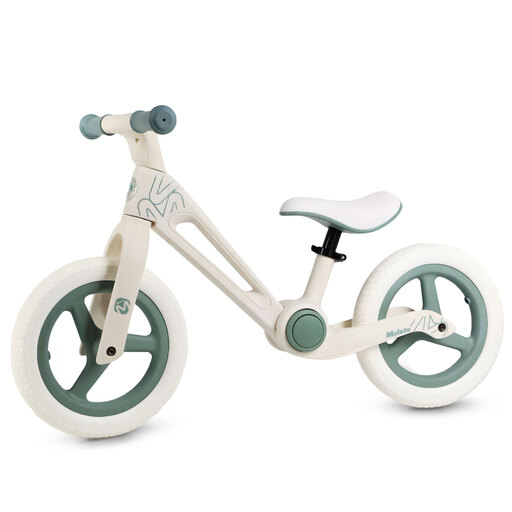
Why this choice suits this profile : This pedal-free balance bike is suitable for families looking for a simple configuration for beginners, with an adjustable saddle and handlebars as stated by the manufacturer.
The adjustment options reduce the risk of buying a balance bike that will quickly become unsuitable as the child grows.
A pedal-free design, an adjustable saddle and assembly described as straightforward.
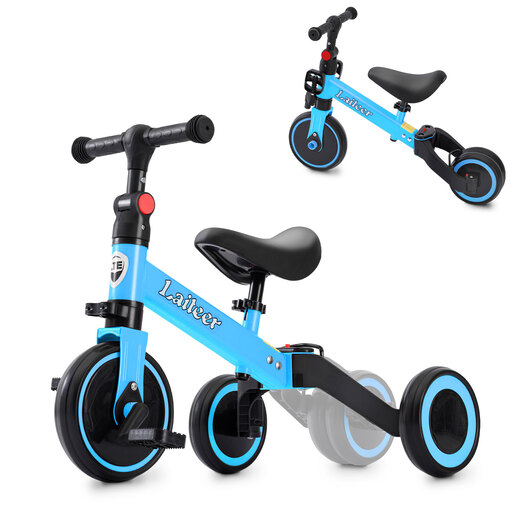
Why this choice suits this profile : This 3-in-1 model is designed for parents who want to combine a balance bike, a pedal tricycle and a pedal-free tricycle in a single product.
The conversion lets you adapt the configuration as your child progresses, rather than buying several products over time.
An adjustable saddle, puncture-resistant EVA wheels, non-slip grips and a foldable design as stated by the manufacturer.

Why this choice suits this profile : According to the product title, this format is aimed at children aged 2 to 6, with flexible, adjustable saddle and handlebars as stated by the manufacturer.
The non-inflatable wheels eliminate pressure checks and reduce the risk of punctures.
Non-inflatable tyres, a weight presented as lightweight and assembly described as easy.
We have put together a comprehensive, real-time updated selection of products that meet these demanding selection criteria and European safety regulations.
Before every outing, check that the saddle and handlebars are properly tightened. Also inspect the wheels, grips and any removable parts. Even a puncture-proof tyre can become damaged or develop unusual play.
Your child should use their balance bike in a suitable area, away from traffic and under adult supervision. For outdoor rides, wearing a properly adjusted helmet is recommended. On a convertible model, make sure that no pedal or accessory is loose or incorrectly fitted.
Many models are suitable from the age of 2, but the ability to get on, get off and place both feet on the ground varies from one child to another. A sufficiently low saddle and a weight that is easy to control are more important than the age shown on the box.
It depends on the child’s growth, the adjustment range and the strength of the components. An adaptable balance bike or a tricycle with removable pedals can support several stages of development, provided the child’s size and the maximum load remain compatible with the product.
A balance bike takes a simple approach focused on balance. An adaptable tricycle offers greater stability and may provide several configurations. For a birthday present, compare the space available at home, the usual terrain and the child’s ability to handle the product above all.