People who bake biscuits regularly
If you melt chocolate or mix it into biscuit dough, both Lindt DESSERT and Nestlé Dessert are described by their brands as ranges intended for baking.


For biscuits where the chocolate needs to be melted or mixed into the dough, a bar specifically intended for baking is the most straightforward choice. You could also consider a plain eating chocolate bar if its ingredients suit the recipe and you’re happy to adapt it. If you’re choosing how intense you want the flavour to be, Lindt describes its DESSERT Noir 51% as milder than its 70% version. In all cases, check the ingredients and allergen information on the bar you buy.
If you melt chocolate or mix it into biscuit dough, both Lindt DESSERT and Nestlé Dessert are described by their brands as ranges intended for baking.
If you’re deciding between a milder flavour and a more pronounced cocoa note, compare the options for your recipe. Lindt describes its DESSERT Noir 51% as milder than its 70% version; Carrefour states that its Noir Dessert bar contains at least 52% cocoa.
Before baking or sharing the biscuits, check the ingredients, allergens and nutritional information for the specific bar. Where it appears on the packaging, Nutri-Score is a voluntary additional guide, according to Santé publique France and the DGCCRF.
When choosing a single chocolate bar for biscuits, start with how you’ll use it in the recipe, then choose the flavour you want and check the ingredients.
| What to consider | What to check | Who is it for? |
|---|---|---|
| Use in baking | Look for an explicit “dessert” or “for baking” use. If you don’t want to change the texture of the dough, also check whether the bar contains any extra ingredients. | When I melt chocolate or mix it into biscuit dough, I prefer a bar that’s described as suitable for that use. Around 50% of consumers put this baking requirement first. |
| Chocolate intensity | Compare the cocoa percentage of the version you’re considering with the “of which sugars” figure per 100 g. Don’t use one to infer the other. | If I’m after biscuits with a milder chocolate flavour or, on the other hand, a more pronounced cocoa taste, my choice of bar changes the recipe. This flavour profile is the priority for around 30% of consumers. |
| Ingredients and allergens | Read the ingredients, allergens and any “may contain” statements on the bar you buy. Also check the nutritional values per 100 g. | Before sharing my biscuits, I want to know exactly what’s in the chocolate I’ve used. This is the main concern for around 20% of consumers. |
The French levy mentioned by the Ministry of the Economy applies to sugary drinks, not solid chocolate bars.
To compare the bars you use in your biscuits, check the amount of sugars per 100 g in the nutrition declaration instead.
According to Santé publique France and the DGCCRF, displaying Nutri-Score is voluntary and doesn’t replace the other information on the label.
If it’s shown, use it as an additional guide when comparing similar products. Also check the ingredients, allergens and nutritional values.
Pieces of nuts, caramel or biscuit added to the chocolate will end up in your mixture and may change the flavour or texture you’re aiming for.
If you want dough without these additions, check the ingredients list and choose a bar that suits your recipe.
Lindt describes its DESSERT range as suitable for baking, with options including Noir 51% and Noir Intense 70%.
Nestlé describes this range as intended for homemade desserts. A Noir 70% baking version is also listed on a Carrefour France product page.
The Carrefour France product page lists a 200 g Noir Dessert bar containing at least 52% cocoa.
Côte d’Or L’Original Noir is listed on a Carrefour France product page as a single dark chocolate bar for eating.
E.Leclerc DRIVE lists baking chocolate separately from eating chocolate bars in its range.
These bars offer two ways to approach chocolate biscuits: choose a chocolate described as suitable for desserts, or consider an eating chocolate bar and adapt the recipe.
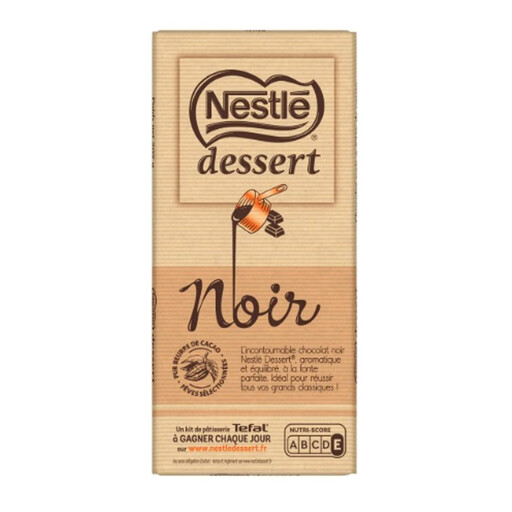 Image unavailable
Worth considering for biscuits where the chocolate is melted or mixed into the dough: this bar’s description says it’s suitable for baking and melting.
Stated size: 205 g. If cocoa intensity is important to you, check the percentage on the packaging. Also check the “may contain milk and nuts” information for the version you buy.
 Image unavailable
Worth considering if you’re looking for an eating chocolate bar with a high cocoa percentage and are happy to adapt your biscuit recipe.
This 100 g bar contains 85% cocoa. Don’t confuse it with the Lindt DESSERT range: if you plan to melt it, check that its intended use and ingredients suit your recipe.
You could, if its ingredients suit your recipe and you’re happy to adapt it. Check in particular for added ingredients, fillings and allergens. If you’re melting the chocolate or mixing it into the dough, a bar explicitly intended for baking remains the most straightforward choice.
No. Santé publique France and the DGCCRF describe Nutri-Score as a voluntary label that complements nutritional information. Whether or not it appears, check the nutritional values and ingredients list for the bar you choose.
Check the ingredients, highlighted allergens and any “may contain” statements on the packaging of the specific bar. The DGCCRF sets out the rules for declaring allergens in prepacked foods; don’t assume one version has the same ingredients as another.
No: the levy described by the Ministry of the Economy applies to sugary drinks, not solid chocolate bars. To check the sugar content of the chocolate you choose, look at the “of which sugars” line in the nutritional values per 100 g.